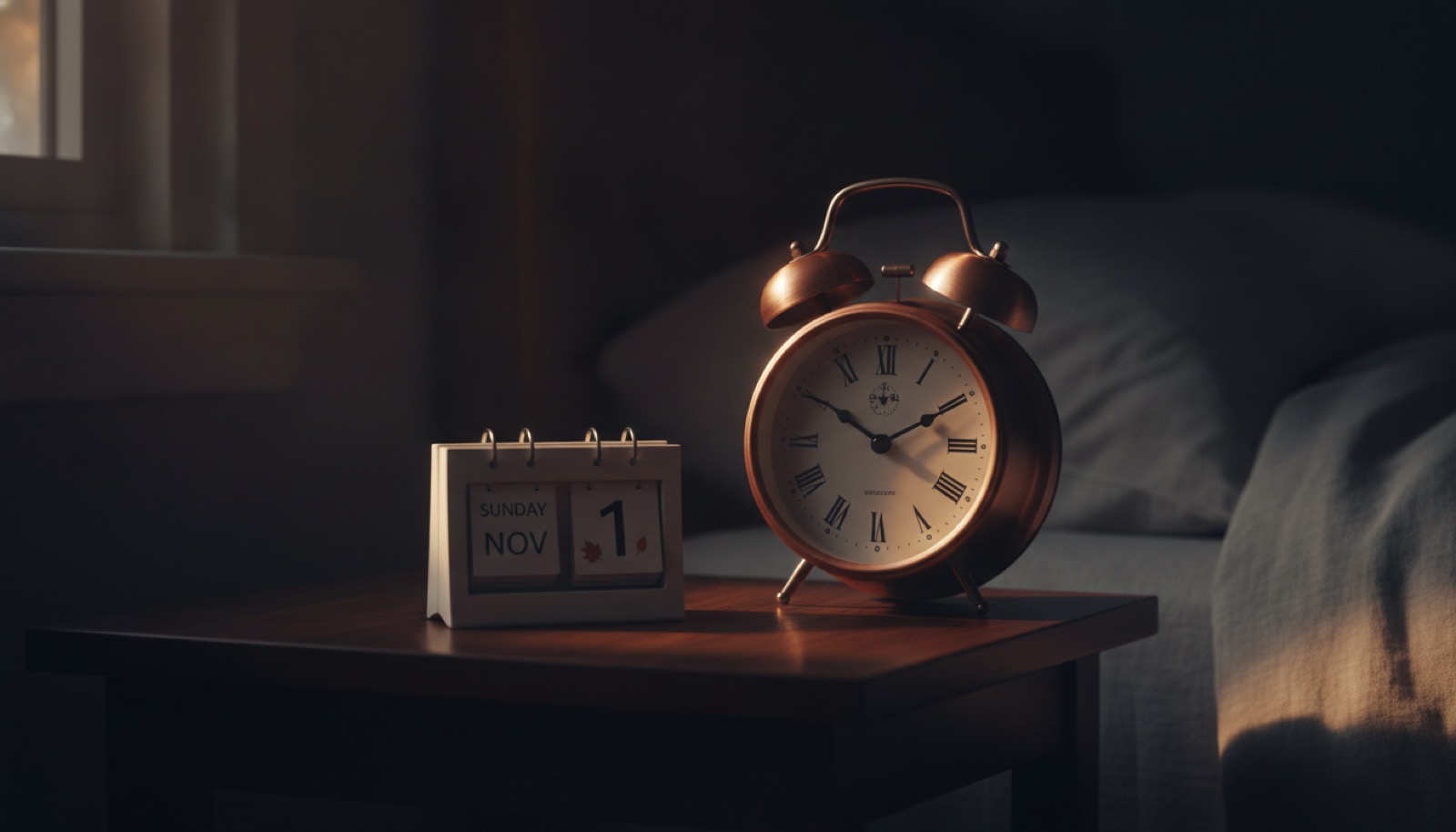
Die Zeitumstellung verschiebt die soziale Uhr um eine Stunde, waehrend die innere Uhr hinterherhinkt, wie ein Mini-Jetlag. Warum die Umstellung im Fruehjahr schwerer faellt, wie Licht die innere Uhr in die richtige Richtung schiebt und ein Tagesplan fuer die Woche um den Termin.
Why the clock change feels like a small jet lag
A daylight saving time change moves the social clock by one hour overnight while your internal circadian clock stays where it was, so for a few days the two are out of phase, exactly the mismatch that produces jet lag after travel. The difference is that you have not moved: the clock on the wall moved instead. Because the human circadian pacemaker only re-entrains by roughly an hour a day, that one-hour offset takes at least a day or two to absorb, and longer for some people (Kantermann et al. 2007, Curr Biol). This is why the Monday after the change brings later sleep onset, harder waking, and daytime grogginess in many people; it is a timing problem, not a sleep-quantity problem, and it is closely related to the mechanism behind ordinary jet lag.
Spring forward is harder than fall back
The two changes are not equal. In spring, clocks jump forward an hour, so you are asked to fall asleep and wake an hour earlier than your body wants; this is a phase advance, and the human clock advances more slowly and reluctantly than it delays. In autumn, clocks fall back an hour, a phase delay, which is easier because the intrinsic circadian period runs slightly longer than 24 hours and drifting later is the direction of least resistance. Kantermann et al. found the spring transition disrupts the rest-activity rhythm for up to several weeks in some people, especially late chronotypes, while the autumn transition resolves faster. Plan for more effort and a longer runway around the spring-forward change.
Shift the schedule in 15-minute steps before the change
The single most effective move is to stop treating the change as an overnight event and instead pre-adapt over the three to four days before it. Move bedtime and wake time in 15-minute steps each day toward the new clock: earlier before a spring-forward, later before a fall-back. By the morning of the change your body is already most of the way there and only has to absorb the last fraction of the hour rather than the whole hour at once. This is the same graded-advance logic used to beat travel jet lag in how to get over jet lag fast, applied to a stationary clock change. Move meal times with the schedule, since regular meals are a secondary time cue.
Use light in the right direction
Light is the strongest lever, and its direction depends on which change you face. For the spring-forward (advance), get 10-30 minutes of bright light within an hour of your new, earlier wake time, since morning light advances the clock (Khalsa et al. 2003); a 10,000 lux lamp substitutes before sunrise, and the dose logic is in the morning sunlight protocol. Equally important, keep evenings dim and avoid bright screens before bed, because bright evening light pushes the clock later, the wrong way for spring. For the fall-back (delay), the reverse helps: welcome light later in the day and limit intense early-morning light so you are not pulled even earlier. Misusing light, especially bright evenings before spring, actively works against the adjustment.
Anchor a fixed wake time and a cool dark room
Regardless of direction, a fixed wake time held every day, including the weekend after the change, is the backbone of a fast adjustment. Sleeping in for hours on the following Saturday re-opens the gap between your clock and the schedule and prolongs the grogginess, the same pattern as social jet lag. Keep the bedroom around 18 C and dark to protect the core-temperature drop that sleep maintenance depends on, and finish caffeine 8-10 hours before your new bedtime so the earlier target time is reachable. These environment levers do not shift the clock themselves, but they remove the obstacles that keep the new schedule from sticking.
Where melatonin fits, and who struggles most
For the spring-forward advance, a low dose of melatonin, 0.3-0.5 mg taken in the early evening a few hours before the target bedtime, can nudge the clock earlier, since evening melatonin advances phase along its response curve; higher retail doses oversedate without adding benefit, as covered in the melatonin dosing guide. It is a minor lever next to light and a graded schedule, not a substitute for them. The people who struggle most with any clock change are late chronotypes and adolescents, whose clocks already run late and who therefore feel the spring advance hardest (Kantermann et al. 2007). If that is you, start the pre-adaptation earlier, four days out rather than two, and be strict about morning light. This article is educational and not medical advice.
Questions logged on this protocol
Warum bin ich nach der Zeitumstellung so muede?
Weil die Uhr an der Wand um eine Stunde springt, Ihre innere Uhr aber am alten Stand bleibt, sodass beide fuer einige Tage nicht synchron sind, genau wie ein kleiner Jetlag. Die innere Uhr verschiebt sich nur um etwa eine Stunde pro Tag, deshalb braucht das Aufholen der einen Stunde mindestens ein bis zwei Tage (Kantermann et al. 2007). Das Ergebnis sind spaeteres Einschlafen, schwereres Aufwachen und Tagesmuedigkeit. Es ist ein Problem der Taktung, nicht der Schlafmenge, und laesst sich mit richtig getaktetem Licht und einem festen Aufstehzeitpunkt beschleunigen.
Ist die Umstellung im Fruehjahr schlimmer als im Herbst?
Ja. Im Fruehjahr springt die Uhr vor, Sie sollen also eine Stunde frueher schlafen und aufstehen, das ist eine Phasenvorverlagerung, und die menschliche Uhr verschiebt sich langsamer nach vorne als nach hinten. Im Herbst faellt die Uhr zurueck, eine Phasenverzoegerung, die leichter faellt, weil die innere Periode etwas laenger als 24 Stunden laeuft. Kantermann et al. fanden, dass die Fruehjahrsumstellung den Ruhe-Aktivitaets-Rhythmus bei manchen Menschen ueber Wochen stoert, besonders bei spaeten Chronotypen, waehrend der Herbst schneller verarbeitet wird.
Wie stelle ich mich am besten auf die Zeitumstellung ein?
Behandeln Sie sie nicht als Ereignis ueber Nacht, sondern passen Sie sich in den drei bis vier Tagen davor in 15-Minuten-Schritten an: Bett- und Aufstehzeit jeden Tag naeher an die neue Uhr ruecken, frueher vor dem Fruehjahr, spaeter vor dem Herbst. Kombinieren Sie das mit hellem Licht innerhalb einer Stunde nach dem neuen Aufstehen fuer das Fruehjahr und dimmen Sie die Abende. So muss Ihr Koerper am Umstellungstag nur noch einen Bruchteil der Stunde aufholen statt die ganze Stunde auf einmal.
Hilft Melatonin bei der Zeitumstellung?
Fuer die Fruehjahrsumstellung kann eine niedrige Dosis von 0,3 bis 0,5 mg am fruehen Abend die Uhr etwas nach vorne schieben, da abendliches Melatonin die Phase vorverlagert. Hoehere Handelsdosen machen nur schlaefrig, ohne mehr zu bewirken. Es ist ein kleiner Hebel neben Licht und einem gestaffelten Zeitplan, kein Ersatz dafuer. Dieser Artikel ist zu Bildungszwecken und keine medizinische Beratung.
Warum treffen mich Zeitumstellungen als Nachteule staerker?
Spaete Chronotypen und Jugendliche haben eine ohnehin spaet laufende innere Uhr, deshalb faellt ihnen die Fruehjahrsvorverlagerung am schwersten (Kantermann et al. 2007). Wenn das auf Sie zutrifft, beginnen Sie die Anpassung frueher, etwa vier Tage vorher statt zwei, und seien Sie streng mit dem Morgenlicht sowie mit gedimmten Abenden. Ein fester Aufstehzeitpunkt, auch am Wochenende danach, verhindert, dass sich die Luecke zwischen innerer Uhr und Zeitplan wieder oeffnet.
- [01]
- [02]
- [03]
- [04]
Other stacks in this hub
Is Insomnia Genetic? What Twin Studies and Genome Research Actually Show
Insomnia does run in families, and large genetic studies have found real inherited risk, but genes set a vulnerability rather than a destiny. What twin studies and genome-wide research show about the heritability of insomnia, why the environment and habits still decide whether that vulnerability becomes a lasting problem, and why the treatment is the same either way.
What Causes Insomnia: The Triggers That Start It and the Habits That Keep It Going
Insomnia is rarely caused by one thing. The most useful model separates the traits that make you vulnerable, the event that triggers a bad stretch, and the coping habits that turn a few rough nights into a lasting problem. What the research says about stress, caffeine, an irregular schedule, medical and psychiatric causes, and why the behaviors that feel helpful at 3am are often what keep insomnia alive.
Night Sweats: Why You Sweat in Your Sleep and When It Signals Something
Sleep is supposed to run cool, so sweating through the night is a sign the body's temperature control has been pushed the wrong way. What the physiology says about the core temperature drop that sleep depends on, the everyday causes like a hot room, alcohol, and bedding, the hormonal and medical causes worth knowing, and the red flags that mean night sweats need a doctor.