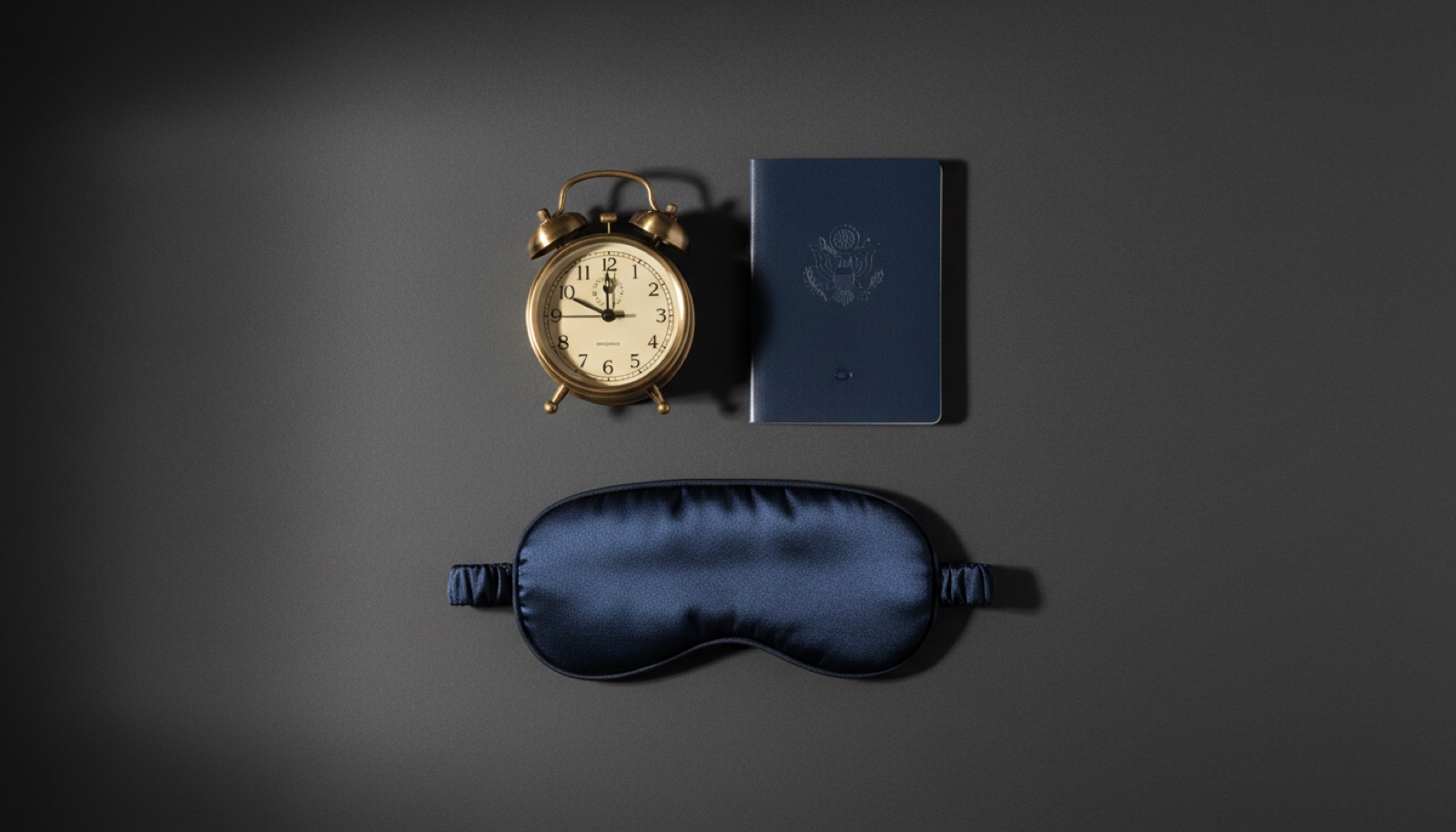
Two Protocol cards for directional travel. Eastbound = phase advance. Westbound = phase delay. Melatonin at 0.3-0.5mg, light exposure windows, pre-flight prep.
Questions logged on this protocol
Why is eastbound harder than westbound?
The human circadian period is slightly longer than 24 hours; Czeisler et al. 1999 (Science) measured a mean of ~24.18 hours in healthy adults. Delaying phase (westbound) aligns with that natural drift; advancing phase (eastbound) fights it. The practical effect: most travelers adapt ~1 hour per day eastbound and ~1.5 hours per day westbound. A six-zone eastbound trip takes roughly a week to fully re-entrain without intervention.
What melatonin dose and when?
0.3-0.5mg, taken 5 hours before target sleep onset at destination. Herxheimer & Petrie 2002 (Cochrane Database) reviewed 10 trials and found consistent benefit for eastward travel across 5+ time zones. Higher doses (3-10mg sold at retail) produce more sedation but no greater phase-shift per Brzezinski et al. 2005 (Sleep Med Rev). Timing matters more than dose: take it too early and you delay phase in the wrong direction.
Should I pre-shift before the flight?
For trips of 4+ time zones, yes. Eastman & Burgess 2009 (Sleep Med Clin) recommend shifting sleep onset 1 hour earlier per day for 2-3 days pre-flight (eastbound) or 1 hour later (westbound), paired with morning light (east) or evening light (west). Travelers who pre-shift land already partially entrained and cut recovery time in half.
What about short trips of 1-2 nights?
Don't re-entrain. Stay on home time for sleep as much as destination logistics allow. Full circadian shift takes days you don't have; chasing it leaves you dysregulated both directions. Keep meals and caffeine on a home-time schedule, and use melatonin only if you must sleep at an unfamiliar clock time at destination.
Does alcohol on the plane help or hurt?
Hurts. Alcohol suppresses REM sleep in the first half of the night and is associated with fragmented sleep architecture (Ebrahim et al. 2013, Alcohol Clin Exp Res). Cabin altitude already reduces blood oxygen saturation; adding alcohol compounds the effect. Hydrate, skip the wine, time sleep to the destination clock if the flight is long enough.
Can children use this protocol?
The light exposure parts (morning light east, evening light west) apply at any age. Melatonin in children is off-label; AASM and most pediatric sleep specialists recommend against routine use without a clinician's supervision. For kids, focus on light timing, meal timing, and strict destination-schedule bedtime from night one.
- [01]
- [02]
- [03]
- [04]
- [05]
Other stacks in this hub
Is Insomnia Genetic? What Twin Studies and Genome Research Actually Show
Insomnia does run in families, and large genetic studies have found real inherited risk, but genes set a vulnerability rather than a destiny. What twin studies and genome-wide research show about the heritability of insomnia, why the environment and habits still decide whether that vulnerability becomes a lasting problem, and why the treatment is the same either way.
What Causes Insomnia: The Triggers That Start It and the Habits That Keep It Going
Insomnia is rarely caused by one thing. The most useful model separates the traits that make you vulnerable, the event that triggers a bad stretch, and the coping habits that turn a few rough nights into a lasting problem. What the research says about stress, caffeine, an irregular schedule, medical and psychiatric causes, and why the behaviors that feel helpful at 3am are often what keep insomnia alive.
Night Sweats: Why You Sweat in Your Sleep and When It Signals Something
Sleep is supposed to run cool, so sweating through the night is a sign the body's temperature control has been pushed the wrong way. What the physiology says about the core temperature drop that sleep depends on, the everyday causes like a hot room, alcohol, and bedding, the hormonal and medical causes worth knowing, and the red flags that mean night sweats need a doctor.