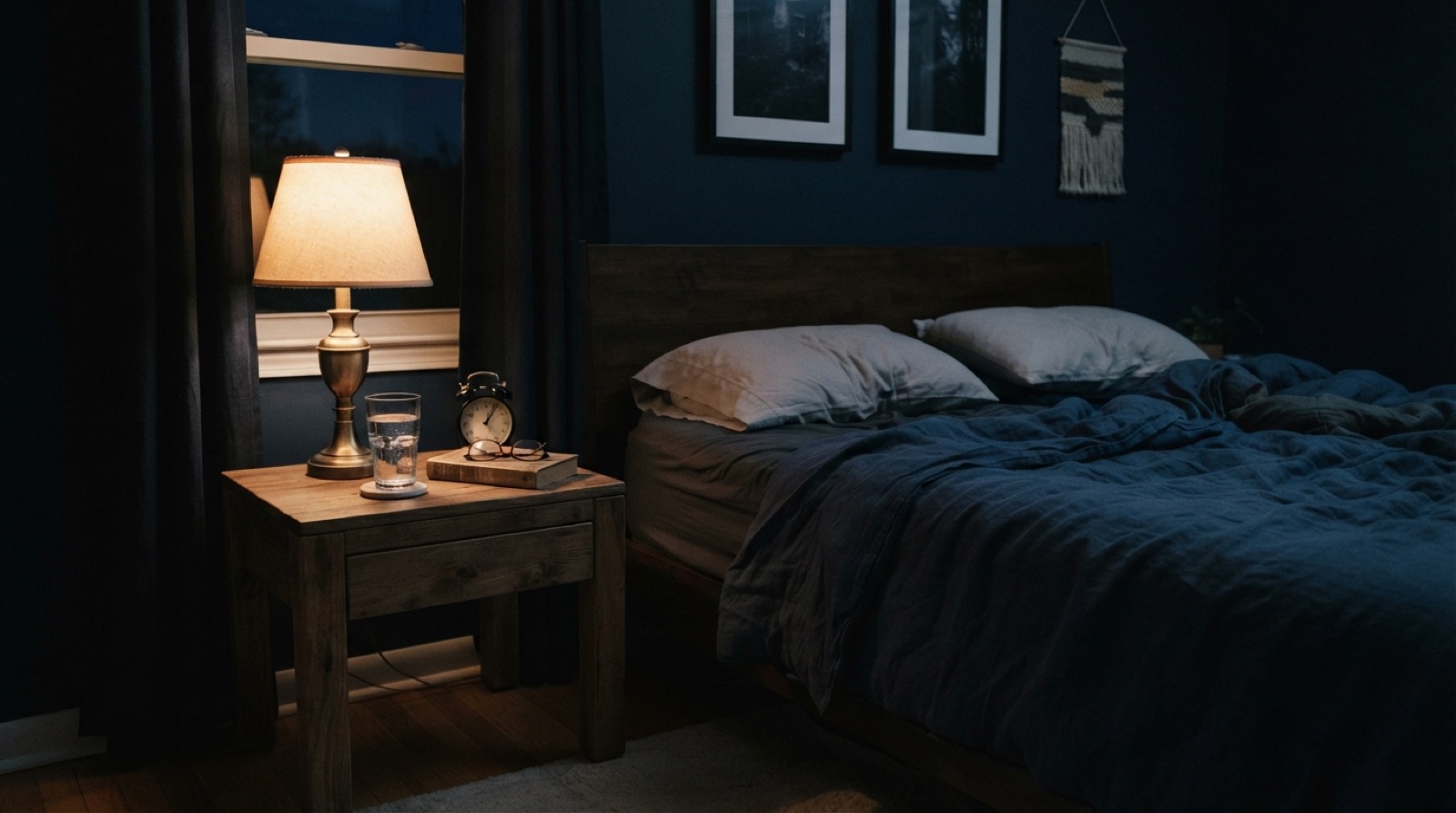
Sleep disturbance affects 40-60% of women in the menopausal transition. Hot flashes, falling estrogen and progesterone, a rising apnea risk, and the levers from temperature and light to hormone therapy, with the doses.
How common menopausal sleep disturbance is
Sleep complaints rise sharply across the menopausal transition. Population data summarized by Baker et al. 2018 (Nat Sci Sleep) put the prevalence of sleep disturbance at roughly 40-60% in perimenopausal and postmenopausal women, substantially higher than in premenopausal women of the same age. The most common patterns are difficulty staying asleep and early-morning awakening rather than trouble falling asleep, which points to the role of night-time symptoms and hormonal shifts rather than a simple delay in sleep timing. This is one of the most consistent and underrecognized changes in midlife sleep.
Why it happens (hormones, hot flashes, and the clock)
Several mechanisms stack. Falling and fluctuating estrogen and progesterone affect sleep directly (progesterone has mild sedative, sleep-promoting properties) and indirectly by triggering vasomotor symptoms. Hot flashes and night sweats are the dominant driver: they often precede or accompany an awakening, and the thermoregulatory surge is incompatible with the core-body-temperature drop that sleep depends on. Mood changes (the transition raises depression and anxiety risk) and a rising prevalence of obstructive sleep apnea after menopause add further load. The result is fragmented, less restorative sleep rather than a single tidy cause (Baker et al. 2018).
The temperature and behavioral levers (first line, no prescription)
Because vasomotor symptoms are the main mechanical disruptor, temperature management is the highest-yield self-directed lever: a cool bedroom (~18 C), breathable layered bedding you can shed mid-night, and moisture-wicking sleepwear. The standard circadian levers still apply and matter more in midlife: a fixed wake time anchored by morning light, a caffeine cutoff 8-10 hours before bed, and limiting evening alcohol, which both worsens hot flashes and fragments the second half of the night. These are the same levers covered across CircadianStack, applied to a population where the night-time disruption is hormonal rather than schedule-driven.
CBT-I works for menopausal insomnia
Cognitive behavioral therapy for insomnia (CBT-I) is first-line for chronic insomnia generally, and it works in this population specifically. McCurry et al. 2016 (JAMA Intern Med) randomized peri- and postmenopausal women with insomnia and vasomotor symptoms to telephone-delivered CBT-I and found significant improvements in insomnia severity and sleep that exceeded the control, independent of hormone status. This matters because it gives women a durable, non-pharmacological option that does not depend on a hormone-therapy decision, and it addresses the conditioned arousal and time-in-bed habits that often outlast the hormonal trigger.
Hormone therapy and non-hormonal medical options
Menopausal hormone therapy improves sleep mainly by reducing vasomotor symptoms; Cintron et al. 2017 (Menopause) reviewed trials and found a consistent benefit on sleep, largely mediated by fewer hot flashes. The Menopause Society (formerly NAMS) position statements treat hormone therapy as an individualized decision weighing symptom burden against personal risk factors. For women who cannot or prefer not to take hormones, certain SSRIs/SNRIs and other agents reduce vasomotor symptoms and may indirectly help sleep. All of this is clinician-directed. CircadianStack's standing caution applies: avoid high-dose melatonin or sedatives as a default, and screen for the sleep apnea whose prevalence rises after menopause. Specific hormone-therapy and non-hormonal prescribing guidance is clinician- and region-specific.
Questions logged on this protocol
Why does menopause make sleep worse?
Several causes stack. Falling and fluctuating estrogen and progesterone affect sleep directly and trigger hot flashes and night sweats, which are the main mechanical disruptor: the thermoregulatory surge fights the core-temperature drop sleep needs and frequently causes an awakening. Mood changes and a rising risk of obstructive sleep apnea after menopause add to it. The result, documented by Baker et al. 2018, is more difficulty staying asleep and early waking, affecting roughly 40-60% of women in the transition.
What can I do tonight without a prescription?
Target temperature and the basics. Keep the bedroom around 18 C, use breathable layered bedding you can shed during a night sweat, and wear moisture-wicking sleepwear. Anchor a fixed wake time with morning light, stop caffeine 8-10 hours before bed, and limit evening alcohol, which worsens hot flashes and fragments sleep. These behavioral and environmental levers address the night-time disruption directly and are the sensible first step before any medication.
Does hormone therapy help with sleep?
Often, mainly by reducing hot flashes and night sweats. Cintron et al. 2017 (Menopause) reviewed trials and found hormone therapy consistently improved sleep, largely through fewer vasomotor symptoms rather than a direct sedative effect. The Menopause Society treats it as an individualized decision that weighs symptom severity against personal risk factors, so it is a conversation to have with your clinician, not a default. For women who prefer not to use hormones, non-hormonal options exist that also reduce vasomotor symptoms.
Does CBT-I work if my sleep problem is hormonal?
Yes. McCurry et al. 2016 (JAMA Intern Med) tested CBT-I in peri- and postmenopausal women who had both insomnia and hot flashes and found it significantly improved insomnia severity and sleep, independent of hormone status. CBT-I targets the conditioned arousal and irregular time-in-bed habits that often persist even after the hormonal trigger settles, which is why it is first-line for chronic insomnia. It is a durable option that does not require a hormone-therapy decision.
Should I be checked for sleep apnea?
Possibly. The prevalence of obstructive sleep apnea rises after menopause, and it is frequently underrecognized in women because the presentation can lean toward fatigue and insomnia rather than classic loud snoring. If you have loud snoring with witnessed breathing pauses, gasping, morning headaches, or heavy daytime sleepiness, ask about a sleep evaluation rather than assuming all of the sleep loss is hormonal. Treating insomnia while missing apnea is a common and consequential error.
Is melatonin a good option for menopausal sleep?
Not as a high-dose default. Melatonin shortens sleep onset modestly but does little for the sleep-maintenance and night-sweat awakenings that dominate menopausal sleep disturbance, and CircadianStack's standing position is to avoid doses above the physiological range. The higher-yield levers are temperature management, the standard circadian basics, CBT-I, and, where appropriate, clinician-directed treatment of vasomotor symptoms. Discuss any supplement with your clinician, especially alongside other medications. This article is educational and not medical advice.
- [01]
- [02]
- [03]
- [04]
Other stacks in this hub
Is Insomnia Genetic? What Twin Studies and Genome Research Actually Show
Insomnia does run in families, and large genetic studies have found real inherited risk, but genes set a vulnerability rather than a destiny. What twin studies and genome-wide research show about the heritability of insomnia, why the environment and habits still decide whether that vulnerability becomes a lasting problem, and why the treatment is the same either way.
What Causes Insomnia: The Triggers That Start It and the Habits That Keep It Going
Insomnia is rarely caused by one thing. The most useful model separates the traits that make you vulnerable, the event that triggers a bad stretch, and the coping habits that turn a few rough nights into a lasting problem. What the research says about stress, caffeine, an irregular schedule, medical and psychiatric causes, and why the behaviors that feel helpful at 3am are often what keep insomnia alive.
Night Sweats: Why You Sweat in Your Sleep and When It Signals Something
Sleep is supposed to run cool, so sweating through the night is a sign the body's temperature control has been pushed the wrong way. What the physiology says about the core temperature drop that sleep depends on, the everyday causes like a hot room, alcohol, and bedding, the hormonal and medical causes worth knowing, and the red flags that mean night sweats need a doctor.