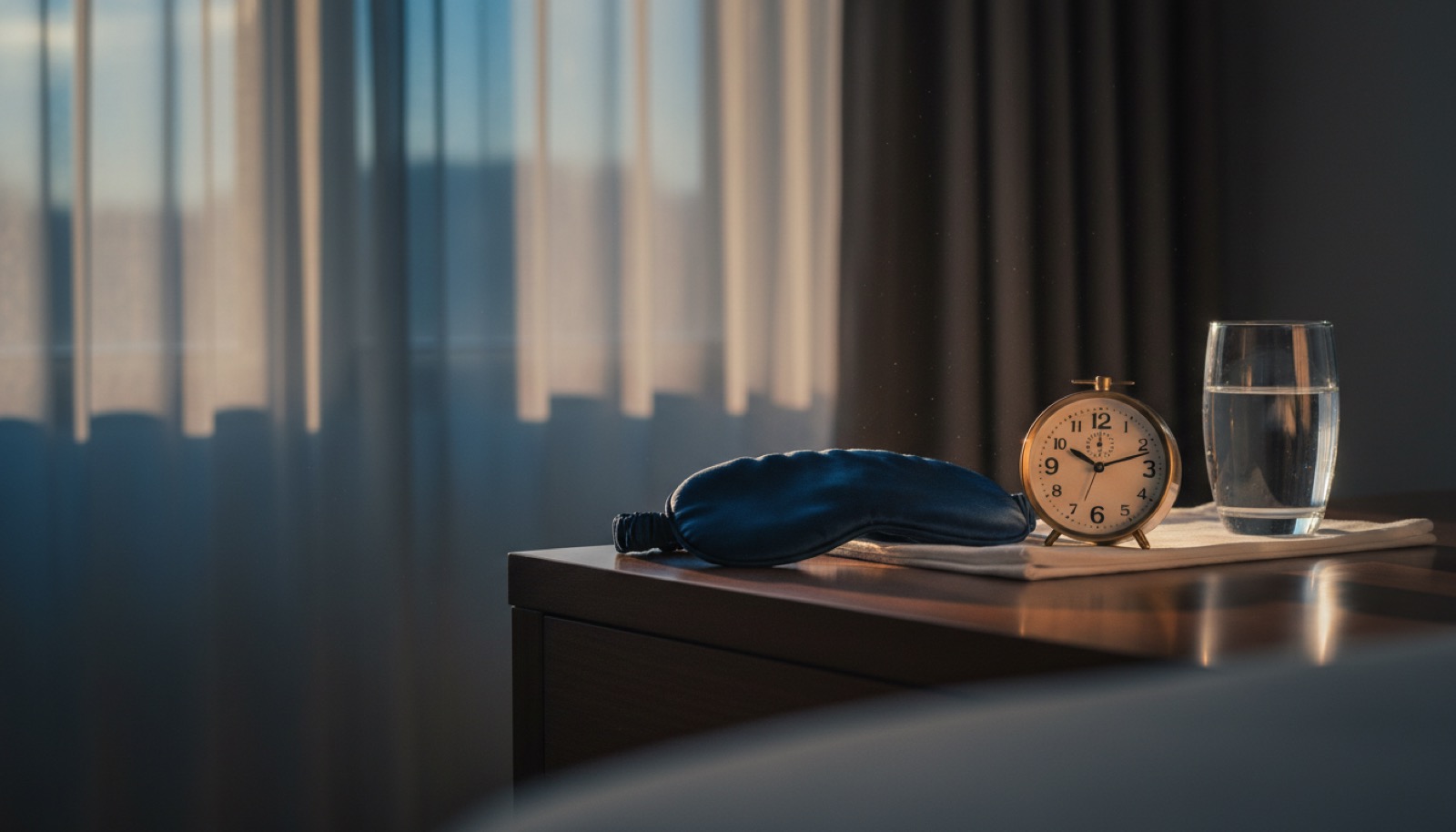
Jet lag is a clock-misalignment problem, so the fast route is the one that shifts the clock fastest: correctly timed light, low-dose melatonin, and pre-shifting before you fly. The ranked levers, with doses and directions.
Understand what 'fast' means: you are shifting a clock
Jet lag is not tiredness from travel; it is a temporary misalignment between your internal clock and the destination's day-night cycle, and recovery is gated by how fast that clock can shift. The human pacemaker re-entrains at best about 1 hour per day eastbound and ~1.5 hours per day westbound (the asymmetry follows from the ~24.18 h intrinsic period measured by Czeisler et al. 1999, Science). 'Fast' therefore means using the cues that move the clock at its maximum rate and avoiding the ones that move it the wrong way, not finding a trick that bypasses the clock. The single biggest mistake is fighting the clock with mistimed light. For the full directional breakdown, see the east-vs-west jet lag protocol.
Lever 1: correctly timed light is the strongest tool
Light is by far the most powerful zeitgeber, so timing it correctly is the fastest lever. The phase response curve to light (Khalsa et al. 2003, J Physiol) sets the rule: light in the destination morning advances the clock (helps eastbound travel), light in the destination evening delays it (helps westbound travel). So eastbound, get bright light early at the destination and avoid bright light in the late evening; westbound, get evening light and avoid early-morning light for the first couple of days. Outdoor daylight delivers 10,000-100,000 lux, far more than any indoor lighting, so going outside at the right time is the highest-yield action you can take on arrival.
Lever 2: low-dose melatonin, timed to the destination night
Melatonin is the second lever, and it is a timing signal rather than a sleeping pill, so dose timing matters more than dose size. The Cochrane review by Herxheimer & Petrie 2002 found melatonin consistently reduced jet lag across 5 or more time zones, most clearly eastbound, at 0.5-5 mg taken close to destination bedtime, with 0.5 mg about as effective as 5 mg. Take 0.3-0.5 mg roughly 5 hours before, or at, target destination bedtime. Higher retail doses add sedation without faster shifting and can sustain melatonin into the morning. For the full dose-and-timing logic, see the melatonin dosing guide; the review also warns that taking it at the wrong destination time can worsen adaptation.
Lever 3: pre-shift before you fly (trips of 4+ zones)
The fastest recovery often starts before takeoff. Eastman & Burgess 2009 (Sleep Med Clin) showed that shifting sleep timing by about 1 hour per day for 2-3 days before departure, paired with correctly timed light, leaves travelers partially entrained on arrival and can roughly halve recovery time. Eastbound, move sleep and wake earlier each day and get morning light; westbound, move them later and get evening light. This is the highest-leverage move for long eastbound trips, the hardest direction to recover from, because it converts the worst case into a smaller residual shift on arrival.
Lever 4: anchor meals, caffeine, and the first night's sleep
Secondary cues help once light and melatonin are doing the main work. Shift meals to the destination clock immediately, since feeding time entrains peripheral clocks in the liver and gut. Use caffeine strategically: it is useful in the destination morning to support daytime wakefulness, but stop it 8-10 hours before destination bedtime because its ~5-6 hour half-life otherwise wrecks the first night's sleep. Skip alcohol on the plane and on the first night; it fragments sleep architecture (Ebrahim et al. 2013) and undercuts the consolidated night you need to lock in the shift. Keep the first destination night dark, cool, and on the local clock.
When not to chase a full shift, and when to see a clinician
For short trips of 1-2 nights, the fastest functional strategy is often not to re-entrain at all: stay on home time for sleep where logistics allow, because a full shift takes more days than you have and chasing it leaves you dysregulated in both directions. For longer stays, commit fully to the destination clock from night one. Melatonin in children is off-label and should not be used routinely without a clinician's guidance; the light-timing parts of this protocol apply at any age. This article is educational and not medical advice. Persistent insomnia or daytime impairment well beyond the expected recovery window warrants a clinical assessment rather than more self-treatment.
Questions logged on this protocol
What is the fastest way to get over jet lag?
Use the cues that shift the clock fastest and avoid the ones that shift it the wrong way. Get bright light at the right time of the destination day (morning light eastbound, evening light westbound), take 0.3-0.5 mg melatonin around destination bedtime (most useful eastbound), and, for trips of 4 or more zones, pre-shift your sleep by about an hour a day for 2-3 days before flying. The clock re-entrains at best about 1 hour per day eastbound and ~1.5 hours per day westbound, so correctly timed light plus pre-shifting can roughly halve recovery versus doing nothing.
How long does jet lag take to go away?
Roughly one day per time zone eastbound and a bit faster westbound, because the human clock shifts at best about 1 hour per day east and ~1.5 hours per day west (the asymmetry follows from the slightly-longer-than-24-hour intrinsic period; Czeisler et al. 1999). A six-zone eastbound trip can take close to a week to fully resolve without intervention. Correctly timed light, low-dose melatonin, and pre-shifting before departure can compress that meaningfully. See the east-vs-west jet lag protocol for the directional timing.
Does melatonin help jet lag, and how much should I take?
Yes, especially eastbound. The Cochrane review by Herxheimer & Petrie 2002 found melatonin consistently reduced jet lag across 5 or more time zones, with 0.5 mg about as effective as 5 mg. Take 0.3-0.5 mg around destination bedtime; timing matters more than dose, and taking it at the wrong destination time can worsen adaptation. Higher retail doses add sedation, not faster shifting, and can keep melatonin elevated into the morning. See the melatonin dosing guide for the full dose-and-timing logic.
Should I sleep on the plane or stay awake?
Match the plane to the destination night where possible. On an overnight eastbound flight, try to sleep during what will be night at the destination; on a daytime westbound flight, stay awake so you can sleep on the local clock that night. Skip alcohol, which fragments sleep (Ebrahim et al. 2013), and limit caffeine to the destination morning. The goal is to arrive already nudged toward the destination clock, then reinforce it with correctly timed light on arrival.
How do I prevent jet lag before a trip?
For trips of 4 or more time zones, pre-shift your sleep schedule by about an hour a day for 2-3 days before departure, in the direction of travel: earlier with morning light for eastbound trips, later with evening light for westbound trips (Eastman & Burgess 2009). This leaves you partially entrained on arrival and can roughly halve recovery time. It is the single highest-leverage step for long eastbound trips, which are otherwise the slowest to recover from.
Does staying hydrated or eating on the local schedule cure jet lag?
Hydration helps you feel better and counters dry cabin air, but it does not shift the clock, so it does not cure jet lag on its own. Eating on the destination schedule does help as a secondary cue, since meal timing entrains peripheral clocks in the liver and gut, but it is weaker than light. Treat hydration and meal timing as supporting moves layered on top of the main levers: correctly timed light, low-dose melatonin, and pre-shifting. This article is educational and not medical advice.
- [01]
- [02]
- [03]
- [04]
- [05]
Other stacks in this hub
Is Insomnia Genetic? What Twin Studies and Genome Research Actually Show
Insomnia does run in families, and large genetic studies have found real inherited risk, but genes set a vulnerability rather than a destiny. What twin studies and genome-wide research show about the heritability of insomnia, why the environment and habits still decide whether that vulnerability becomes a lasting problem, and why the treatment is the same either way.
What Causes Insomnia: The Triggers That Start It and the Habits That Keep It Going
Insomnia is rarely caused by one thing. The most useful model separates the traits that make you vulnerable, the event that triggers a bad stretch, and the coping habits that turn a few rough nights into a lasting problem. What the research says about stress, caffeine, an irregular schedule, medical and psychiatric causes, and why the behaviors that feel helpful at 3am are often what keep insomnia alive.
Night Sweats: Why You Sweat in Your Sleep and When It Signals Something
Sleep is supposed to run cool, so sweating through the night is a sign the body's temperature control has been pushed the wrong way. What the physiology says about the core temperature drop that sleep depends on, the everyday causes like a hot room, alcohol, and bedding, the hormonal and medical causes worth knowing, and the red flags that mean night sweats need a doctor.