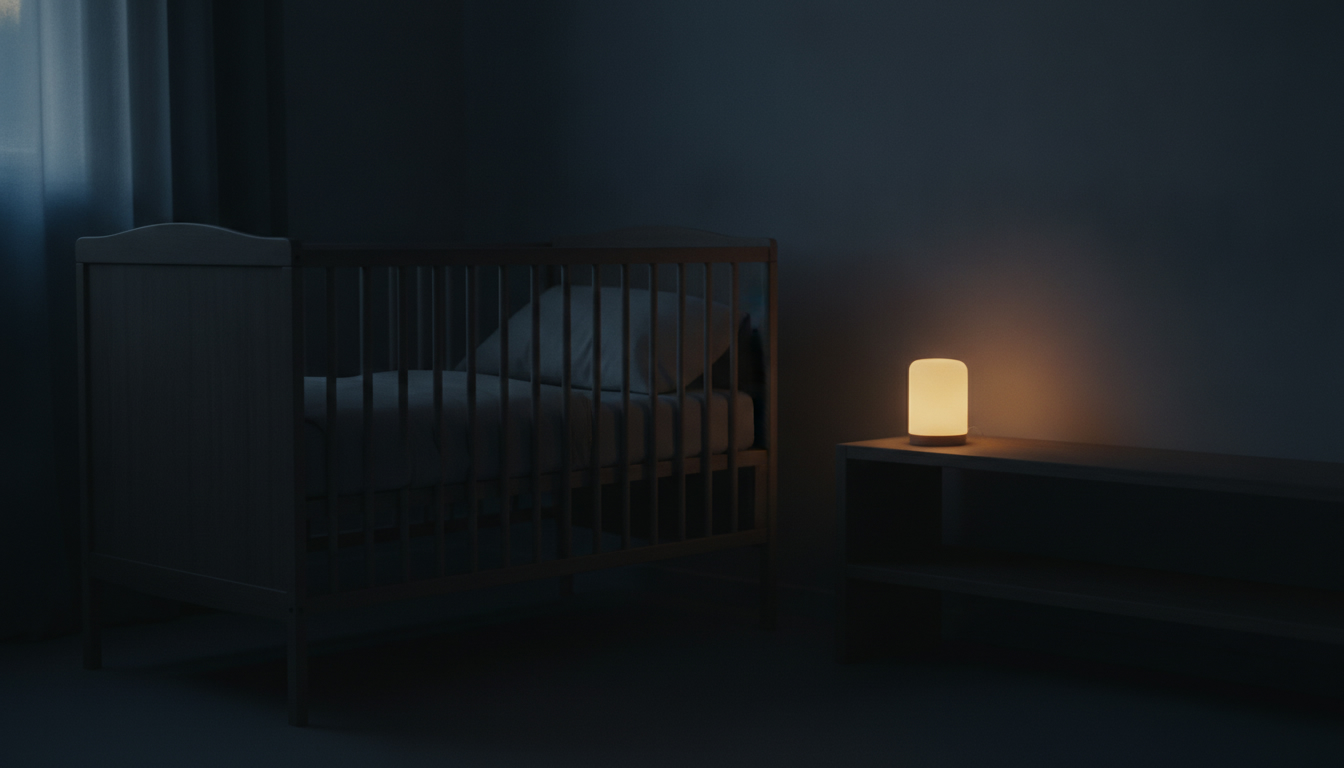
Newborns have no working body clock, so the day-night rhythm has to develop over the first months. What the melatonin, cortisol, and temperature data show about when it emerges, and the light and routine cues that help it settle.
Newborns are born without a working body clock
A full-term newborn does not have a functioning circadian rhythm at birth. The master clock in the suprachiasmatic nucleus is present but not yet driving the daily hormonal and temperature cycles that organize an adult's day, so a newborn's sleep is distributed in short bouts around the clock with little regard for day or night. What rhythm exists in the first weeks is largely inherited from the mother during pregnancy, through the placental transfer of melatonin and maternal cues, and it fades after birth once that external signal is gone. Rivkees 2003 (Pediatrics) describes this early period as one in which the infant's own clock has not yet taken over, which is why the classic newborn pattern is feeding and sleeping every few hours regardless of the time. Understanding that the clock is genuinely not built yet reframes the first weeks: the scattered sleep is developmentally normal, not a problem to be fixed.
The timeline: when the rhythm actually emerges
The infant's own circadian rhythm develops gradually over the first months rather than switching on at a single moment. Body-temperature rhythm is often the first to appear, becoming detectable within the first weeks to two months. The cortisol rhythm, with its morning peak, tends to organize over the first few months, and the melatonin rhythm, the strongest hormonal night signal, typically becomes clearly rhythmic around 2 to 3 months and strengthens thereafter. McGraw et al. 1999 (Sleep) tracked a single infant in detail and found sleep-wake, temperature, and cortisol rhythms consolidating on slightly different schedules over the first months. In practical terms, most families notice night sleep beginning to lengthen somewhere between 6 and 12 weeks, with a clearer day-night pattern usually established by 3 to 4 months, though the range between healthy babies is wide.
Melatonin, cortisol, and temperature: the signals coming online
The day-night rhythm you eventually see in a baby's sleep is the visible result of several internal rhythms maturing underneath it. Melatonin is the key nighttime signal: infants produce very little in the first weeks, and a measurable nocturnal melatonin rhythm emerges over the first few months, which is part of why night sleep lengthens around that time (Joseph et al. 2015, Chronobiology International). Cortisol, which should peak in the morning to promote waking, develops its adult-like morning rise over a similar window. Core body temperature develops a daily rhythm early. These systems do not mature in perfect lockstep, so there is a phase during which a baby may show a temperature rhythm before a strong melatonin one, which is one reason early night sleep can be inconsistent even as the overall trend improves.
Light is the main cue that trains the infant clock
Just as in adults, light is the dominant zeitgeber, the environmental cue that entrains the developing infant clock, and it is the lever parents can actually use. Studies of infant light exposure suggest that babies exposed to more light in the daytime and darker conditions at night tend to develop consolidated night sleep sooner (Tsai et al. 2012, and related work). The mechanism is the same one that governs adult circadian entrainment: bright light in the day and darkness at night sharpen the contrast the clock uses to lock onto the 24-hour cycle, a principle covered in our explainer on what a zeitgeber is. This does not mean flooding a nursery with light or leaving a baby in the dark all day; it means making days bright and active and nights dim and calm, so the environment carries a clear day-night signal.
What parents can and cannot do
The realistic goal in the first months is to support the emerging rhythm, not to impose one. The things that genuinely help are low-effort and align with the light cue: keep daytime bright and interactive, take the baby outside or near a window during the day, and keep night feeds dim, quiet, and brief so nighttime reads as different from daytime. Keeping loose consistency in the timing of the day helps the clock find its anchor. What does not work is expecting a newborn to sleep through the night before the biology is in place, or enforcing a rigid feeding schedule to force it, which can interfere with feeding and is not how the rhythm develops. Newborn feeding should follow the baby's needs; the circadian pattern will follow development, and the cues simply help it settle a little sooner and more smoothly.
When to check with a professional
Wide variation between babies is normal, and a scattered sleep pattern in the first weeks and months is expected rather than a sign of a disorder. That said, some situations warrant a conversation with a pediatrician or health visitor. Premature infants develop circadian rhythms on a timeline shifted relative to their birth date, closer to their corrected age, so their day-night pattern may emerge later, and this is worth discussing with the care team. Concerns about feeding, weight gain, unusual sleepiness or difficulty waking for feeds, or breathing during sleep are medical questions and should go to a professional rather than being managed as a sleep-training issue. Safe-sleep guidance, placing a baby on the back to sleep in a clear crib, is a separate and higher priority than any circadian cueing and should never be traded off against it. This article is educational and not medical advice.
Questions logged on this protocol
At what age do babies develop a circadian rhythm?
It develops gradually over the first months rather than at a fixed age. Newborns have essentially no working circadian rhythm, so their sleep is scattered around the clock. A body-temperature rhythm often appears within the first weeks to two months, the cortisol rhythm organizes over the first few months, and a clear nocturnal melatonin rhythm typically emerges around 2 to 3 months (Joseph et al. 2015). Most parents notice night sleep beginning to lengthen between 6 and 12 weeks, with a recognizable day-night pattern usually settling by 3 to 4 months. The range between healthy babies is wide, so the timeline is a guide, not a deadline.
Why do newborns have their days and nights mixed up?
Because the internal clock that separates day from night has not developed yet. A newborn's suprachiasmatic nucleus is present but not yet driving the daily melatonin, cortisol, and temperature cycles that organize adult sleep, so the baby sleeps and wakes in short bouts driven by hunger rather than the time of day (Rivkees 2003). Any rhythm in the first weeks is a fading remnant of maternal cues from pregnancy. The mix-up is not a bad habit; it is the normal state before the clock is built, and it resolves as the infant's own rhythms come online over the first months.
Can I help my baby develop a day-night rhythm faster?
You can support it, mainly through light. Keep daytime bright and active, get the baby into daylight during the day, and keep night feeds dim, quiet, and low-stimulation so night reads as clearly different from day. Studies of infant light exposure suggest stronger day-night light contrast is associated with earlier consolidation of night sleep (Tsai et al. 2012). Loose consistency in the daily pattern also helps the clock find its anchor. What you cannot do is force the rhythm before the biology is ready or impose a rigid feeding schedule to make a newborn sleep through; the pattern follows development, and the cues just help it settle a little sooner.
Should I keep the house completely dark all day so my baby sleeps?
No, and doing so can be counterproductive. The developing clock uses the contrast between bright days and dark nights to lock onto the 24-hour cycle, so removing daytime light removes the very signal that helps a day-night rhythm form. The better approach is to make daytime bright and darkness a nighttime cue: let daylight into the home during the day and keep the sleep environment dark and dim at night. This day-night contrast is the same entrainment principle that governs adult circadian rhythms, described in our guide to what a zeitgeber is. Daytime naps do not require a blacked-out room in the early months.
Do premature babies develop a circadian rhythm later?
Typically their rhythm emerges relative to their corrected age rather than their birth date, so it can appear later than in a full-term baby of the same calendar age. Premature infants also spend early weeks in environments where light and sound are less clearly day-night structured, which can matter for the developing clock. The practical implication is to judge development against corrected age and to discuss sleep and any feeding or health concerns with the neonatal or pediatric care team, who can advise for the individual baby. This article is educational and not medical advice.
Is it normal for a 2-month-old to still wake through the night?
Yes. At 2 months many babies are only just beginning to develop a nocturnal melatonin rhythm, so frequent night waking and feeding are developmentally normal and not a sign that something is wrong. Night sleep commonly begins to lengthen between 6 and 12 weeks and consolidates further over the following months, but the timeline varies widely between healthy infants. Supporting the rhythm with bright days and dim, calm nights can help it settle, while expecting a 2-month-old to sleep through before the clock has matured usually leads to unnecessary worry. Concerns about feeding, weight, or unusual sleepiness are worth raising with a professional.
- [01]
- [02]
- [03]
- [04]
Other stacks in this hub
Is Insomnia Genetic? What Twin Studies and Genome Research Actually Show
Insomnia does run in families, and large genetic studies have found real inherited risk, but genes set a vulnerability rather than a destiny. What twin studies and genome-wide research show about the heritability of insomnia, why the environment and habits still decide whether that vulnerability becomes a lasting problem, and why the treatment is the same either way.
What Causes Insomnia: The Triggers That Start It and the Habits That Keep It Going
Insomnia is rarely caused by one thing. The most useful model separates the traits that make you vulnerable, the event that triggers a bad stretch, and the coping habits that turn a few rough nights into a lasting problem. What the research says about stress, caffeine, an irregular schedule, medical and psychiatric causes, and why the behaviors that feel helpful at 3am are often what keep insomnia alive.
Night Sweats: Why You Sweat in Your Sleep and When It Signals Something
Sleep is supposed to run cool, so sweating through the night is a sign the body's temperature control has been pushed the wrong way. What the physiology says about the core temperature drop that sleep depends on, the everyday causes like a hot room, alcohol, and bedding, the hormonal and medical causes worth knowing, and the red flags that mean night sweats need a doctor.