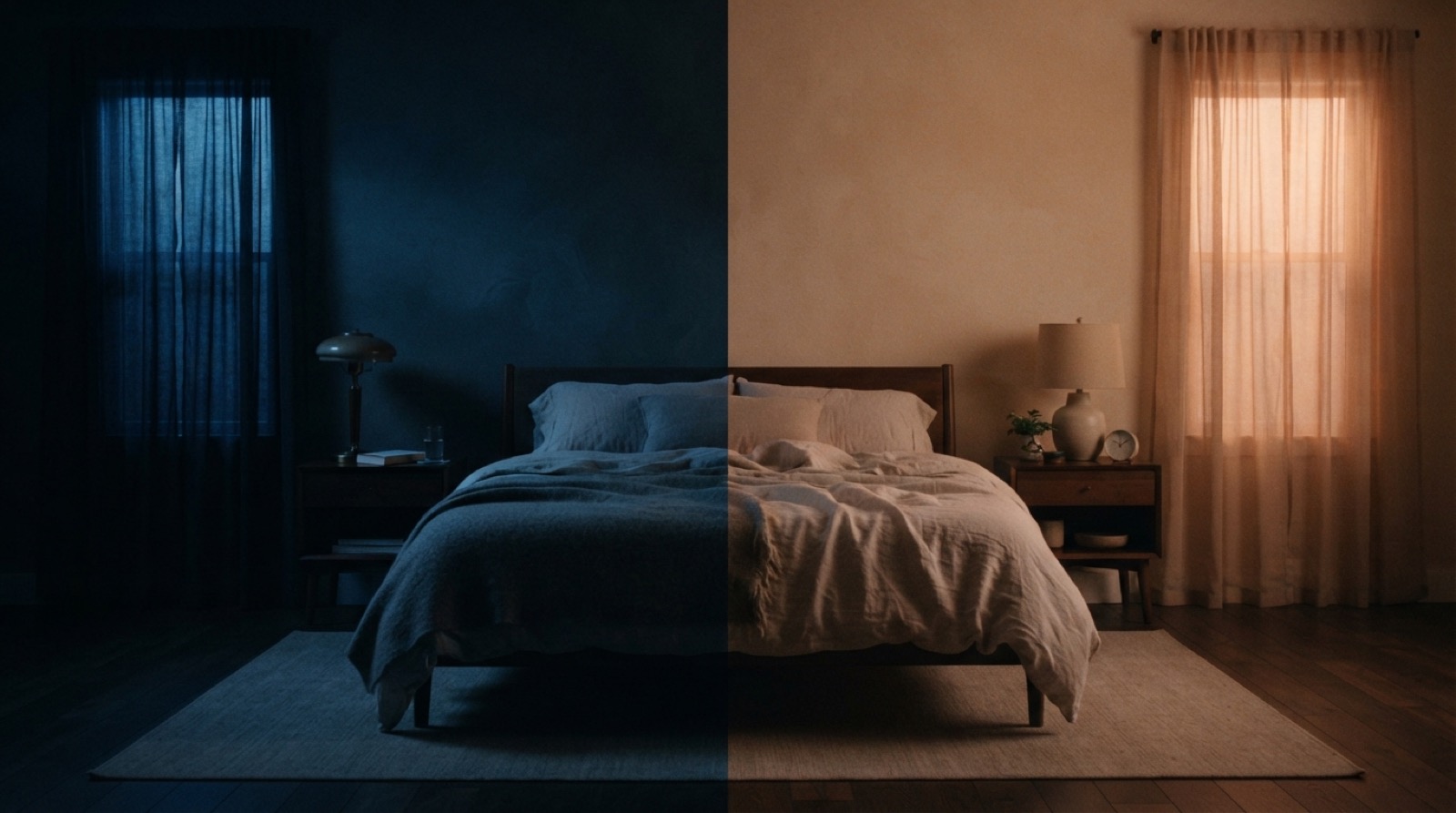
Biphasic sleep means two sleep bouts per 24 h. The historical 'first and second sleep', the siesta pattern, and the forced-desynchrony data on split schedules, with what holds up and what does not.
What 'biphasic' means (two bouts, not less sleep)
Biphasic sleep is simply two distinct sleep episodes per 24 hours rather than one consolidated night (monophasic). The two best-documented forms are a long night plus a daytime nap (the siesta pattern) and a segmented night of two bouts separated by a wakeful interval. Crucially, 'biphasic' describes the distribution of sleep, not its total amount. A healthy biphasic schedule still delivers an adult's ~7-9 hours (Hirshkowitz et al. 2015, the National Sleep Foundation consensus); it just packages it into two windows. This is the distinction that separates evidence-based biphasic patterns from the polyphasic schemes that try to use fragmentation as an excuse to sleep less.
The historical 'first and second sleep'
Historian A. Roger Ekirch documented (2001, Am Hist Rev; expanded in his 2005 book) that pre-industrial Western Europeans commonly slept in two bouts: a 'first sleep' beginning a few hours after dusk, a wakeful interval of one to two hours used for quiet activity, then a 'second sleep' until morning. He argued the consolidated single-block night is partly a product of artificial lighting and industrial schedules. The pattern is a historical and anthropological observation, not a prescription, but it establishes that a segmented night can be a normal human variant rather than a disorder.
Wehr's short-photoperiod experiment
Thomas Wehr's 1992 study (J Sleep Res) is the most-cited laboratory demonstration. When healthy adults were placed in a long 14-hour nightly dark period for weeks, their sleep spontaneously split into two bouts separated by 1-3 hours of quiet, restful wakefulness, with a melatonin and prolactin peak during the mid-night interval. This showed segmented sleep can emerge naturally under long nights and is not inherently pathological. The important caveat: it occurred under an artificially extended dark period, not modern light-rich evenings, so it does not mean a typical person should engineer a mid-night waking.
The siesta pattern and the post-lunch dip
The most practical biphasic pattern for modern life is a nocturnal anchor plus a short early-afternoon nap timed to the post-lunch circadian dip in alertness (a real dip in the circadian alerting signal, not merely a food effect). Mednick et al. 2003 (Nat Neurosci) showed a daytime nap restored perceptual performance, and a 60-90 min nap containing slow-wave and REM produced learning gains comparable to a full night. For function without harming the night, the evidence favors a short nap (see the napping-protocol post for the dose): ~20-30 minutes, before roughly 3 pm.
Split-sleep schedules in the lab and field
Operational research (military, shift, sustained-operations contexts) has tested deliberately split schedules. Reviews such as Kosmadopoulos et al. 2014 (and the Mollicone et al. 2008 forced-desynchrony work) found that when total sleep time is held constant, splitting it into two anchored bouts preserves neurobehavioral performance about as well as one consolidated bout. The lever that mattered was total sleep, not its packaging. This is the strongest support for biphasic schedules: they are a viable way to distribute adequate sleep, not a way to need less of it.
Why 'Uberman' and extreme polyphasic schedules fail
Polyphasic schemes such as 'Uberman' (six 20-minute naps, ~2 h/day total) or 'Everyman' (a short core plus naps) claim that frequent napping lets the brain front-load REM and slow-wave sleep and survive on a fraction of normal sleep. There is no controlled evidence that this is safe or that function is maintained; the homeostatic and circadian systems do not work this way, and self-reports converge on cumulative deficit, microsleeps, and impaired cognition. No peer-reviewed controlled trial supports chronic Uberman-style 2-4 h/day polyphasic schedules as safe in healthy adults. Biphasic with adequate total sleep is evidence-supported; extreme polyphasic sleep restriction is not.
Questions logged on this protocol
What is biphasic sleep?
Biphasic sleep is sleeping in two separate bouts per 24 hours instead of one consolidated night. The two well-documented forms are a long night plus a daytime nap (the siesta pattern) and a segmented night of two bouts separated by a quiet wakeful interval. The defining point is that biphasic describes how sleep is distributed, not how much there is: a healthy biphasic schedule still totals an adult's roughly 7-9 hours (Hirshkowitz et al. 2015), just split across two windows.
Is biphasic sleep healthy?
It can be, when total sleep time is adequate. Operational and forced-desynchrony studies (reviewed by Kosmadopoulos et al. 2014; Mollicone et al. 2008) found that splitting a fixed amount of sleep into two anchored bouts preserves daytime performance about as well as one consolidated block. Wehr 1992 (J Sleep Res) showed a segmented night can even emerge naturally under long dark periods. The health question is decided by whether the two bouts together reach your individual sleep need, not by the number of bouts.
What is the difference between biphasic and polyphasic sleep?
Biphasic means two sleep bouts per day; polyphasic means three or more. The important difference in practice is total sleep. Evidence-supported biphasic patterns (night plus short nap, or two adequate night bouts) still deliver a full ~7-9 hours. Extreme polyphasic schedules such as 'Uberman' deliberately cut total sleep to 2-4 hours using many short naps, and there is no controlled evidence that this is safe or that cognition is maintained. Chronic ultra-short polyphasic schedules lack any supporting controlled trial in healthy adults.
Was the 'first and second sleep' real?
Historically, yes. Historian A. Roger Ekirch (2001, Am Hist Rev) documented that pre-industrial Western Europeans commonly slept in a 'first sleep' and a 'second sleep' separated by a wakeful hour or two, and argued the single consolidated night is partly a product of artificial lighting and industrial schedules. Wehr's 1992 laboratory work lends physiological plausibility: under long dark periods, modern adults' sleep also split into two bouts with a melatonin-rich quiet interval between them. It is a documented historical pattern, not a recommendation to wake yourself mid-night.
Can I just add a nap to make my sleep biphasic?
Yes, and this is the safest biphasic pattern for most people. A short nap of about 20-30 minutes taken in the early-afternoon circadian dip (before roughly 3 pm) restores alertness without measurably harming the nocturnal bout (Mednick et al. 2003). The failure modes are predictable: naps longer than ~30 minutes risk slow-wave sleep and grogginess, and naps after mid-afternoon erode nighttime sleep pressure. See the napping-protocol guide for the dose-specific timing.
Does biphasic sleep mean I can sleep less?
No. This is the central misconception. Splitting sleep into two bouts does not reduce your physiological need; controlled split-sleep studies preserved performance only when total sleep time was held adequate (Kosmadopoulos et al. 2014). The homeostatic (sleep-pressure) and circadian systems still require the full amount. Schedules that use fragmentation as a pretext to sleep 2-4 hours total produce cumulative deficit and impaired cognition, regardless of how the bouts are arranged.
Is segmented sleep at night a sign of insomnia?
Not necessarily. A calm, brief mid-night wakeful interval that you fall back asleep from, with adequate total sleep, can be a benign segmented pattern rather than a disorder (Ekirch 2001; Wehr 1992). It becomes a problem when the awakening is prolonged, distressing, or you cannot return to sleep and total sleep falls short, which is sleep-maintenance insomnia. If mid-night waking is frequent and leaves you short on sleep or anxious, treat it as insomnia (CBT-I is first-line) rather than reframing it as biphasic sleep. Distinguishing benign segmented sleep from sleep-maintenance insomnia is clinical and depends on distress and total sleep time.
- [01]
- [02]
- [03]
- [04]
- [05]
- [06]
Other stacks in this hub
How to Improve REM Sleep: What Actually Raises It and What Just Wrecks It
You cannot force REM sleep directly, but several everyday habits quietly suppress it, and removing them is how you get more. What the research says about when REM happens across the night, why alcohol and short sleep cut it most, and why the single biggest lever is simply giving yourself enough time asleep in the early morning hours.
Is 7 Hours of Sleep Enough? What the Evidence Actually Says
Seven hours is the number most sleep authorities put at the bottom of the healthy adult range, which makes it enough for many people and too little for some. What the large studies and the official recommendations say about the 7-hour mark, why sleep need varies between people, and the honest signs that tell you whether your own 7 hours is sufficient or short.
How Much Sleep Do Women Need? Separating the Evidence From the Myth
A popular claim says women need more sleep than men. The recommended ranges are actually the same for both, but there are real, evidence-based reasons a woman's sleep can differ across the menstrual cycle, pregnancy, and menopause. What the guidelines say, what the sex-difference research does and does not show, and how life stage changes the picture.