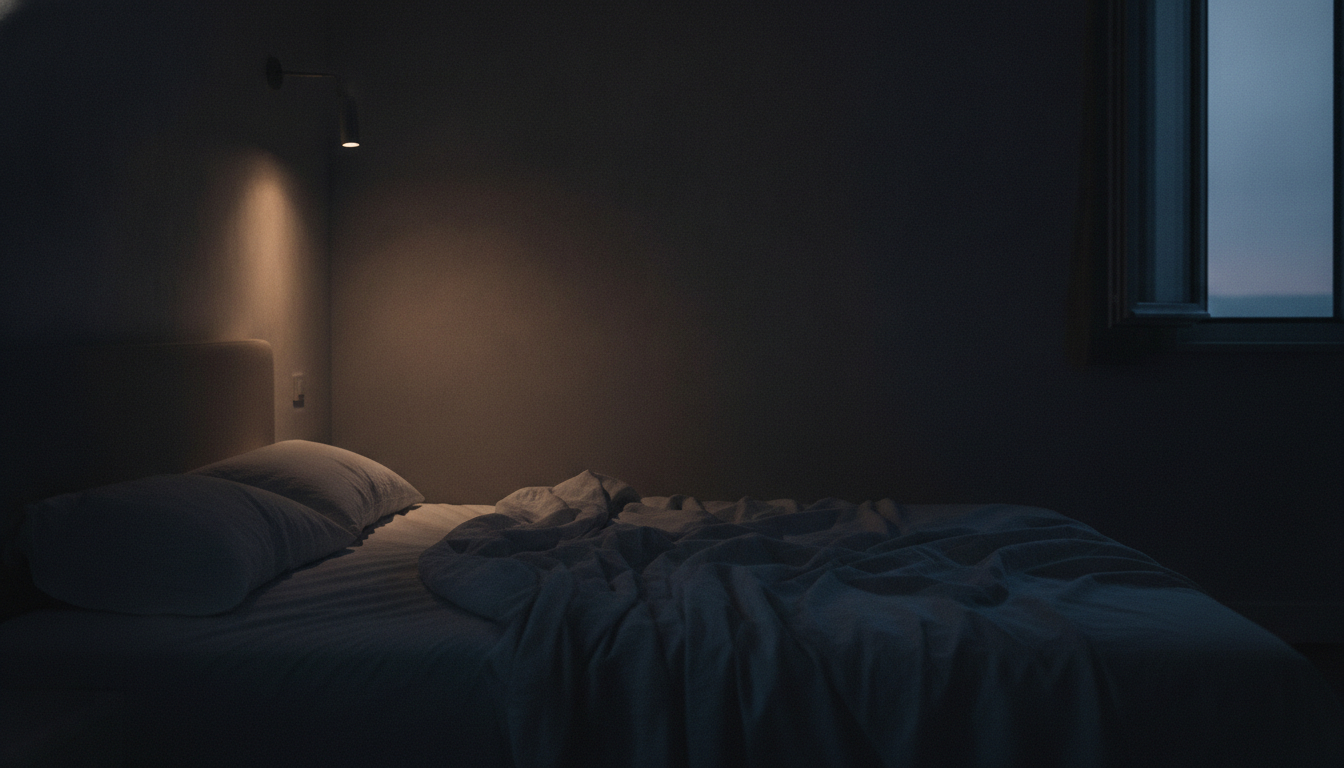
Sleep paralysis is a brief inability to move or speak while falling asleep or waking, caused by REM muscle atonia intruding into wakefulness. How common it is, why the hallucinations feel so real, the triggers that raise the odds, and the sleep habits that reduce it.
What sleep paralysis is
Sleep paralysis is a brief period, seconds to a couple of minutes, in which you are conscious but unable to move or speak, occurring either while falling asleep or, more often, while waking. Awareness returns before the body's motor control does, so the mind is awake inside a body that is still switched off. It is common, usually harmless, and by itself not a sign of illness: when it happens without other symptoms it is classified as recurrent isolated sleep paralysis in the American Academy of Sleep Medicine's diagnostic manual. What makes it frightening is not danger but the mismatch, being alert and aware while completely immobile, often accompanied by vivid hallucinations. Understanding what is actually happening in the brain removes most of the fear, because the mechanism is well characterized and benign.
The mechanism: REM atonia in the wrong place
During REM sleep, the stage where most vivid dreaming happens, the brainstem actively paralyzes the skeletal muscles, a state called REM atonia, so that you do not physically act out your dreams. Normally this paralysis switches off before you wake. Sleep paralysis is what happens when the timing slips and consciousness returns while REM atonia is still in force, or when atonia intrudes at sleep onset: you wake into a body that has not yet been released. This is the same muscle-paralysis system that fails in the opposite direction in REM sleep behavior disorder, where atonia is absent and people act out dreams. Seen this way, sleep paralysis is not a malfunction of the body but a brief desynchronization between the wake system and the REM system, which is why it resolves on its own within seconds to minutes as the two realign.
Why the hallucinations feel so real
Many episodes come with hallucinations, and they cluster into recognizable types: a sensed 'intruder' or presence in the room, pressure on the chest or a feeling of choking or suffocation (sometimes called the 'incubus'), and vestibular-motor sensations of floating, falling, or leaving the body. They feel intensely real because the brain is still partly in REM, generating dream imagery, while awareness is switched on, so dream content is overlaid onto the real bedroom. The chest-pressure sensation is amplified by REM breathing, which is shallow and rapid, so a conscious person notices restricted breathing and the fear system fills in a cause. These experiences are the likely origin of 'old hag' and night-attack folklore across many cultures. Knowing they are REM imagery, not events, is itself part of the countermeasure, because the fear is what makes an episode feel long and traumatic.
How common it is and who gets it
Sleep paralysis is far more common than most people assume. The systematic review by Sharpless & Barber 2011 (Sleep Med Rev) pooled dozens of studies and estimated that about 7.6% of the general population experiences it at least once in their lifetime, rising to roughly 28% in students and 32% in psychiatric samples. So a single episode is a normal human experience, not a disorder. It is more frequent in people with disrupted or insufficient sleep, in those under high stress or with anxiety and post-traumatic stress, and it is one of the classic features of narcolepsy, alongside excessive daytime sleepiness and cataplexy. For the large majority, though, it is isolated and occasional, and its frequency tracks closely with how disrupted their sleep has been.
The triggers that raise the odds
The associated factors are consistent across the literature (Denis et al. 2018, Sleep Med Rev). Sleep deprivation and irregular schedules are the most reproducible triggers, because sleep loss produces REM rebound, more and more intense REM, which increases the chances of a mistimed atonia overlap, a mechanism that connects directly to accumulated sleep debt and to the irregular timing of shift work. Sleeping supine (on the back) is repeatedly linked to more episodes. Psychological stress, anxiety, and trauma raise the odds, as does alcohol near bedtime, which fragments sleep and disrupts REM. Jet lag and any abrupt schedule change work the same way. The through-line is that anything which fragments sleep or forces REM rebound raises the probability, which is also why the countermeasures are mostly about sleep regularity rather than anything exotic.
How to reduce episodes, and when to see a doctor
Because the biggest triggers are sleep loss and irregularity, the highest-yield fixes are the fundamentals: a fixed wake time seven days a week, enough sleep to avoid REM rebound (most adults need 7-9 hours), limiting alcohol and late caffeine, and managing stress, since anxiety both triggers episodes and is worsened by them, a loop covered in the guide to sleep anxiety. Switching from back to side sleeping helps many people. During an episode, the practical move is to stop struggling, since fighting the paralysis spikes panic and makes it feel longer, and instead focus on moving one small part, a finger or toe, or on slowing the breath until the atonia lifts on its own. See a clinician if episodes are frequent and distressing, or if they come with excessive daytime sleepiness or sudden muscle weakness triggered by emotion, which can indicate narcolepsy and deserves evaluation. This article is educational and not medical advice.
Questions logged on this protocol
Is sleep paralysis dangerous?
No. Sleep paralysis is benign and self-limiting: episodes last from seconds to a couple of minutes and end on their own as the wake and REM systems realign. When it happens without other symptoms it is classified as recurrent isolated sleep paralysis, a normal variation rather than a disease. It feels frightening because you are conscious but immobile, often with vivid hallucinations, but nothing harmful is happening to the body. The main harm is the anxiety it creates, which can make future episodes more likely, so understanding the mechanism is itself protective.
What causes sleep paralysis?
It is caused by REM muscle atonia intruding into wakefulness. During REM sleep the brainstem paralyzes the skeletal muscles so you do not act out dreams; normally this switches off before you wake. In sleep paralysis, consciousness returns while that paralysis is still active, or atonia intrudes as you fall asleep, so you are awake inside a body that has not yet been released. The vivid hallucinations happen because the brain is still partly generating REM dream imagery while you are aware, overlaying it onto the real room.
How do I stop a sleep paralysis episode while it is happening?
Do not fight it. Struggling against the paralysis spikes panic and makes the episode feel longer and more frightening. Instead, remind yourself that it is harmless REM atonia that will pass in under a minute or two, and focus on moving one small part of the body, such as a finger or a toe, or on slowing and deepening your breathing. Any of these tends to help you surface. The hallucinated presence or chest pressure is dream imagery, not a real threat, and naming it as such reduces the fear that prolongs the experience.
How do I reduce how often I get sleep paralysis?
Target the triggers, which are mostly sleep loss and irregularity. Keep a fixed wake time seven days a week, get enough sleep to avoid REM rebound (most adults need 7-9 hours), limit alcohol and late caffeine, and manage stress and anxiety. Try sleeping on your side rather than your back, since supine posture is repeatedly linked to more episodes (Denis et al. 2018). These are the same fundamentals that stabilize sleep generally, and because sleep deprivation is the most reproducible trigger, fixing your schedule is usually the single most effective step.
When should I see a doctor about sleep paralysis?
Occasional isolated sleep paralysis needs no medical attention. See a clinician if episodes are frequent and distressing, if they seriously disrupt your sleep or cause significant anxiety about going to bed, or if they occur alongside excessive daytime sleepiness or sudden muscle weakness triggered by strong emotion. That combination can indicate narcolepsy, which is diagnosable and treatable, and deserves proper evaluation (Sharpless 2016). For most people, though, improving sleep regularity resolves the problem without any medical treatment.
- [01]
- [02]
- [03]
- [04]
Other stacks in this hub
How to Improve REM Sleep: What Actually Raises It and What Just Wrecks It
You cannot force REM sleep directly, but several everyday habits quietly suppress it, and removing them is how you get more. What the research says about when REM happens across the night, why alcohol and short sleep cut it most, and why the single biggest lever is simply giving yourself enough time asleep in the early morning hours.
Is 7 Hours of Sleep Enough? What the Evidence Actually Says
Seven hours is the number most sleep authorities put at the bottom of the healthy adult range, which makes it enough for many people and too little for some. What the large studies and the official recommendations say about the 7-hour mark, why sleep need varies between people, and the honest signs that tell you whether your own 7 hours is sufficient or short.
How Much Sleep Do Women Need? Separating the Evidence From the Myth
A popular claim says women need more sleep than men. The recommended ranges are actually the same for both, but there are real, evidence-based reasons a woman's sleep can differ across the menstrual cycle, pregnancy, and menopause. What the guidelines say, what the sex-difference research does and does not show, and how life stage changes the picture.