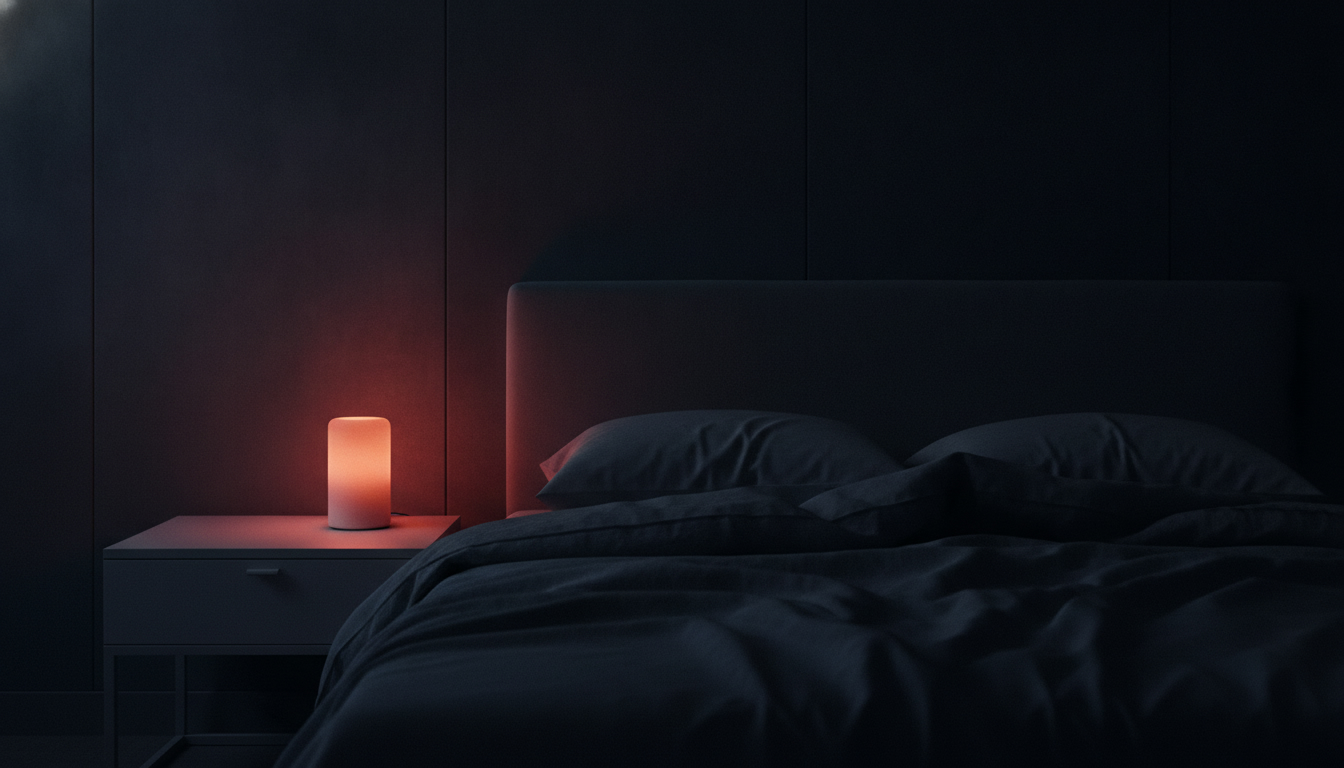
Red and amber light suppress melatonin far less than blue-white light at equal intensity, which is why night lights and evening bulbs shift red. What the action-spectrum data show, the practical wavelength and brightness targets, and where the claims outrun the evidence.
Why light color matters at night: melanopsin and the action spectrum
The signal that tells the clock it is daytime and suppresses melatonin runs mostly through melanopsin, a photopigment in retinal ganglion cells that is most sensitive to short-wavelength light near 480 nm. Brainard et al. 2001 (J Neurosci) and Thapan et al. 2001 (J Physiol) independently mapped the action spectrum for melatonin suppression and both found the peak in the blue range, falling off steeply toward the red end. Lockley et al. 2003 (J Clin Endocrinol Metab) showed 460 nm blue light suppressed melatonin roughly twice as strongly as an equal dose of 555 nm green. Long-wavelength red light sits at the far, insensitive tail of that curve, which is the entire mechanistic basis for choosing red or amber light after dark.
What counts as 'red': wavelength versus the marketing
The circadian benefit comes from genuinely long wavelengths, roughly 600 nm (amber) and up toward 630 nm and beyond (deep red), where melanopsin sensitivity is low. The problem is that many products labeled 'warm' or 'red' are broad-spectrum white LEDs with a warmer tint that still emit meaningful energy below 500 nm. A true amber or red bulb, or a dedicated long-wavelength LED, is what the action-spectrum data actually support. Warm-white (around 2700 K) is better than cool-white (5000 K and up) but is a compromise, not the same thing as red; if the goal is minimal melatonin impact, the narrower and longer the wavelength, the better.
Intensity matters as much as color
Color is only half the equation, because melatonin suppression is dose-dependent on the number of photons reaching the retina, not just their wavelength. Gooley et al. 2011 (J Clin Endocrinol Metab) found that exposure to ordinary room light (about 200 lux) before bed suppressed melatonin in most people and shortened its duration, compared with dim light under 3 lux. A bright red light can still deliver enough photons to matter, while a very dim white light may do little. The practical rule is to minimize both: keep evening light dim first, then make what remains long-wavelength. A red light that is too bright defeats its own purpose.
Where red light genuinely helps
The clearest use cases are situations where you need some light at night but want to protect melatonin. A red or amber night light for a hallway or bathroom lets you navigate a 3am trip without the melatonin hit that a bright white bathroom light delivers, and without the alertness spike that can make it hard to fall back asleep. Parents feeding at night, shift workers who need dim task light during a sleep window, and anyone who reads briefly before lights-out are the people with the most to gain. In each case the logic is the same: some illumination is unavoidable, so make it the wavelength the clock notices least.
What red light does not do
Red light at night is a harm-reduction tool, not a sleep aid, and several popular claims outrun the evidence. It does not phase-advance the morning clock, so it is no substitute for the bright morning light that actually pulls your rhythm earlier. It is not a sedative, and one small trial in athletes (Zhao et al. 2012, J Athletic Enhancement) that reported better sleep with evening red-light-therapy exposure is a single, small, weak study that does not establish red light as a treatment. And red light is not perfectly inert: Figueiro and Rea 2010 (Int J Endocrinol) found that red light at night could still raise alertness and shift some physiological markers, so it lowers the circadian cost of night light without eliminating it.
Practical setup: bulbs, dimming, and the wind-down window
The simplest implementation is to give the last 2-3 hours before bed their own lighting layer: switch off overhead cool-white fixtures and use low-output amber or red lamps at or below eye level. Smart bulbs that can be set to a deep amber or red at low brightness work, as do dedicated red night-light bulbs. Keep brightness to the lowest usable level, since Gooley et al. 2011 showed intensity drives suppression. Pair this with the rest of evening light hygiene: dim screens or filter them, keep the bedroom dark for sleep, and then get bright light in the morning, which is the half of the cycle that does the phase-setting work.
Questions logged on this protocol
Does red light really help you sleep?
It helps indirectly, by not hurting. Red and amber light sit at the insensitive end of the melatonin action spectrum (Brainard et al. 2001; Thapan et al. 2001), so at equal brightness they suppress melatonin far less than white or blue light. That protects the natural evening melatonin rise better than a bright white light would. But red light is not a sedative and does not actively make you sleepy; its value is that it lets you have some light at night at a much lower circadian cost. It is harm reduction, not a sleep treatment.
What color light is best for sleep at night?
Long-wavelength light, meaning amber to red (roughly 600 nm and up), is the best choice for the hours before bed and for any night lighting. That is the range where melanopsin, the photopigment driving melatonin suppression, is least sensitive (Lockley et al. 2003). Warm-white light around 2700 K is a reasonable second-best and clearly better than cool-white above 5000 K, but it still emits some blue. Whatever the color, keep it dim: Gooley et al. 2011 showed that even ordinary room light suppresses melatonin, so brightness matters alongside color.
Is red light better than night mode on my phone?
For the same brightness, dedicated red or amber lighting shifts further toward the harmless end of the spectrum than a phone's night mode, which only warms the display color and still emits blue while the screen stays bright. But the comparison is not quite fair, because they solve different problems: night mode addresses screen light, while a red bulb addresses the room. The most effective approach is to do both and, more importantly, to dim everything, since intensity drives melatonin suppression as much as color does.
Do red light therapy panels help you sleep?
The evidence is thin. Red light therapy panels (photobiomodulation) are marketed for skin and muscle recovery, and the claim that they improve sleep rests largely on one small study in female basketball players (Zhao et al. 2012) that is too small and weak to generalize. Bright red light at night can also raise alertness (Figueiro and Rea 2010), which is the opposite of what you want before bed. There is no strong evidence that red-light-therapy panels are a sleep aid, and using a bright one late could plausibly work against sleep.
How bright should a red night light be?
As dim as you can make it while still seeing safely. Melatonin suppression is dose-dependent (Gooley et al. 2011 found roughly 200 lux of room light was enough to suppress it), so a bright red light can still cost you some melatonin even though red is the least disruptive color. A low-output bulb, a few lux at eye level, is plenty for navigating a room at night. The combination that protects sleep best is dim and long-wavelength together, not one or the other.
- [01]
- [02]
- [03]
- [04]
- [05]
Other stacks in this hub
Cortisol and Sleep: The Morning Hormone That Times Your Wake
Cortisol is not only a stress hormone; it follows a strong daily rhythm that peaks in the early morning to drive waking and falls to its low at night to allow sleep. What the research says about the cortisol awakening response, how stress and disrupted sleep push the rhythm out of shape, and why fixing the rhythm matters more than chasing a single cortisol number.
Eating Before Bed and Sleep: What a Late Meal Does to Your Night
A late meal is not automatically bad for sleep, but eating large, heavy, or the wrong foods close to bedtime reliably disturbs it, and meal timing is also a signal to your body clock. What the research says about reflux, blood sugar, and circadian meal timing, and how to eat in the evening without wrecking your night.
What Happens When Your Circadian Rhythm Is Disrupted
Your body clock does far more than control sleep; it schedules hormones, metabolism, temperature, and alertness across the day. When behavior falls out of step with the clock, through shift work, jet lag, social jet lag, or erratic light, the misalignment shows up as poor sleep, daytime dysfunction, and, over the long run, metabolic and mood consequences. What the research says, and how the clock realigns.