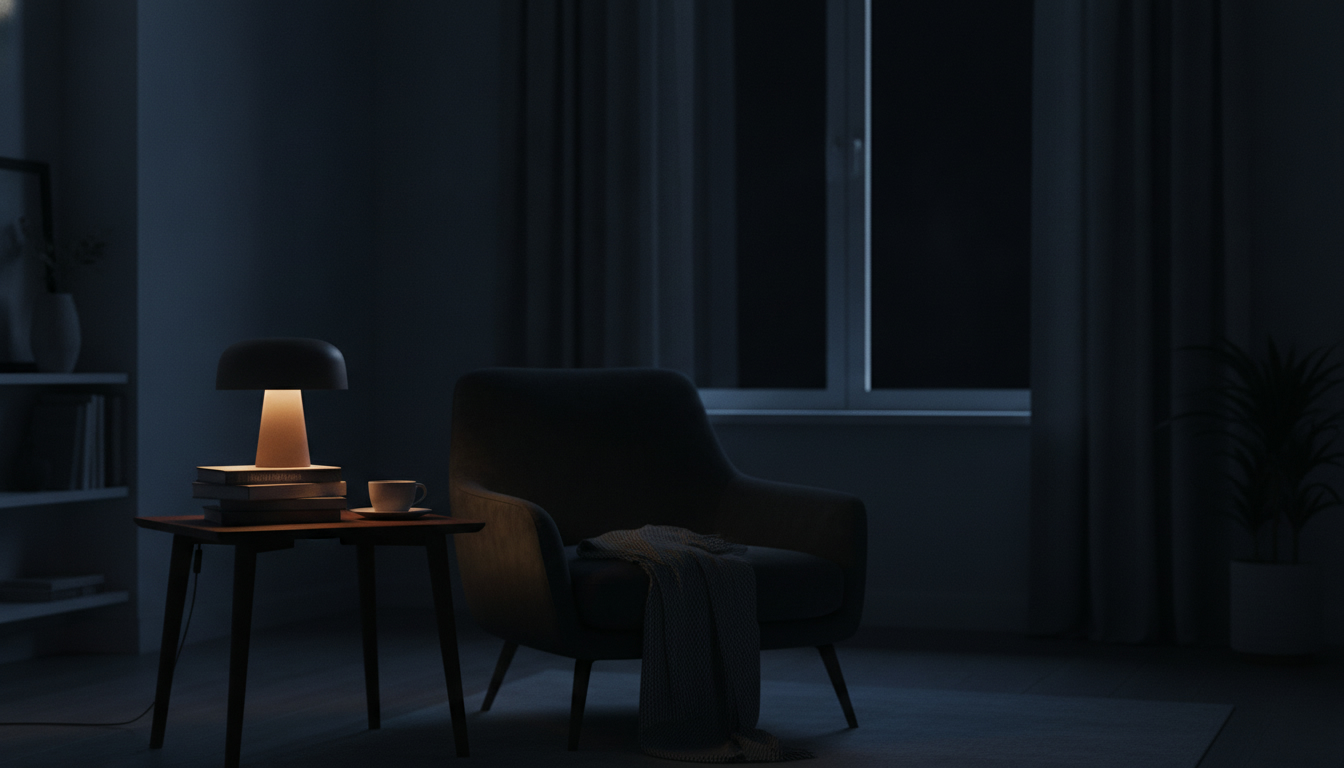
Bright evening light is the single most common thing keeping a healthy clock late. The lux targets, the timing window, how to handle overhead lights and screens, and where blue-blockers actually fit, with the melatonin-suppression evidence behind each step.
Why evening light is the lever that keeps you up
Light is the dominant zeitgeber, the cue that sets the master clock in the suprachiasmatic nucleus (see the circadian rhythm pillar). Morning light advances the clock and evening light delays it, which is the whole point of the phase response curve. Bright light in the last few hours before bed suppresses the evening rise of melatonin and pushes the biological night later, so you feel wide awake at the time you wanted to be asleep. Evening light hygiene is simply the deliberate removal of that delaying signal, the mirror image of the morning sunlight protocol.
The lux target: dimmer than you think
The threshold for melatonin suppression is far lower than most people assume. Zeitzer et al. 2000 mapped the dose-response and found melatonin is measurably suppressed at light levels well under a normally lit living room, with roughly half-maximal suppression at only around 100 lux. Gooley et al. 2011 showed that ordinary room light before bedtime shortened melatonin duration by about 90 minutes compared with dim light. The practical target for the last 2-3 hours before bed is roughly 10 lux at eye level, which feels quite dim: think a single low lamp, not overhead lighting.
Kill the overhead light, drop the lamps low and warm
The highest-yield single change is turning off ceiling lights, because overhead fixtures put bright light straight into the lower visual field where the melanopsin-containing retinal cells that drive the clock are densest. Replace them with one or two low-wattage warm lamps placed below eye height, and use the lowest comfortable brightness. Warm color temperature helps at the margin because the short-wavelength (blue) part of the spectrum is the most potent melatonin suppressant, but total brightness matters more than color, so a bright 'warm' room still delays the clock.
Screens: dim and warm them, do not rely on filters alone
Evening screen use delays melatonin and sleep onset (Chang et al. 2015 found light-emitting e-readers pushed melatonin later and reduced next-morning alertness; Cajochen et al. 2011 showed similar effects from bright displays). Night mode and blue-light filters help by lowering brightness and warming the spectrum, but the evidence that color-shifting alone rescues sleep is weak once brightness stays high, which is why the honest fix is to dim the screen hard, enable night mode, and hold it further away. See the guide on whether blue-light filters help sleep for what the data actually support.
Where blue-blockers and red light actually fit
Amber blue-blocking glasses are an evening tool, not a morning one: worn in the last hour or two they cut the short-wavelength light that suppresses melatonin most, which is useful when you cannot control a bright environment (a late shift, a lit kitchen, unavoidable screens). They are a backstop, not a license to sit in a bright room. Similarly, shifting night lights and late lamps to red or deep amber suppresses melatonin far less at the same brightness. See the blue-blocker glasses guide and the piece on red light at night for the specifics.
Sensitivity varies, so anchor it to the morning
Individual sensitivity to evening light varies several-fold between people (Phillips et al. 2019), so some will feel the effect of a bright kitchen strongly while others barely notice, which is why the target is a behavior (dim the last few hours) rather than a promise of a fixed result. Evening dimming works best as the back half of a two-sided protocol: bright light early to advance the clock, dim light late to stop delaying it. On its own it nudges; paired with a fixed wake time and morning light it re-anchors a drifted clock (see how to reset your circadian rhythm).
Questions logged on this protocol
How dim should my lights be before bed?
Aim for roughly 10 lux at eye level in the last 2-3 hours before bed, which is much dimmer than a normally lit room. Practically that means overhead lights off, one or two low warm lamps below eye height, and screens dimmed with night mode. The reason the target is so low is that melatonin suppression begins at surprisingly modest light levels, with about half-maximal suppression near 100 lux in Zeitzer et al. 2000, so 'a bit dimmer' is not enough.
Does the color of the light matter, or just the brightness?
Both, but brightness matters more. Short-wavelength (blue) light is the most potent melatonin suppressant, so warming the color helps at the margin, and it is why warm lamps and night mode are recommended. But a bright warm-colored room still suppresses melatonin, so you cannot fix a bright environment with color temperature alone. Lower the total brightness first, then warm the spectrum.
Do blue-blocking glasses replace dimming the lights?
No. Amber blue-blockers cut the most suppressive part of the spectrum and are a useful backstop when you cannot control the environment, such as a late shift or a bright kitchen, but they are not a substitute for dimming. Wearing them in a still-bright room leaves most of the brightness intact. Use them on top of dimming, mainly in the last hour or two before bed. See the blue-blocker glasses guide for details.
How long before bed should I start dimming?
About 2-3 hours before your target bedtime, which is the window in which evening light most effectively delays the clock and suppresses the natural melatonin rise. You do not need total darkness, just a steady step down: overhead lights off, low warm lamps, dimmed screens. The goal is to let melatonin rise on schedule rather than holding it back with light.
Will one dim evening fix a late sleep schedule?
No. A single dim evening stops you from pushing the clock later that night, but re-anchoring a genuinely delayed clock takes consistent evening dimming paired with a fixed wake time and bright morning light, held across days including weekends. Evening light hygiene is one half of the lever; morning light is the other. For the full step-by-step, see how to reset your circadian rhythm.
- [01]
- [02]
- [03]
- [04]
- [05]
Other stacks in this hub
Cortisol and Sleep: The Morning Hormone That Times Your Wake
Cortisol is not only a stress hormone; it follows a strong daily rhythm that peaks in the early morning to drive waking and falls to its low at night to allow sleep. What the research says about the cortisol awakening response, how stress and disrupted sleep push the rhythm out of shape, and why fixing the rhythm matters more than chasing a single cortisol number.
Eating Before Bed and Sleep: What a Late Meal Does to Your Night
A late meal is not automatically bad for sleep, but eating large, heavy, or the wrong foods close to bedtime reliably disturbs it, and meal timing is also a signal to your body clock. What the research says about reflux, blood sugar, and circadian meal timing, and how to eat in the evening without wrecking your night.
What Happens When Your Circadian Rhythm Is Disrupted
Your body clock does far more than control sleep; it schedules hormones, metabolism, temperature, and alertness across the day. When behavior falls out of step with the clock, through shift work, jet lag, social jet lag, or erratic light, the misalignment shows up as poor sleep, daytime dysfunction, and, over the long run, metabolic and mood consequences. What the research says, and how the clock realigns.