What actually shortens sleep-onset latency: stimulus control, a cool dark room, a fixed wake time, light and caffeine timing, and the limits of breathing tricks. Doses and the studies behind them.
Fix the wake time before anything else
A single fixed wake time, held all seven days, is the most powerful and most overlooked lever for falling asleep faster at night. Wake time anchors the circadian clock and sets when sleep pressure peaks. If the wake time drifts, the evening sleep window drifts with it, and no bedtime ritual will compensate. This is why the how-to-fix-sleep-schedule protocol starts here: stabilise the morning, and the evening onset follows. Pair it with morning light (~1,000-10,000 lux within 60 minutes of wake) to lock the phase.
Stimulus control: only sleep (and sex) in bed
Bootzin's stimulus-control instructions (Bootzin 1972; a core component of CBT-I and AASM behavioral guidance) are the best-evidenced behavioral tool for sleep onset. The rules: go to bed only when sleepy; if you are not asleep within about 20 minutes, get up and do something quiet in dim light until sleepy again; use the bed only for sleep and sex; keep a fixed wake time. The mechanism is associative: lying awake repeatedly teaches the brain that bed equals wakefulness. Getting up breaks that conditioning.
Drop core body temperature (cool, dark room)
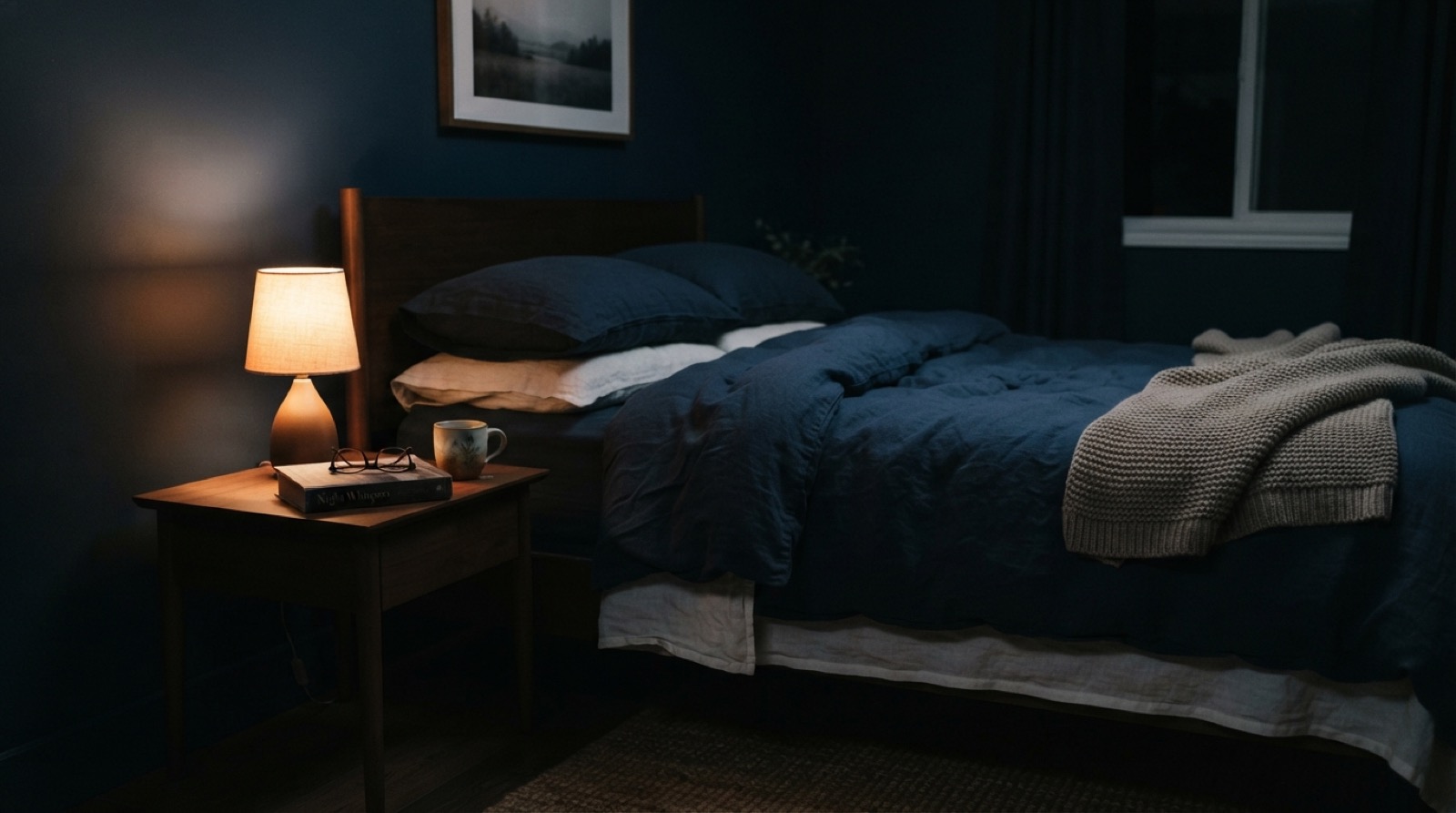
Sleep onset is tightly coupled to a fall in core body temperature, driven by heat loss through the hands and feet (Kräuchi et al. 2000, Am J Physiol). A bedroom around 18 degrees C (the commonly cited 15-19 degrees C range) facilitates that drop. A warm bath or shower 1-2 hours before bed paradoxically helps: it draws blood to the skin and accelerates the subsequent core-temperature decline (a finding supported by the Haghayegh et al. 2019 meta-analysis). Keep the room dark; even modest light delays the process.
Time caffeine and alcohol correctly
Caffeine has a half-life of about 5-6 hours, so a mid-afternoon coffee still has meaningful levels at bedtime. Drake et al. 2013 (J Clin Sleep Med) found 400 mg taken even 6 hours before bed measurably disrupted sleep, which is why the caffeine-and-sleep protocol sets the last dose 8-10 hours before bed. Alcohol is a false friend: it shortens sleep-onset latency but fragments the second half of the night and suppresses REM (Ebrahim et al. 2013). For falling asleep without wrecking sleep quality, fix caffeine timing and skip the nightcap.
Dim the evening light
Bright evening light suppresses melatonin and delays the circadian signal for sleep. Cajochen et al. 2011 and the broader melatonin-suppression literature show short-wavelength light near 480 nm is the most potent suppressor. The practical dose: keep ambient light under roughly 10 lux at the eye in the 1-2 hours before bed, warm and dim the overhead lights, and use device night modes or blue-blocking glasses if you must use screens. This is the same lever the evening-light and blue-blocker guides cover; it both advances onset and protects sleep depth.
What about breathing tricks and the 'military method'?
The '4-7-8' breath, the so-called 'military method', and progressive muscle relaxation work by lowering physiological arousal, and lowered arousal does help sleep onset. But the controlled evidence that any specific viral technique reliably shortens sleep-onset latency in healthy adults is weak, and the dramatic '60 seconds to sleep' claims are not supported. The 'military method' / '4-7-8' onset-time claims circulating online are largely anecdotal and lack controlled trials. Use them as an arousal-reduction layer if they calm you, not as a replacement for fixed timing and stimulus control, which are the levers with real evidence.
Questions logged on this protocol
How can I fall asleep faster tonight?
The fastest-acting levers are environmental and behavioral: cool the bedroom to around 18 degrees C, make it dark, dim ambient light under ~10 lux in the last 1-2 hours, and if you are not asleep within about 20 minutes, get out of bed and do something quiet in dim light until sleepy (stimulus control; Bootzin 1972). A warm bath 1-2 hours earlier accelerates the core-temperature drop that triggers sleep (Haghayegh et al. 2019). Avoid clock-watching, which raises arousal. The durable fix, a fixed wake time, works over weeks, not one night.
How long should it normally take to fall asleep?
A sleep-onset latency of roughly 10-20 minutes is typical and healthy. Falling asleep in under 5 minutes consistently can be a sign of sleep deprivation rather than good sleep, and routinely taking more than ~30 minutes points toward sleep-onset insomnia or misaligned timing. The number to watch is consistency: if onset is regularly long despite adequate sleepiness and good habits, that is the threshold to consider CBT-I rather than more bedtime tricks.
Does the '4-7-8' or 'military' breathing method work?
They can lower arousal, which helps some people drift off, but the strong claims (falling asleep in 60 seconds or two minutes) are not supported by controlled trials. The mechanism, slow breathing reducing sympathetic arousal, is plausible, and the methods are harmless. Treat them as an optional relaxation layer, not a primary intervention. Viral onset-speed claims for the 4-7-8 and 'military' methods are anecdotal and lack controlled evidence. The levers with real evidence are fixed wake time, stimulus control, and light and temperature timing.
What temperature should my bedroom be to fall asleep?
Around 18 degrees C, within a commonly cited 15-19 degrees C range. Sleep onset depends on a fall in core body temperature mediated by heat loss through the skin of the hands and feet (Kräuchi et al. 2000). A cooler room supports that drop; an overheated room blocks it. A warm bath or shower 1-2 hours before bed helps rather than hurts, because the subsequent rebound cooling accelerates the core-temperature decline (Haghayegh et al. 2019 meta-analysis).
Why can't I fall asleep even when I'm tired?
The most common reasons are misaligned timing and conditioned arousal. A late or variable wake time pushes your circadian sleep window later, so you feel physically tired but your clock is not signaling sleep. Evening bright light and late caffeine compound it (caffeine's half-life is ~5-6 hours; Drake et al. 2013). And repeatedly lying awake teaches the brain that bed means wakefulness. Fix the wake time, get morning light, cut caffeine 8-10 hours before bed, dim the evening, and apply stimulus control. If it persists beyond a few weeks, consider CBT-I.
Is lying in bed with my eyes closed as good as sleep?
No, but it is not worthless either. Quiet wakeful rest does not provide the restorative slow-wave and REM architecture that sleep does, so it cannot replace sleep or repay sleep debt. More importantly, lying in bed awake for long stretches actively trains the bed as a wake cue and worsens onset over time, which is exactly what stimulus control is designed to prevent. If you are not asleep within about 20 minutes, the evidence-based move is to get up, not to keep lying there.
- [01]
- [02]
- [03]
- [04]
- [05]
Other stacks in this hub
The Best Time to Exercise for Sleep: Why Evening Workouts Are Mostly Fine
Regular exercise is one of the most reliable ways to sleep better, and the old warning to avoid evening workouts has largely not held up. What the research says about how exercise improves sleep, whether the time of day matters, and the one narrow exception, vigorous exercise finished right before bed, that can genuinely delay sleep onset.
How Long Does Melatonin Last? Onset, Duration, and Why Timing Beats Dose
Melatonin does not work like a sleeping pill, and its short pharmacokinetics explain why. What the research says about how fast it kicks in, how long it stays in your system, why a big dose does not last longer in a useful way, and why when you take it matters far more than how much.
The Best Sleeping Position: What the Evidence Says and Why It Depends on You
There is no single best position for everyone, but the evidence does favor some positions for specific problems. What the research says about side, back, and stomach sleeping for snoring and apnea, reflux, back and neck pain, and pregnancy, and why comfort and the position you actually stay in matter more than chasing an ideal you cannot hold.