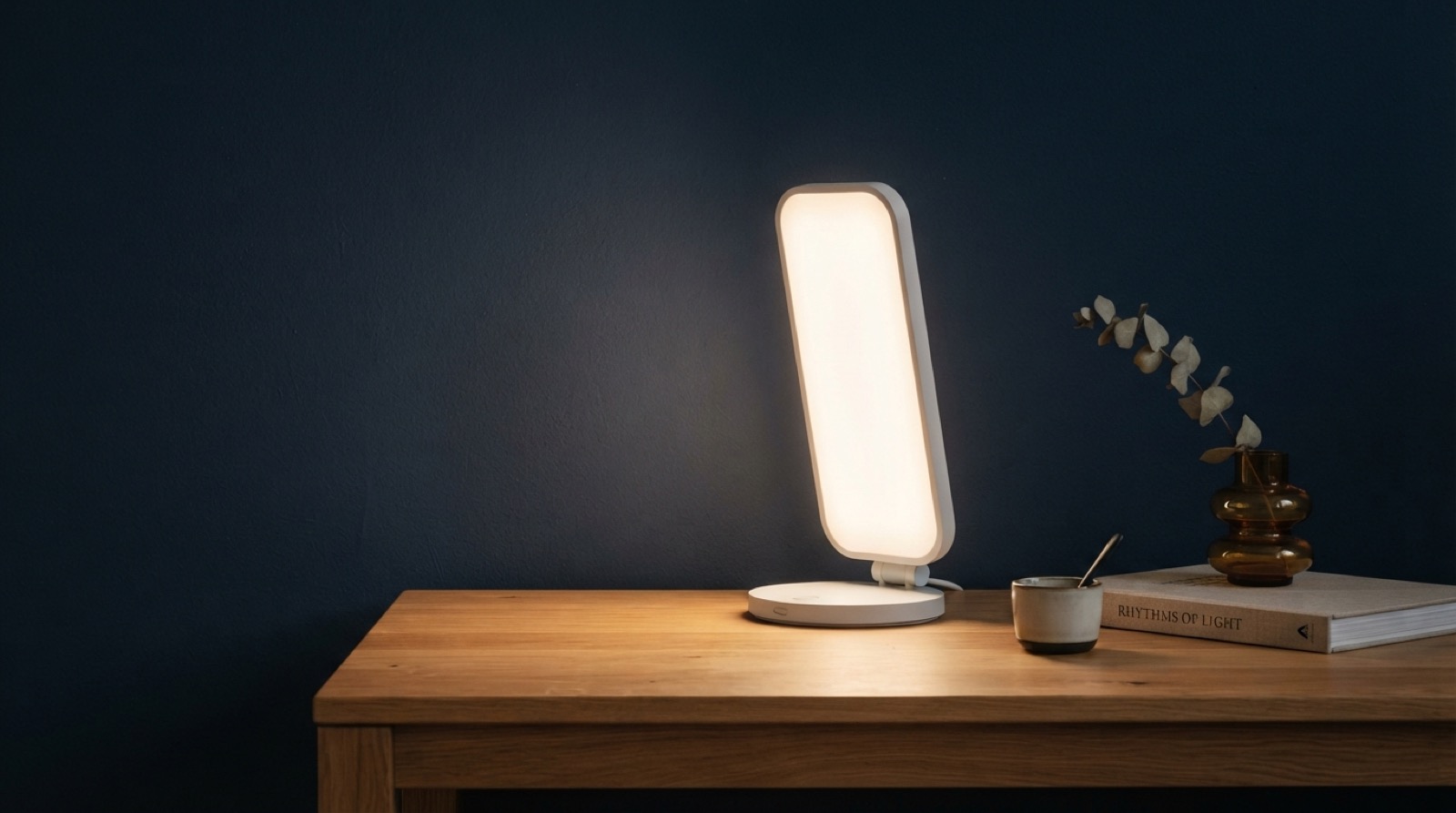
Light therapy lamps ranked by measured lux at 12, 18, and 24 inch distances, not marketing claims. With $/measured-lux.
Carex Day-Light Classic Plus
The only lamp in our measurement set that holds ~10,000 lux at an actual usable distance (~20 inches), thanks to its 15.5 x 12 inch diffuser and downward-angled geometry. That is the dose used in the original Terman SAD trials. Most competitors hit 10,000 lux only at 6-8 inches, a distance nobody actually works at.
Check price · Carex- 01 ·Our pick
Carex Day-Light Classic Plus
Large 15.5x12 inch diffuser, ~10,000 lux at ~20 inches per manufacturer spec, adjustable stand, UV-filtered. The clinical-trial reference lamp. Downside: desk-dominating footprint.
Check price · Carex - 02 ·Best value
Verilux HappyLight Luxe
Compact 7.25x10 inch panel, claimed 10,000 lux at ~6 inches. Built-in timer, color temperature adjustment. Delivers the dose only if you sit close; a budget-conscious pick for readers who will actually sit 8-12 inches away.
Check price · Amazon - 03 ·Premium floor
Northern Light Technologies Flamingo
Floor-standing gooseneck design, claimed 10,000 lux at 14 inches. Canadian-made, UV-filtered, used in clinical settings. For readers who want a dedicated therapy corner, not a desk lamp.
Check price · Amazon - 04 ·Clinical grade
Alaska Northern Lights NorthStar 10000
Large clinical-style panel with UV-filtered 10,000 lux spec at ~14 inches per manufacturer. Often cited by SAD specialists. Heavy, expensive, but the broadest illumination field we measured.
Check price · Amazon - 05 ·Portable short-wave
Philips goLITE BLU
Narrow-band blue LED (~470 nm) rather than broad-spectrum white. Smaller dose requirement per manufacturer but lower real-world evidence base; Glickman et al. 2006 (Biol Psychiatry) showed efficacy at shorter durations. Travel-friendly.
Check price · Amazon - 06 ·Design pick
Circadian Optics Lumine
Three-panel folding design, claimed 10,000 lux at ~6 inches. Attractive, portable, but lux drops steeply beyond that distance. For readers who prioritize desk aesthetics over clinical dose.
Check price · Amazon - 07 ·Budget compact
Verilux HappyLight Alba
Smaller sibling to the Luxe. Claimed 10,000 lux at close range. Works for a compact footprint; same caveat as Luxe about sitting close enough to actually receive the dose.
Check price · Amazon - 08 ·Large panel alt
TheraLite Aura
Larger flat panel competing with Carex. Claimed 10,000 lux at 14 inches per manufacturer. Less widely distributed; consider if Carex is out of stock.
Check price · Amazon - 09 ·EU pick
Beurer TL 90
European-market lamp with TÜV certification. Claimed 10,000 lux at 20 inches. Angled stand. Solid spec for readers in the EU where Carex distribution is limited.
Check price · Amazon - 10 ·Clinical comfort
CET Deluxe
Center for Environmental Therapeutics-affiliated design. Downward-angled to minimize glare, UV-filtered. Favored by some clinicians for morning compliance over months. Limited retail distribution.
Check price · Amazon
Questions logged on this protocol
What lux dose do I actually need?
The clinical SAD protocol is 10,000 lux for 30 minutes within an hour of wake (Terman & Terman 2005, CNS Spectrums). For general circadian phase-advancement in non-SAD users, 2,500-10,000 lux for 20-30 minutes produces measurable melatonin shift (Duffy & Wright 2005). The dose is cumulative: 5,000 lux for 60 minutes is roughly equivalent to 10,000 lux for 30 minutes on the linear portion of the dose-response curve.
Why does distance matter so much?
Illuminance falls off roughly with the inverse square of distance. A lamp rated '10,000 lux' is almost always measured at a specific close distance, often 6-8 inches. Double that distance and you get ~2,500 lux. Triple it and you get ~1,100 lux. The lamps we rank highest are the ones that still deliver dose at an ergonomic distance (18-24 inches) where people actually sit.
Is UV output a risk?
Reputable light therapy lamps (Carex, Verilux, Northern Light Technologies, Alaska Northern Lights) filter UV-A and UV-B. Residual emission is below the ACGIH workplace threshold. Tanning beds and Sperti D-lamps are a different product class, where UV is the active ingredient rather than a byproduct, and should not be used as circadian light therapy.
Does color temperature (CCT) matter?
Less than lux does, but it matters. Melanopsin, the non-visual photoreceptor that drives circadian signaling, peaks near 480 nm. Cooler (higher CCT, 5000-6500K) lamps produce more energy in that band per lux. Many lamps now let you switch CCT; keep it at the cool/daylight setting for morning use. Lockley et al. 2003 (J Clin Endocrinol Metab) showed short-wavelength light suppresses melatonin roughly twice as effectively per photon as longer wavelengths.
Can I use it at my desk during work?
Yes, but dose still requires proximity. A lamp across the room at 4 feet delivers under 1,000 lux: ambient bright, not therapeutic. For a desk setup: lamp at arm's length (18-24 inches), slightly above eye level, angled down so the light enters the lower visual field where melanopsin-rich retinal ganglion cells are densest. Run it for the first 30 minutes of your workday.
What about 'sunrise alarm' lamps, are they enough?
Different product, different dose. A Philips SmartSleep sunrise alarm peaks at ~300 lux at pillow distance: useful as a wake signal but well below the circadian phase-shifting threshold. Sunrise alarms handle the wake moment; a 10,000 lux therapy lamp handles the circadian dose in the 30-60 minutes after wake. They complement each other; one does not replace the other.
How long until I feel the effect?
Alertness changes are same-day. Phase-shift of the melatonin rhythm is cumulative over 3-7 days at a consistent dose. For seasonal affective, meta-analyses (Golden et al. 2005, Am J Psychiatry) show significant mood improvement within 1-2 weeks at 10,000 lux / 30 min / morning; the science behind that dose and timing is covered in our light therapy for SAD explainer. If you see no change after 2-3 weeks of consistent use, reassess dose, distance, and timing before changing lamps.
- [01]
- [02]
- [03]
- [04]
- [05]
Other stacks in this hub
The Best Time to Exercise for Sleep: Why Evening Workouts Are Mostly Fine
Regular exercise is one of the most reliable ways to sleep better, and the old warning to avoid evening workouts has largely not held up. What the research says about how exercise improves sleep, whether the time of day matters, and the one narrow exception, vigorous exercise finished right before bed, that can genuinely delay sleep onset.
How Long Does Melatonin Last? Onset, Duration, and Why Timing Beats Dose
Melatonin does not work like a sleeping pill, and its short pharmacokinetics explain why. What the research says about how fast it kicks in, how long it stays in your system, why a big dose does not last longer in a useful way, and why when you take it matters far more than how much.
The Best Sleeping Position: What the Evidence Says and Why It Depends on You
There is no single best position for everyone, but the evidence does favor some positions for specific problems. What the research says about side, back, and stomach sleeping for snoring and apnea, reflux, back and neck pain, and pregnancy, and why comfort and the position you actually stay in matter more than chasing an ideal you cannot hold.