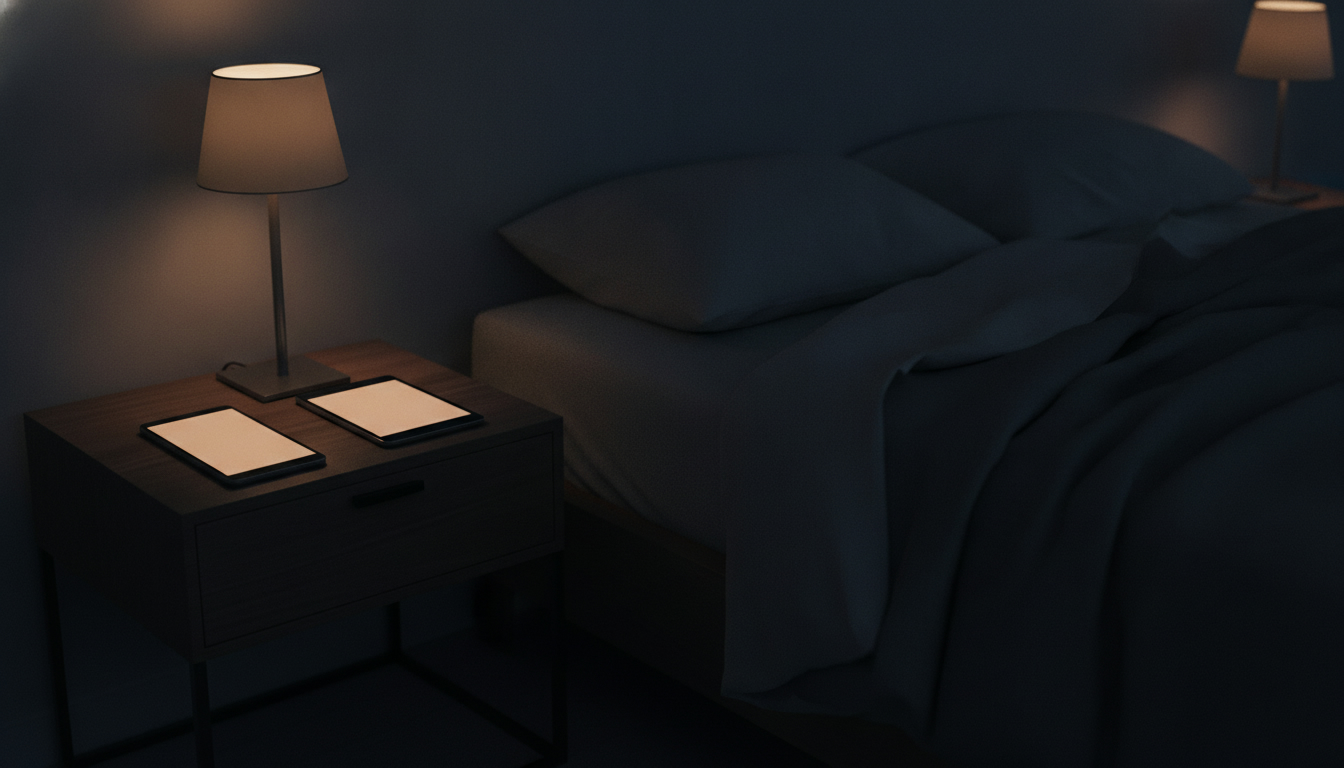
Night Shift, dark mode, and blue-light filter apps warm the screen to cut short-wavelength light. What the melatonin and sleep trials actually found, why brightness and use time matter more than color, and where the claims outrun the data.
What a blue-light filter and night mode actually do
Features like Apple's Night Shift, Android's equivalent, dark mode, and third-party apps such as f.lux work by warming the display's color temperature, shifting it from cool blue-white toward amber as the evening progresses. The stated goal is to cut the short-wavelength (blue) light that most strongly suppresses melatonin. What they do not do, at their default settings, is reduce the screen's overall brightness much, and they do not change the content on the screen. Understanding that a filter changes color but not necessarily intensity or engagement is the key to knowing why the real-world effect is smaller than the marketing implies.
Why blue specifically: the melanopsin action spectrum
The rationale is sound in principle. Melatonin suppression is driven mainly by melanopsin-containing retinal cells that peak in sensitivity near 480 nm, in the blue range, as Brainard et al. 2001 (J Neurosci) and Lockley et al. 2003 (J Clin Endocrinol Metab) established. Screens emit disproportionately in that band because of their white LED backlights. So removing blue should, on paper, reduce the circadian signal. Sasseville et al. 2006 (J Pineal Res) confirmed the direction by showing that filtering short wavelengths with amber lenses reduced melatonin suppression under bright light. The open question is not whether blue matters, but whether a modest screen filter cuts enough of it, at typical brightness, to change sleep.
What the trials actually found
The headline study is Chang et al. 2015 (PNAS), which found that reading from a light-emitting e-reader before bed suppressed melatonin, delayed its onset, lengthened time to fall asleep, and reduced next-morning alertness compared with reading a print book. That establishes that bright evening screen light matters. But that study compared a screen with paper, not a filter with no filter. When researchers tested filters specifically, results were weaker: Nagare et al. 2019 (Light Res Technol) found that an iPad in Night Shift mode at normal brightness did not significantly reduce melatonin suppression, and only dimming the display helped. The evidence supports the mechanism but is lukewarm on filters as a standalone fix.
Brightness and use time matter more than color
The recurring finding across this literature is that intensity and duration outweigh color temperature. Melatonin suppression is dose-dependent on total photons, so a bright warm screen can still suppress melatonin, while a dim screen of any color does less. Nagare et al. 2019 found brightness reduction did more than the color filter alone. On top of the light itself, the behavioral effect matters: an engaging feed, a work email, or a suspenseful show keeps you aroused and awake regardless of how amber the pixels are. This is why the most reliable levers are using screens less in the last hour, dimming aggressively, and choosing calm content, with the color filter as a minor add-on.
Filter versus blue-blocker glasses versus just dimming
A software filter only addresses the one screen it runs on, leaving overhead lights and other devices untouched. Blue-blocker glasses (covered in the blue-blocker guide) filter everything reaching the eye, including room light, which is why the amber-lens studies such as Sasseville et al. 2006 show clearer effects than phone night modes. The most complete approach is to dim the whole environment: reduce room light, warm and dim the screen, and consider amber glasses if you must be in a bright-lit space. Dimming the room addresses the biggest photon source, which a per-app screen filter cannot touch.
Practical setup
If you use screens in the evening, schedule the blue-light filter to ramp on 2-3 hours before your target bedtime, set it to its warmest level, and lower brightness to the dimmest comfortable setting, since Nagare et al. 2019 showed dimming does more than filtering. Then treat it as the smallest of your levers: the larger wins are turning off overhead cool-white light, keeping the last 30-60 minutes screen-light and calm, and getting bright light in the morning to keep the clock anchored. A filter is worth enabling because it costs nothing, but it will not rescue a bright, late, stimulating evening on its own.
Questions logged on this protocol
Do blue light filters actually work?
Partly, and less than the marketing suggests. Blue is the wavelength that most suppresses melatonin (Brainard et al. 2001), so filtering it is directionally correct. But when researchers tested filters at normal screen brightness, the effect was small: Nagare et al. 2019 found an iPad in Night Shift mode did not significantly reduce melatonin suppression, and only lowering brightness helped. Filters help most as one part of a wind-down that also dims the screen and the room. On their own, at full brightness, they do little.
Is night mode or Night Shift good for sleep?
It is a reasonable, cost-free thing to enable, but it is a minor lever. Night Shift and similar modes only warm the display color; they do not lower brightness much or change what you are looking at. Nagare et al. 2019 showed that at typical brightness the color shift alone did not meaningfully cut melatonin suppression. Use it, but pair it with lower brightness, less screen time in the last hour, and dimmer room lighting, which do more for your sleep than the color filter.
Is dark mode better for sleep?
Only marginally, and not because it is dark-themed per se. Dark mode reduces the total light a screen emits by showing more dark pixels, which lowers the photon dose reaching your eyes, and dose is what drives melatonin suppression (Gooley et al. 2011). So a dim screen in dark mode is better than a bright one in light mode. But the effect is small compared with simply reducing brightness and screen time before bed. There is no strong evidence that dark mode by itself measurably improves sleep.
Should I use a blue light filter or blue-blocker glasses?
They cover different areas. A screen filter only affects that one device, while blue-blocker glasses filter all light reaching your eyes, including overhead room light, which a phone filter cannot touch. The amber-lens studies (Sasseville et al. 2006) tend to show clearer melatonin effects than phone night modes for that reason. If your evenings are lit by bright overhead light, glasses or dimming the room will do more than a screen filter. Ideally, dim the room, warm and dim the screen, and add glasses only if you must be in a bright space.
How long before bed should I turn on the filter?
About 2-3 hours before your target bedtime, which matches the window in which evening light most affects melatonin timing. Set it to the warmest available setting and, more importantly, lower the screen brightness, since Nagare et al. 2019 showed dimming did more than the color shift. But the single most effective step is reducing screen use in the final 30-60 minutes: no filter compensates for a bright, engaging screen right up to lights-out.
- [01]
- [02]
- [03]
- [04]
- [05]
Other stacks in this hub
Cortisol and Sleep: The Morning Hormone That Times Your Wake
Cortisol is not only a stress hormone; it follows a strong daily rhythm that peaks in the early morning to drive waking and falls to its low at night to allow sleep. What the research says about the cortisol awakening response, how stress and disrupted sleep push the rhythm out of shape, and why fixing the rhythm matters more than chasing a single cortisol number.
Eating Before Bed and Sleep: What a Late Meal Does to Your Night
A late meal is not automatically bad for sleep, but eating large, heavy, or the wrong foods close to bedtime reliably disturbs it, and meal timing is also a signal to your body clock. What the research says about reflux, blood sugar, and circadian meal timing, and how to eat in the evening without wrecking your night.
What Happens When Your Circadian Rhythm Is Disrupted
Your body clock does far more than control sleep; it schedules hormones, metabolism, temperature, and alertness across the day. When behavior falls out of step with the clock, through shift work, jet lag, social jet lag, or erratic light, the misalignment shows up as poor sleep, daytime dysfunction, and, over the long run, metabolic and mood consequences. What the research says, and how the clock realigns.