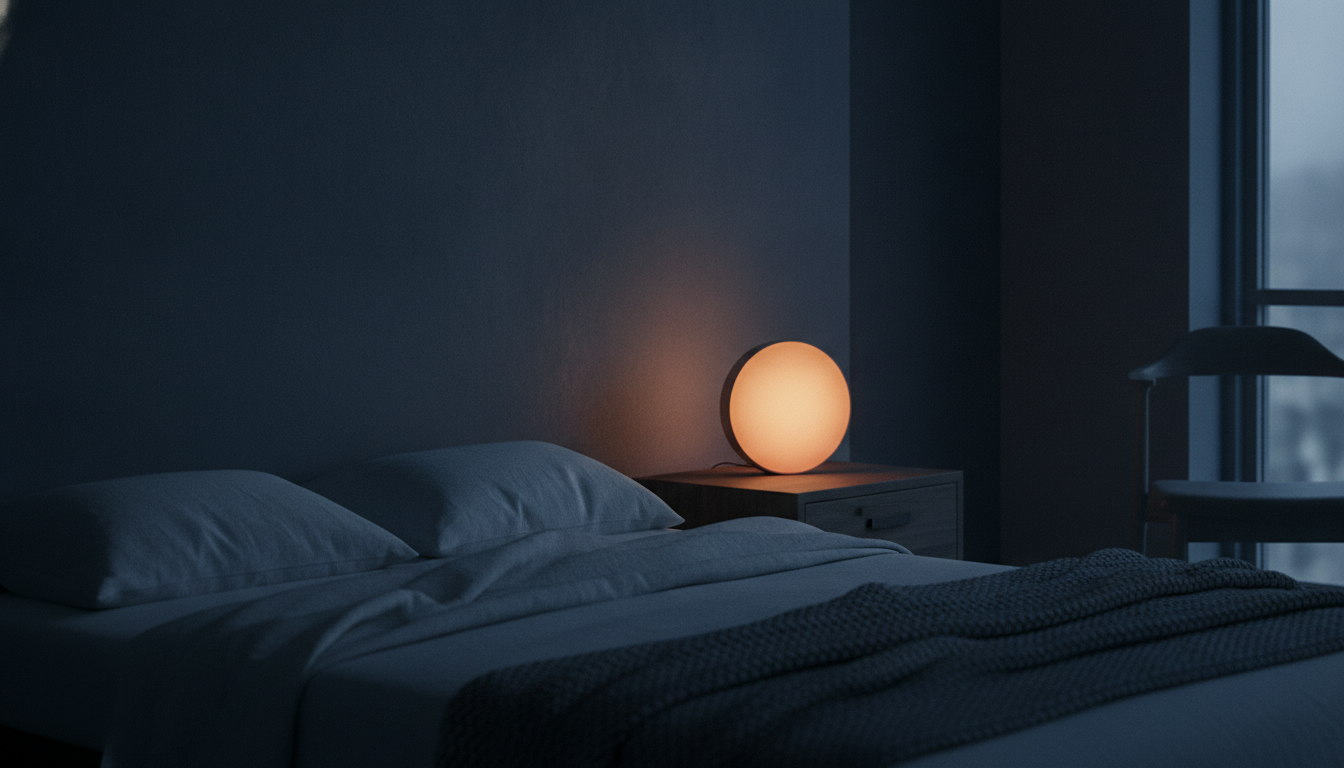
Dawn simulators wake you with gradually brightening light instead of an alarm. What the trials show for alertness, mood, and easier waking, where the effect is real versus overstated, and how they compare with a proper morning-light dose.
What a dawn simulator is and how it works
A dawn simulator is a light, often built into a bedside 'wake-up light' or sunrise alarm, that brightens gradually over 20 to 40 minutes before your set wake time, mimicking a natural sunrise. The proposed mechanism is that light reaching the eyes through closed lids in the final stretch of sleep nudges you toward lighter sleep stages, so the alarm (or the light peak itself) wakes you out of light sleep rather than deep sleep. Because waking from deep sleep is what produces grogginess, waking from light sleep should reduce that sleep inertia.
The evidence on easier waking and grogginess
This is the best-supported benefit. Reviews and trials of wake-up lights (Thompson et al. 2014) report that gradual dawn light improves the subjective ease of waking and reduces morning sleep inertia compared with waking in darkness to an alarm. Van De Werken et al. 2010 found dawn simulation reduced the feeling of grogginess and improved some objective and subjective measures shortly after waking. The effect sizes are modest and the studies small, but the direction is consistent: for the specific problem of a hard, groggy wake-up, a dawn simulator genuinely helps.
Mood, winter, and the SAD context
Dawn simulation has been studied as a treatment for seasonal affective disorder, where dark winter mornings are part of the problem. Some trials (including work by Terman and by Danilenko) found dawn simulation improved winter-depressive symptoms, in a few comparisons rivaling a standard bright-light box, though the SAD literature overall is mixed and bright light remains the better-established treatment. For non-clinical winter sluggishness, the gentler, on-your-own-schedule nature of a dawn light makes it an easy, low-risk thing to try. For the fuller picture, see the SAD light therapy explainer.
Alertness and morning performance
Beyond just feeling less groggy, dawn simulation shows some carryover into early-morning alertness and mood. Gabel et al. 2013 compared dawn simulation, bright light, and no light on morning cortisol and cognitive performance and found dawn light produced a favorable morning response, with the dawn condition boosting the natural post-waking cortisol rise and improving how alert people felt. The gains are real but should be kept in proportion: they are a smoother start to the day, not a wholesale upgrade to daytime cognition.
What they do not do: shift your clock
The key limit is intensity. A dawn simulator peaks at a few hundred lux at most, while the circadian phase-shifting effect of light depends on a much larger dose, which is why outdoor morning light (thousands to tens of thousands of lux) is the standard tool for advancing a delayed clock. A dawn light wakes you more pleasantly, but it does not deliver enough light to reliably move your body clock earlier by itself. If your problem is a genuinely delayed sleep phase, the dawn light is a helpful add-on, not a substitute for a real morning bright-light dose (see the morning-sunlight protocol).
Dawn simulator vs sunrise alarm vs light box
These overlap but are not the same. A 'sunrise alarm' is a consumer product that combines a dawn-simulating light with an alarm and often sound; a dawn simulator is the light-ramp function itself; a light-therapy box is a separate high-intensity (typically 10,000-lux) device used for a fixed dose after you are already awake. For easier waking, a sunrise alarm with a good dawn ramp is the right buy (see the sunrise alarm clock comparison). For actually shifting a delayed clock or treating winter low mood, you want the higher-intensity light box, used as a morning dose.
Questions logged on this protocol
Do dawn simulators actually work?
For making waking easier and less groggy, yes, with modest but consistent support. Trials of wake-up lights find that gradual dawn light improves the subjective ease of waking and reduces morning sleep inertia compared with waking in the dark to an alarm (Thompson et al. 2014; Van De Werken et al. 2010). The studies are small and the effects moderate, but the benefit is real for the specific problem of a hard morning wake-up.
Can a dawn simulator reset my circadian rhythm?
Not on its own. Its peak brightness is a few hundred lux at most, far below the dose needed to reliably shift your body clock, which is why outdoor morning light at thousands of lux is the standard tool for advancing a delayed rhythm. A dawn light is a pleasant wake-up aid and a useful add-on, but if your goal is to move a delayed sleep phase earlier, you need a proper morning bright-light protocol.
Are dawn simulators good for SAD?
They have some evidence. Several trials found dawn simulation improved winter-depressive symptoms, and a few comparisons put it close to a standard bright-light box, though the overall SAD literature is mixed and bright light therapy remains better established. For clinical seasonal affective disorder, treat a dawn simulator as a possible adjunct and discuss light therapy with a clinician; for ordinary winter morning sluggishness it is a low-risk thing to try.
How bright does a wake-up light need to be?
For the wake-up benefit, brightness is less important than the gradual ramp and the timing: a light that climbs from near-dark to full over 20 to 40 minutes and finishes at your wake time is what eases you out of deep sleep. For any circadian effect you need far more intensity than these lights provide, which is why you follow the dawn light with real outdoor light or a 10,000-lux lamp after you are up.
Dawn simulator vs a regular alarm: which is better?
For grogginess, the dawn simulator generally wins. Waking to a sudden alarm in a dark room often means being pulled out of deeper sleep, which produces sleep inertia, whereas a gradual dawn light nudges you toward light sleep first so the wake-up feels easier. Most people keep a backup sound alarm as well, since the light alone does not always wake heavy sleepers reliably.
How far away should the light be?
Close enough that the light actually reaches your face while you sleep, typically within about 50 cm to 1 metre on the bedside table, angled toward your head. Light intensity falls off sharply with distance, so a wake-up light across the room delivers very little to your eyes. Position it where the brightening light will fall on your face during the final stretch of sleep rather than behind you or under the covers.
- [01]
- [02]
- [03]
- [04]
- [05]
Other stacks in this hub
Cortisol and Sleep: The Morning Hormone That Times Your Wake
Cortisol is not only a stress hormone; it follows a strong daily rhythm that peaks in the early morning to drive waking and falls to its low at night to allow sleep. What the research says about the cortisol awakening response, how stress and disrupted sleep push the rhythm out of shape, and why fixing the rhythm matters more than chasing a single cortisol number.
Eating Before Bed and Sleep: What a Late Meal Does to Your Night
A late meal is not automatically bad for sleep, but eating large, heavy, or the wrong foods close to bedtime reliably disturbs it, and meal timing is also a signal to your body clock. What the research says about reflux, blood sugar, and circadian meal timing, and how to eat in the evening without wrecking your night.
What Happens When Your Circadian Rhythm Is Disrupted
Your body clock does far more than control sleep; it schedules hormones, metabolism, temperature, and alertness across the day. When behavior falls out of step with the clock, through shift work, jet lag, social jet lag, or erratic light, the misalignment shows up as poor sleep, daytime dysfunction, and, over the long run, metabolic and mood consequences. What the research says, and how the clock realigns.