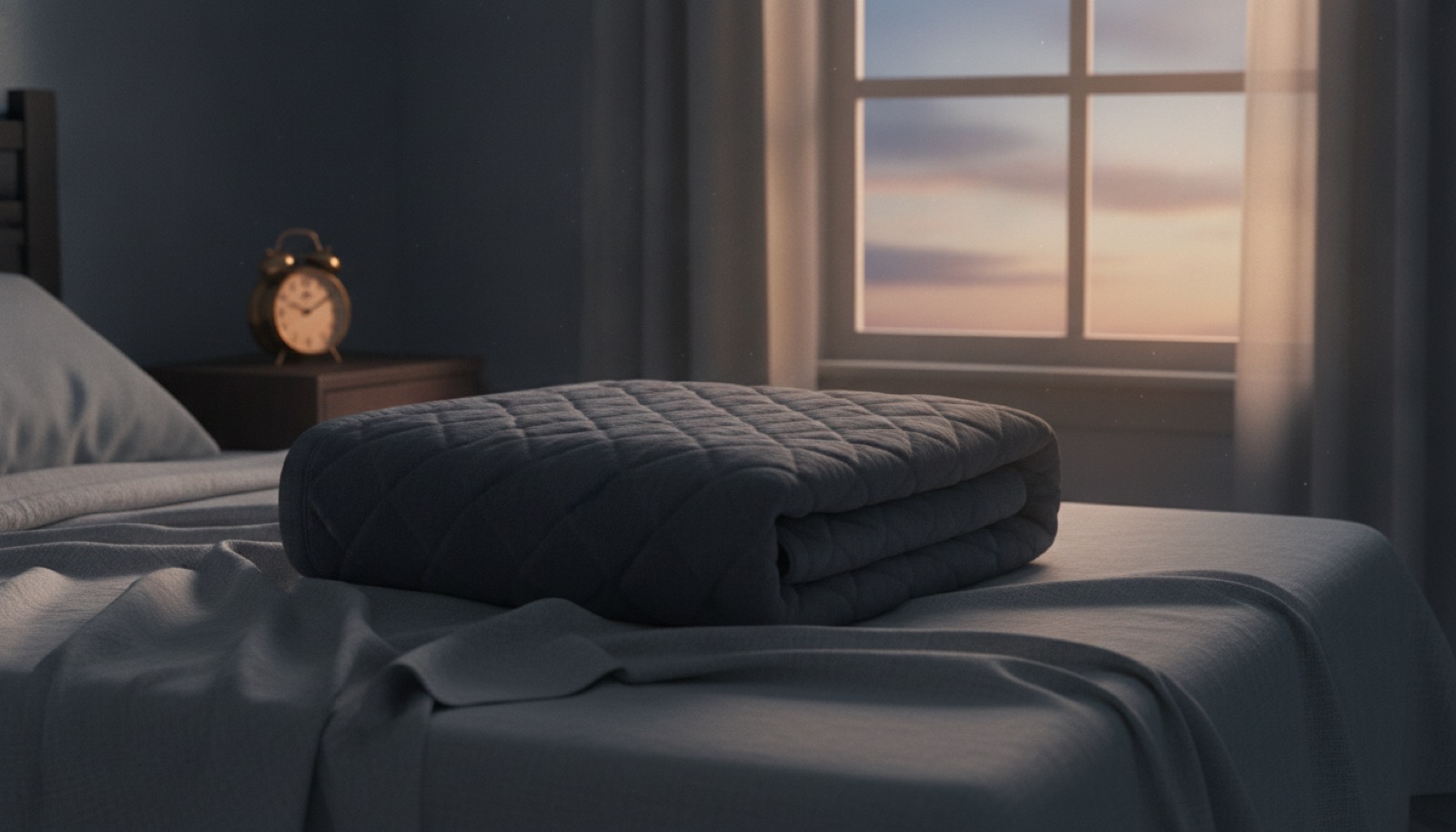
A weighted blanket is one of the few sleep tools with randomized-trial data behind it. The five blankets worth owning, the 10-percent-of-bodyweight rule, glass-bead vs plastic-pellet fill, and where the evidence stops.
Baloo Living Cotton Weighted Blanket
Weight selection is the only spec that reliably changes outcomes, and the defensible target is roughly 10 percent of body weight, the load used in the Ekholm et al. 2020 insomnia trial where an 8 kg chain blanket cut Insomnia Severity Index scores in patients with major depressive disorder. The Baloo is built around that principle: it ships in 12, 15, 20, and 25 lb versions so most adults can land near the 10-percent mark, uses food-grade glass-bead fill that sits flatter and quieter than plastic pellets, and skips the polyester minky cover that traps heat, which matters because sleep depends on a nighttime core-temperature drop. It is not the cheapest blanket here, but it is the one that lets you match the trial dose without overshooting into a load that fragments sleep.
Check price · Amazon- 01 ·Our pick
Baloo Living Cotton Weighted Blanket
Breathable quilted cotton shell, food-grade glass-bead fill, offered in 12, 15, 20, and 25 lb so you can hit ~10 percent of body weight without rounding far off. Runs cooler than fleece-covered blankets, which protects the core-temperature drop sleep needs. Machine washable without a separate duvet cover. Downside: higher price, and the cotton shell wrinkles. The blanket that most reliably delivers the trial-tested load at a sleep-friendly temperature.
Check price · Amazon - 02 ·Best known
Gravity Blanket (original)
The blanket that popularized the category, offered in 15, 20, and 25 lb with a micro-fleece duvet cover and glass-bead fill. Even weight distribution and a well-made cover. The fleece runs warm, so hot sleepers should remove the included cover or size to a lighter weight. Higher per-unit cost driven partly by brand. A solid pick if the cover aesthetics matter and you sleep cool by default.
Check price · Amazon - 03 ·Best value
YnM Weighted Blanket
The budget default. Seven-layer construction, glass-bead fill, and the widest weight range in the category, from 5 lb up to 30 lb in small increments, which makes hitting the 10-percent target easy. Cotton shell without a cover included. Quality control is more variable than premium brands and beads can migrate over years of washing, but per dollar it delivers the same physical load. Best for first-time buyers testing whether the intervention helps them at all.
Check price · Amazon - 04 ·Open-knit, cooler sleepers
Bearaby Cotton Napper
A chunky hand-knit blanket that uses layered fabric weight instead of beads or pellets, so there is no fill to migrate and no crinkle. The open knit breathes better than any bead-filled option, the strongest choice for hot sleepers. Offered in fixed weights around 10, 15, 20, and 25 lb. Trade-offs: it is the most expensive here, and the open weave means uneven point-pressure rather than the smooth distribution of a quilted blanket. Buy for temperature, not for even load.
Check price · Amazon - 05 ·Pharmacy-simple alternative
Luna Adult Weighted Blanket
OEKO-TEX certified cotton, glass-bead fill, broad weight and size range, and a lower price than the premium tier. Fewer color and cover options and a plainer build, but the material and weight logic are identical to blankets costing more. Stocked widely online. A reasonable step up from YnM in quality control without paying the Gravity or Baloo premium.
Check price · Amazon
Questions logged on this protocol
Do weighted blankets actually help you sleep?
The evidence is modest but real, and stronger for anxiety-linked insomnia than for otherwise healthy sleepers. Ekholm et al. 2020 (J Clin Sleep Med) randomized 120 patients with a psychiatric diagnosis and insomnia to an 8 kg chain blanket or a light control; the weighted group was nearly 26 times more likely to reach a substantial drop in Insomnia Severity Index over four weeks. The proposed mechanism is deep-touch pressure raising parasympathetic tone and lowering pre-sleep arousal, which shortens the time it takes to fall asleep. The effect is on sleep onset and subjective quality, not on sleep architecture stages themselves. For the mechanics of why arousal keeps you awake, see our piece on sleep onset latency.
How heavy should a weighted blanket be?
The common rule is roughly 10 percent of your body weight, which is also close to the load used in the trials that showed a benefit (the Ekholm 2020 blanket was 8 kg, about 12 percent for a 70 kg adult). For a 150 lb adult that points to a 15 lb blanket; for a 200 lb adult, 20 lb. Round to the nearest available weight rather than overshooting. Too heavy is a real failure mode: a blanket that feels trapping raises arousal instead of lowering it, and can make hot sleepers wake more. If you are between sizes, size down.
Glass beads or plastic pellets?
Glass beads. They are smaller and denser than plastic poly-pellets, so the same weight sits in a thinner, flatter, quieter layer that distributes pressure more evenly and traps less heat. Plastic pellets are cheaper but bulkier, noisier when you move, and warmer. Every blanket in this ranking except the knit Bearaby uses glass-bead fill for that reason. If a listing does not state the fill type, assume pellets and treat it as a budget compromise.
Will a weighted blanket make me too hot?
It can, and that matters because sleep depends on your core temperature falling by roughly 0.5 to 1 C at night; anything that blocks that drop tends to fragment sleep. The heat problem is mostly the cover, not the weight: fleece and minky shells trap heat, while quilted cotton shells and open-knit blankets breathe. Hot sleepers should choose the Bearaby knit or a cotton-shell blanket like the Baloo, keep the bedroom near 18 C, and remove any included fleece duvet cover in summer. If you consistently wake sweating, the blanket is working against you.
Who should not use a weighted blanket?
Do not use them with infants or toddlers, who cannot reliably push the weight off, and be cautious with anyone who has obstructive sleep apnea, chronic respiratory disease, low blood pressure, or claustrophobia. If breathing already feels effortful lying down, added chest load is the wrong intervention. This is general information, not medical advice; if you have a diagnosed sleep-breathing condition, ask your clinician first. For breathing-related sleep symptoms, start with our overview of sleep apnea symptoms rather than a blanket.
Is a weighted blanket better than melatonin or magnesium?
They act on different problems, so it is not a straight contest. A weighted blanket lowers pre-sleep physiological arousal through deep-touch pressure; low-dose melatonin shifts the timing of the circadian clock; magnesium glycinate supports GABA-A signaling. If your issue is a racing, wired feeling at lights-out, the blanket is the most direct lever. If your problem is a mistimed clock, see melatonin dosing. If it is general sleep-onset support, compare with our best magnesium for sleep guide. Many people who sleep poorly stack the blanket with one supplement rather than choosing.
- [01]
- [02]
- [03]
- [04]
Other stacks in this hub
The Best Time to Exercise for Sleep: Why Evening Workouts Are Mostly Fine
Regular exercise is one of the most reliable ways to sleep better, and the old warning to avoid evening workouts has largely not held up. What the research says about how exercise improves sleep, whether the time of day matters, and the one narrow exception, vigorous exercise finished right before bed, that can genuinely delay sleep onset.
How Long Does Melatonin Last? Onset, Duration, and Why Timing Beats Dose
Melatonin does not work like a sleeping pill, and its short pharmacokinetics explain why. What the research says about how fast it kicks in, how long it stays in your system, why a big dose does not last longer in a useful way, and why when you take it matters far more than how much.
The Best Sleeping Position: What the Evidence Says and Why It Depends on You
There is no single best position for everyone, but the evidence does favor some positions for specific problems. What the research says about side, back, and stomach sleeping for snoring and apnea, reflux, back and neck pain, and pregnancy, and why comfort and the position you actually stay in matter more than chasing an ideal you cannot hold.