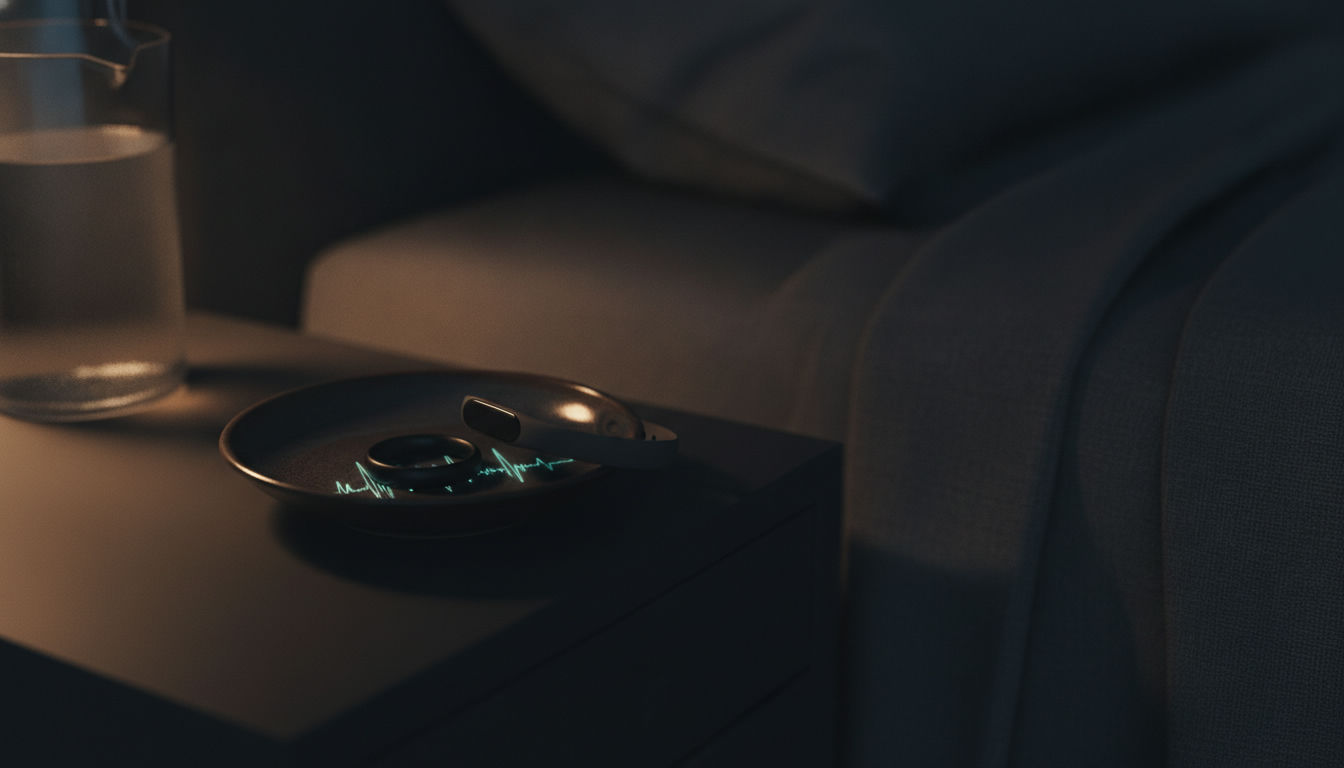
Sleep trackers ranked by how well they actually agree with polysomnography, not by app polish. Total-sleep-time accuracy, where stage estimates break down, and the ring, watch, and under-mattress picks worth buying.
Oura Ring 4
The ring form factor reads the finger's arterial pulse and skin temperature more stably than a wrist band, and Oura is the most-validated consumer tracker in the peer-reviewed literature. de Zambotti et al. 2019 (Sleep Health) found earlier Oura generations tracked total sleep time and wake within tens of minutes of polysomnography, with the usual caveat that stage staging is weaker than the app implies. It is the tracker whose numbers we trust most for the metric that matters, how much you slept and when.
Check price · Amazon- 01 ·Our pick
Oura Ring 4
Finger ring measuring pulse, HRV, respiratory rate, movement, and skin temperature. The most peer-reviewed consumer tracker: de Zambotti et al. 2019 found strong total-sleep-time and wake agreement with polysomnography. Strong for timing, chronotype trend, and temperature-based cycle tracking. Downsides: a subscription for full metrics, and REM/deep splits are estimates, not EEG.
Check price · Amazon - 02 ·Best for recovery
Whoop 5.0
Screenless wrist/bicep strap built around recovery, strain, and HRV rather than a clock. Good sleep/wake detection and a strong sleep-need model that accounts for prior sleep debt. Subscription-only, no display. Best for training-focused readers who want recovery framing over raw stage numbers.
Check price · Amazon - 03 ·Best all-rounder
Apple Watch Series 10
watchOS estimates stages from accelerometer plus heart rate and now flags possible sleep apnea via breathing-disturbance trends (an FDA-cleared feature). Accurate for sleep/wake; stage detail is moderate. Best if you already live in the Apple ecosystem and want one device for everything. Battery means you charge before bed or before the day.
Check price · Amazon - 04 ·Best non-wearable
Withings Sleep Analyzer
A pad that slips under the mattress and tracks sleep, heart rate, snoring, and breathing disturbances with nothing on your body. CE-marked for detecting breathing-disturbance patterns. Best for people who hate wearing anything to bed or want passive snore and apnea-risk screening. It tracks the bed, so it can be fooled by a restless partner.
Check price · Amazon - 05 ·Best battery and athletes
Garmin Venu 3
Multi-day battery so it survives overnight wear without a charging gap, plus a detailed Sleep Score and Body Battery recovery metric. Sleep/wake detection is solid; stage estimates are typical actigraphy-plus-heart-rate quality. Best for endurance athletes and anyone who resents nightly charging.
Check price · Amazon - 06 ·Best for temperature
Eight Sleep Pod 4
A mattress cover that both tracks sleep and actively heats or cools each side of the bed across the night, using temperature as a lever on sleep quality. Tracking is contact-free and it targets the cool-room principle directly. Expensive, subscription-based, and it measures the bed rather than the body.
Check price · Amazon - 07 ·Best budget wearable
Fitbit Charge 6
Inexpensive band with a long-running Sleep Score, stages, and an optional Daily Readiness metric. Reliable for sleep/wake and trends over time. Some deeper analytics sit behind Fitbit Premium. Best entry point for readers who want nightly data without a ring price or a subscription-only device.
Check price · Amazon - 08 ·Best for Android
Google Pixel Watch 3
Fitbit's sleep engine on a full Wear OS smartwatch, with a Sleep Score, stages, and readiness. Comparable tracking quality to the Charge band in a watch body. Best for Android users who want the Fitbit metrics plus smartwatch features. Same overnight-charging trade-off as other bright-screen watches.
Check price · Amazon - 09 ·Budget ring alt
Amazfit Helio Ring
A lower-cost smart ring offering sleep stages, HRV, and readiness without Oura's subscription. Fewer independent validation studies, but a reasonable option for readers who want the no-subscription ring form factor. Treat the stage splits with the same caution as any consumer device.
Check price · Amazon - 10 ·Closest to EEG
Muse S
A headband with actual EEG sensors, the same signal class polysomnography uses to score stages, plus meditation and sleep-onset features. In principle the most physiologically direct stage read on this list, but it is a headband you must wear and charge, aimed at people who genuinely want brain-signal data rather than a passive nightly score.
Check price · Amazon
Questions logged on this protocol
How accurate are sleep trackers, really?
Good at telling sleep from wake, weaker at scoring stages. Consumer trackers infer sleep from movement, heart rate, and heart-rate variability, then estimate light, deep, and REM from patterns in those signals. Validation studies (Chinoy et al. 2021, Sleep, tested seven consumer devices against in-lab polysomnography) generally find high sensitivity for detecting sleep and good total-sleep-time agreement, but noticeably lower accuracy for classifying individual stages, since none of these devices measure brain waves. Use the total sleep time and timing with confidence, and treat the deep and REM percentages as rough trends rather than precise readings.
Which sleep tracker is the most accurate?
In the peer-reviewed literature, Oura has the strongest validation record for a consumer device. de Zambotti et al. 2019 (Sleep Health) found it estimated total sleep time and wake within tens of minutes of polysomnography, and later generations added sensors. That said, accuracy is metric-specific: most modern trackers, including Apple Watch, Fitbit, Garmin, and Whoop, are strong for sleep versus wake and total sleep time, and all of them are limited on stage staging because they infer stages rather than read EEG. If you want the closest thing to lab staging, the Muse S headband uses actual EEG sensors.
Do I need a ring, a watch, or an under-mattress tracker?
It depends on what you will actually wear. A ring like Oura reads a clean pulse signal from the finger and is unobtrusive overnight, which is why it tends to validate well. A watch does more during the day and adds features like apnea screening, but a bright-screen model usually needs charging around your sleep window. An under-mattress pad such as the Withings Sleep Analyzer puts nothing on your body and is ideal if you dislike wearing anything to bed, at the cost of tracking the bed rather than you. Pick the form factor you will keep using every night, because consistency is what makes the trends meaningful.
Can a sleep tracker detect sleep apnea?
Some now screen for signs of it, but none diagnose it. The Apple Watch has an FDA-cleared feature that flags breathing-disturbance patterns over time, and the Withings Sleep Analyzer is CE-marked to detect breathing-disturbance patterns and snoring. These are screening signals that can prompt you to seek testing, not replacements for a diagnostic sleep study. If your tracker repeatedly flags disturbed breathing, or you have loud snoring, gasping, or daytime sleepiness, that points to the pattern described in our sleep apnea symptoms guide and is worth a clinical evaluation.
Will chasing my deep sleep score make me sleep worse?
It can, and there is a name for it: orthosomnia, the anxiety-driven pursuit of perfect tracker numbers that ends up harming sleep. Because the stage percentages are estimates, fixating on a low deep-sleep reading can create bedtime worry that genuinely delays sleep onset, the opposite of the goal. The productive use of a tracker is the multi-week trend, not the single-night stage split. If you want to actually raise slow-wave sleep, the levers are behavioral and covered in our guide on how to get more deep sleep, not in refreshing the app at 2am.
What should I actually look at in the data?
Prioritize the metrics the devices measure well. Total sleep time, sleep timing (when you fall asleep and wake), and wake after sleep onset are reliable and directly actionable, and they map onto the architecture explained in our sleep stages overview. Resting heart rate and HRV trends are useful recovery signals. Treat the deep and REM percentages as directional. The single most valuable output is your habitual sleep window over weeks, because a consistent wake time is the anchor that stabilizes the circadian clock, and a tracker is excellent at showing whether you are holding it.
- [01]
- [02]
- [03]
- [04]
Other stacks in this hub
The Best Time to Exercise for Sleep: Why Evening Workouts Are Mostly Fine
Regular exercise is one of the most reliable ways to sleep better, and the old warning to avoid evening workouts has largely not held up. What the research says about how exercise improves sleep, whether the time of day matters, and the one narrow exception, vigorous exercise finished right before bed, that can genuinely delay sleep onset.
How Long Does Melatonin Last? Onset, Duration, and Why Timing Beats Dose
Melatonin does not work like a sleeping pill, and its short pharmacokinetics explain why. What the research says about how fast it kicks in, how long it stays in your system, why a big dose does not last longer in a useful way, and why when you take it matters far more than how much.
The Best Sleeping Position: What the Evidence Says and Why It Depends on You
There is no single best position for everyone, but the evidence does favor some positions for specific problems. What the research says about side, back, and stomach sleeping for snoring and apnea, reflux, back and neck pain, and pregnancy, and why comfort and the position you actually stay in matter more than chasing an ideal you cannot hold.