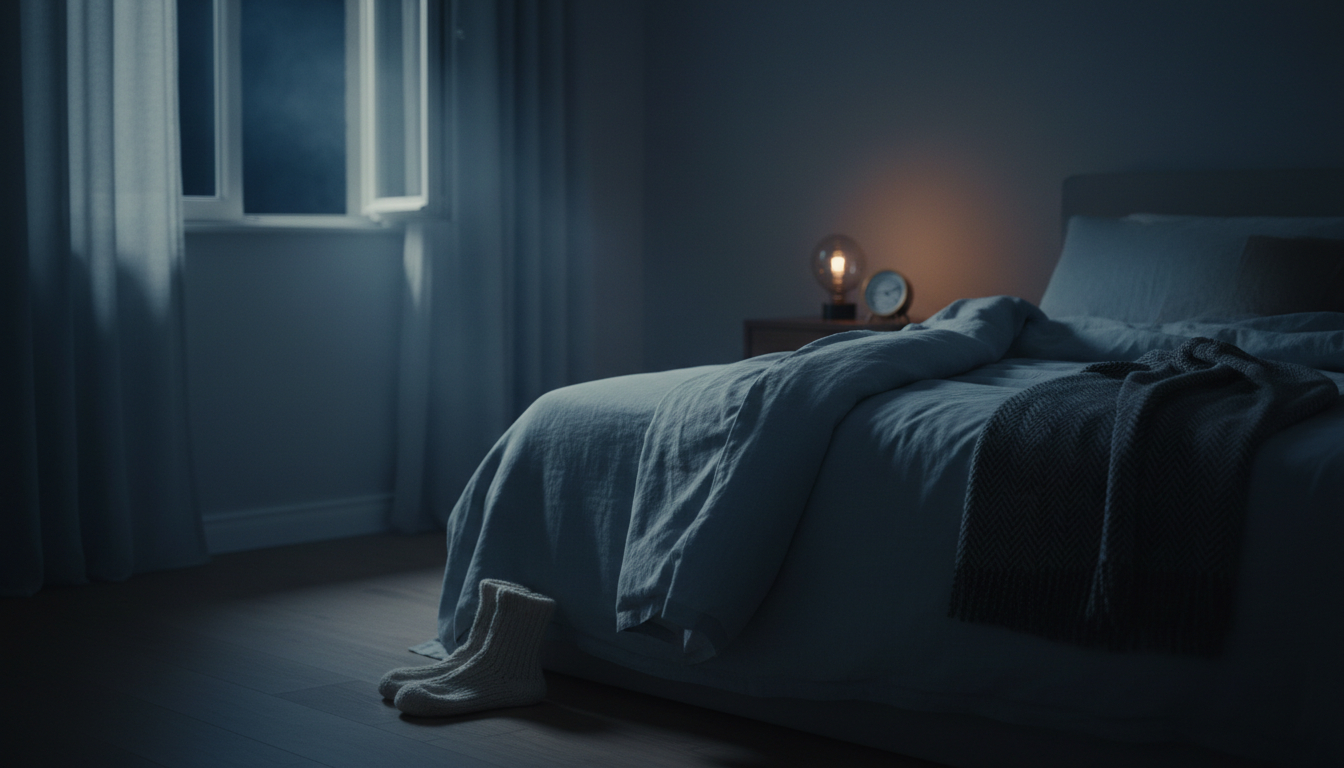
The body drops its core temperature to fall asleep, so a too-warm bedroom blocks the very signal sleep depends on. The ideal room temperature (around 18-19 C / 65-67 F), why warm feet help you fall asleep faster, the warm-bath effect 1-2 hours before bed, and what heat does to deep sleep and REM.
Sleep onset rides a falling core body temperature
Your core body temperature is not flat; it follows a circadian rhythm that peaks in the early evening and falls through the night to a minimum in the early hours, usually around 4-5am. That evening decline is not incidental to sleep, it is part of the trigger: the drop in core temperature is one of the physiological signals that opens the sleep gate, and it correlates tightly with the evening rise in melatonin. Kraeuchi and colleagues (Kraeuchi et al. 2000, Am J Physiol) showed that the rate at which the body sheds heat in the evening predicts how quickly a person falls asleep. The practical consequence is that anything which blocks the core from cooling, chiefly a too-warm room or too much insulation, works against sleep onset, while helping the body offload heat works with it. Temperature is a lever on sleep for the same reason light is: it is a signal the circadian system reads.
The ideal bedroom temperature is cooler than most people keep it
The commonly cited target for the bedroom is around 18-19 C (65-67 F), cooler than the daytime comfort setting most homes run. The logic is thermoregulatory: a cooler ambient temperature lets the body offload heat and complete the core-temperature drop that sleep onset depends on, whereas a warm room forces the body to keep fighting to cool itself. The exact best number varies with bedding, clothing, and individual physiology, so treat 18-19 C as a starting point rather than a law, and adjust by how you actually sleep. What is consistent across the research is the direction: within a sensible range, slightly cool beats warm, and the cost of a too-warm room is measurable in disrupted sleep rather than just discomfort.
The warm-feet paradox: why cool room plus warm extremities works
It sounds contradictory to want a cool room but warm feet, yet both serve the same goal. The body dumps heat through the skin of the hands and feet, and it can only do that when the distal blood vessels dilate. Kraeuchi et al. 1999 (Nature) found that the degree of vasodilation in the feet and hands was the best physiological predictor of how fast people fell asleep, and titled the finding accordingly: warm feet promote the rapid onset of sleep. Cold feet signal constricted vessels, which trap heat in the core and delay the temperature drop. So warming the extremities, with socks or a warm foot area, actually accelerates core cooling by opening the radiators, while the cool room gives that heat somewhere to go. This is why people with persistently cold feet often struggle to fall asleep, and why a bed sock can help more than turning up the thermostat.
The warm-bath effect: heat you 1-2 hours before bed
A warm bath or shower before bed is one of the better-evidenced temperature interventions, and the timing is the whole point. A meta-analysis of passive body heating (Haghayegh et al. 2019, Sleep Med Rev) found that a warm bath or shower at roughly 40-42.5 C, taken about 1-2 hours before bedtime, shortened sleep-onset latency by an average of around 10 minutes and improved self-rated sleep quality. The mechanism is counterintuitive but consistent with the cooling story: warming the skin drives blood to the surface and boosts heat loss, so once you get out, core temperature drops faster and further than it otherwise would, steepening exactly the decline that triggers sleep. The 1-2 hour gap matters because a bath taken right before bed leaves core temperature still elevated at lights-out, which works against onset. Warm early, cool at bedtime.
Why a too-warm room wrecks deep sleep and REM
Heat does not only delay falling asleep, it degrades the sleep you do get. The review by Okamoto-Mizuno & Mizuno (2012, J Physiol Anthropol) summarizes decades of thermal-environment research: heat exposure during sleep increases wakefulness and reduces both slow-wave (deep) sleep and REM sleep, and high humidity makes the effect worse by blocking evaporative cooling. Cold exposure is less disruptive to sleep stages than heat but still increases arousals if it is severe. REM sleep is particularly temperature-sensitive because the body largely suspends its own thermoregulation during REM, leaving you at the mercy of the room. This is why a hot summer night fragments sleep even when you eventually drop off, and why cooling the room protects the architecture of the night, not just the speed of falling asleep. If you wake in the early hours feeling too warm, the room temperature is a prime suspect alongside the usual causes.
Setting it up, and when temperature is the wrong lever
In practice: aim the room at 18-19 C, use breathable bedding you can layer rather than one hot duvet, keep feet warm, and put the warm bath 1-2 hours before bed rather than just before it. If you share a bed with someone who runs hotter or colder, separate blankets solve more arguments than a compromise thermostat. Temperature is a genuine lever, but it is not the only cause of a broken night: if you wake reliably at the same early hour regardless of the room, the pattern is worth reading about in the guide to why you wake at 3am, and if hot flashes are driving the heat, the perimenopause sleep guide covers that specifically. Temperature is a high-yield, low-effort adjustment that too few people make, but it works best stacked with light timing and a consistent wake time rather than on its own. This article is educational and not medical advice.
Questions logged on this protocol
What is the best temperature for sleep?
The commonly cited target is around 18-19 C (65-67 F), a little cooler than most daytime settings. The reason is physiological: the body has to drop its core temperature to fall asleep, and a cool room lets it offload heat and complete that drop, while a warm room fights it. The exact best number depends on your bedding, clothing, and physiology, so use 18-19 C as a starting point and adjust by how you sleep. The reliable rule is direction, not a precise figure: within a sensible range, slightly cool beats warm.
Why do I sleep better in a cool room?
Because sleep onset is triggered partly by a fall in core body temperature, and a cool room helps that fall happen. Your core temperature naturally declines in the evening toward an early-morning minimum, and the speed of that heat loss predicts how fast you fall asleep (Kraeuchi et al. 2000). A cool room gives your body somewhere to dump heat; a warm room traps it and keeps the core elevated, delaying onset and, over the night, reducing deep and REM sleep. So the cool-room preference is not just comfort, it is your thermoregulation working with the sleep signal.
Should I wear socks to bed?
For many people, yes. The body sheds heat through the hands and feet, and it can only do so when those blood vessels are dilated. Kraeuchi et al. 1999 found that warm, vasodilated feet were the best predictor of falling asleep quickly, which is why the finding was titled warm feet promote the rapid onset of sleep. Cold feet mean constricted vessels that trap heat in the core and delay the temperature drop, so warming the feet with socks can actually speed core cooling. Keep the room cool and the feet warm; the two work together rather than against each other.
Does a warm bath before bed help you sleep?
Yes, if you time it right. A meta-analysis of passive body heating (Haghayegh et al. 2019) found that a warm bath or shower at about 40-42.5 C, taken roughly 1-2 hours before bed, shortened the time to fall asleep by around 10 minutes and improved sleep quality. Warming the skin boosts heat loss, so afterward the core temperature drops faster and further, steepening the decline that triggers sleep. The 1-2 hour gap is important: a bath right before bed leaves core temperature still high at lights-out, which works against you. Warm early, then cool down.
Can a room being too hot ruin your sleep?
Yes, and not just by delaying onset. The review by Okamoto-Mizuno & Mizuno (2012) found that heat exposure during sleep increases wakefulness and reduces both slow-wave (deep) sleep and REM, with high humidity making it worse by blocking evaporative cooling. REM is especially vulnerable because the body suspends much of its own thermoregulation during it. That is why a hot, humid night fragments sleep even after you fall asleep, and why cooling the room protects the quality of the night, not only how quickly you drop off.
- [01]
- [02]
- [03]
- [04]
Other stacks in this hub
How to Improve REM Sleep: What Actually Raises It and What Just Wrecks It
You cannot force REM sleep directly, but several everyday habits quietly suppress it, and removing them is how you get more. What the research says about when REM happens across the night, why alcohol and short sleep cut it most, and why the single biggest lever is simply giving yourself enough time asleep in the early morning hours.
Is 7 Hours of Sleep Enough? What the Evidence Actually Says
Seven hours is the number most sleep authorities put at the bottom of the healthy adult range, which makes it enough for many people and too little for some. What the large studies and the official recommendations say about the 7-hour mark, why sleep need varies between people, and the honest signs that tell you whether your own 7 hours is sufficient or short.
How Much Sleep Do Women Need? Separating the Evidence From the Myth
A popular claim says women need more sleep than men. The recommended ranges are actually the same for both, but there are real, evidence-based reasons a woman's sleep can differ across the menstrual cycle, pregnancy, and menopause. What the guidelines say, what the sex-difference research does and does not show, and how life stage changes the picture.