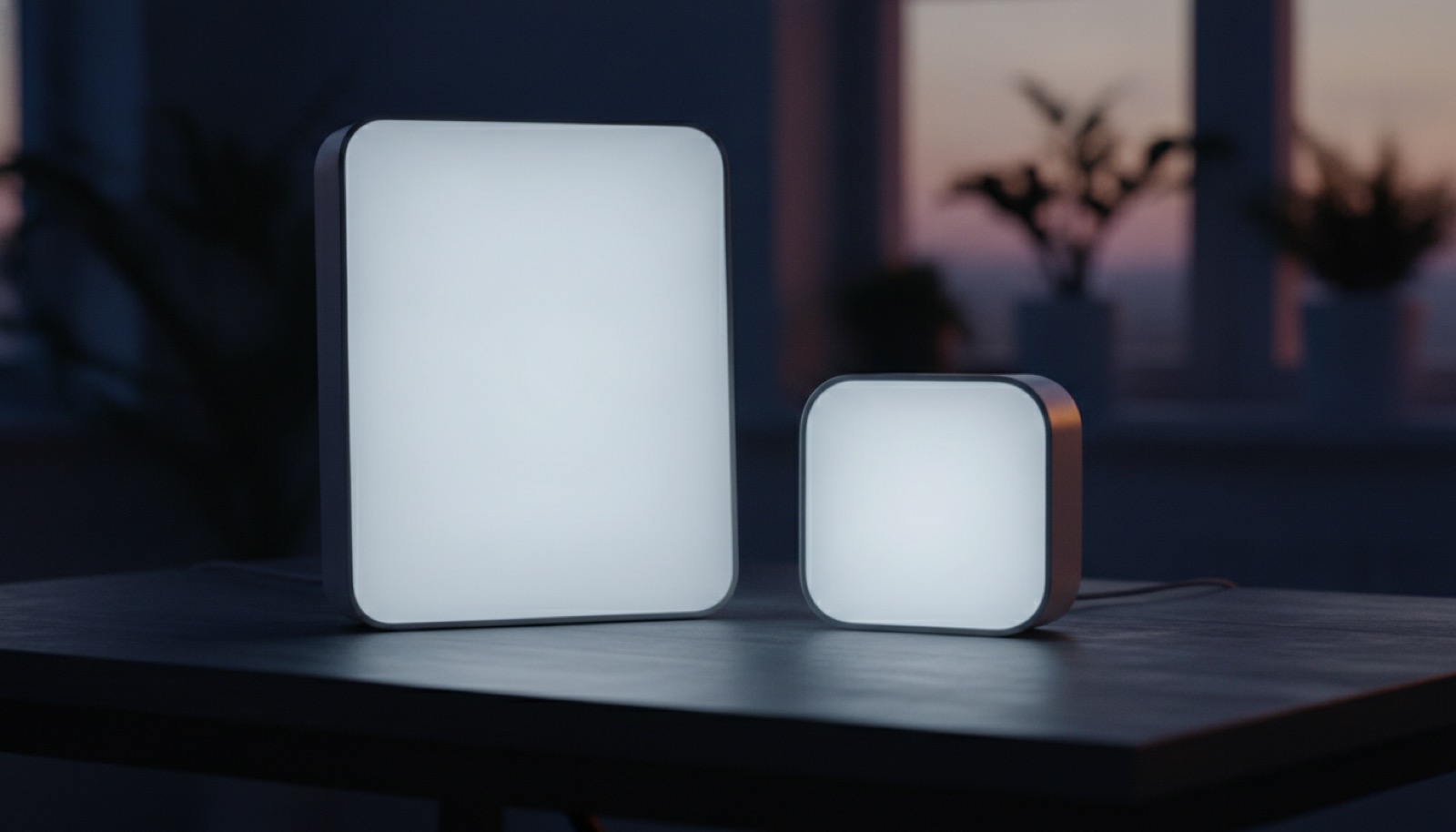
A head-to-head on the two most-cross-shopped light therapy lamps, judged on the one metric that matters: measured lux at the distance you actually sit. Panel size, dose at 12-24 inches, UV filtering, and who each is for.
Carex Day-Light Classic Plus
The Carex holds ~10,000 lux at a usable ~20-inch distance thanks to its large 15.5 x 12 inch diffuser and downward-angled geometry, which is the dose and distance used in the Terman SAD trials (Terman & Terman 2005). The Verilux HappyLight delivers 10,000 lux only at ~6 inches; double that distance and illuminance falls to roughly a quarter by the inverse-square law. The Verilux wins on price, footprint, and portability, so it is the better pick if you will genuinely sit close to it, but for guaranteed clinical dose at an ergonomic distance the Carex is the safer choice.
Check price · Carex- 01 ·Our pick
Carex Day-Light Classic Plus
Large 15.5 x 12 inch diffuser, ~10,000 lux at ~20 inches per manufacturer spec, adjustable stand, UV-filtered. The clinical-trial reference lamp: it delivers the dose at a distance people actually work at. Downside: desk-dominating footprint and a higher price than the Verilux.
Check price · Carex - 02 ·Best value
Verilux HappyLight Luxe
Compact 7.25 x 10 inch panel, claimed 10,000 lux at ~6 inches, with a built-in timer and adjustable color temperature. Cheaper, lighter, and travel-friendly, but it only delivers the therapeutic dose if you sit close; at a comfortable 18-24 inches it drops well below 10,000 lux. Best for readers who will commit to sitting 8-12 inches away.
Check price · Amazon
Questions logged on this protocol
Verilux or Carex: which is better for SAD?
For seasonal affective disorder the target is the clinical protocol, 10,000 lux for 30 minutes within an hour of waking (Terman & Terman 2005, CNS Spectrums). The Carex Day-Light Classic Plus reaches that at a usable ~20-inch distance because of its large diffuser, so it delivers the trial dose at the distance you would actually sit. The Verilux HappyLight reaches 10,000 lux only at ~6 inches, so it can match the dose only if you sit very close. Both are legitimate SAD lamps; the Carex is the lower-effort way to hit the dose reliably. The underlying dose logic is covered in our light therapy for SAD explainer.
Why does the Carex cost more?
You are paying for diffuser area and geometry, not brand. The Carex uses a 15.5 x 12 inch panel angled downward, which spreads 10,000 lux across a larger field and holds that intensity out to roughly 20 inches. The Verilux Luxe is a compact 7.25 x 10 inch panel that concentrates its output at close range. Because illuminance falls with the inverse square of distance, a larger panel that stays bright at arm's length is genuinely harder to build, which is what the price reflects.
Does the Verilux HappyLight actually give 10,000 lux?
Yes, but only at its rated close distance of about 6 inches. Move to 12 inches and the inverse-square falloff drops it to roughly 2,500 lux; at 18 inches you are near 1,100 lux, which is ambient-bright rather than therapeutic. The rating is honest, but the distance it is measured at is closer than most people sit. If you use a HappyLight, position it within 8-12 inches and slightly above eye level to receive the intended dose.
Do both lamps filter UV?
Yes. Both the Carex Day-Light Classic Plus and the Verilux HappyLight line filter UV-A and UV-B, so residual ultraviolet emission is negligible and below workplace thresholds. Neither is a tanning device; UV is a filtered-out byproduct here, not the active ingredient. The active ingredient is visible short-wavelength-rich white light, which drives the melanopsin signaling behind circadian phase-shifting (Lockley et al. 2003).
Which should I buy if desk space is tight?
The Verilux HappyLight Luxe, with the caveat that you must sit close. Its 7.25 x 10 inch footprint suits a crowded desk and it packs for travel, whereas the Carex dominates a desk. The trade-off is that the compact panel only delivers full dose at ~6-8 inches, so commit to sitting close and angling it toward your lower visual field. If you cannot sit that close, the extra footprint of the Carex is buying you a usable dose at a realistic distance. Either way, see our full ranking in best light therapy lamps 2026.
How long until either lamp works?
Alertness shifts can be same-day, but circadian phase-shift and mood effects are cumulative over 1-2 weeks of consistent morning use at 10,000 lux for 30 minutes (Golden et al. 2005, Am J Psychiatry). The lamp only matters insofar as it delivers that dose, which is why distance is the deciding spec between these two. Use whichever you own every morning within an hour of waking, at the distance that actually gives 10,000 lux, and reassess after 2-3 weeks before blaming the hardware.
- [01]
- [02]
- [03]
- [04]
Other stacks in this hub
Cortisol and Sleep: The Morning Hormone That Times Your Wake
Cortisol is not only a stress hormone; it follows a strong daily rhythm that peaks in the early morning to drive waking and falls to its low at night to allow sleep. What the research says about the cortisol awakening response, how stress and disrupted sleep push the rhythm out of shape, and why fixing the rhythm matters more than chasing a single cortisol number.
Eating Before Bed and Sleep: What a Late Meal Does to Your Night
A late meal is not automatically bad for sleep, but eating large, heavy, or the wrong foods close to bedtime reliably disturbs it, and meal timing is also a signal to your body clock. What the research says about reflux, blood sugar, and circadian meal timing, and how to eat in the evening without wrecking your night.
What Happens When Your Circadian Rhythm Is Disrupted
Your body clock does far more than control sleep; it schedules hormones, metabolism, temperature, and alertness across the day. When behavior falls out of step with the clock, through shift work, jet lag, social jet lag, or erratic light, the misalignment shows up as poor sleep, daytime dysfunction, and, over the long run, metabolic and mood consequences. What the research says, and how the clock realigns.