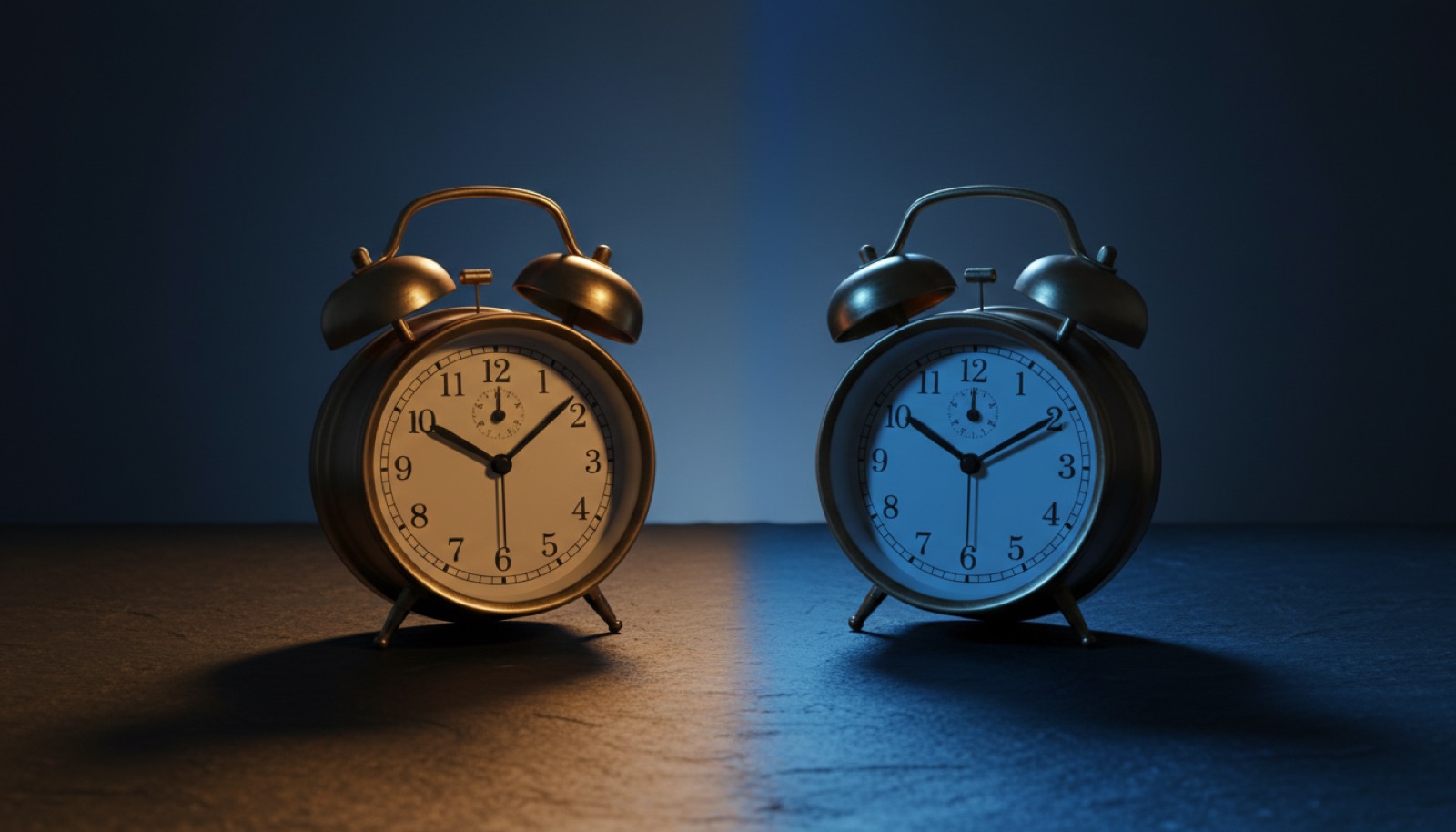
Social jet lag is the mismatch between the sleep timing your body clock wants and the timing your schedule imposes, measured as the shift between work-day and free-day sleep midpoints. What it is, how the MCTQ quantifies it, why late types carry the most, its links to health markers, and how to shrink it.
What social jet lag actually is
Social jet lag is the mismatch between your biological clock and your social schedule, and the term is meant literally: living on a weekday alarm while your clock wants a later timing is like flying across time zones every week without leaving home. Roenneberg and colleagues coined it (Wittmann et al. 2006, Chronobiol Int) to name the routine gap most people run, not a rare disorder. On work days an alarm cuts sleep short and forces an early wake; on free days you sleep at your clock's preferred timing and later. That difference is the jet lag, produced not by travel but by a schedule that does not match your chronotype. For the underlying trait see the chronotype field guide.
How it is measured: the MCTQ midpoint shift
Social jet lag has a precise definition, which is what makes it useful. Using the Munich ChronoType Questionnaire (Roenneberg et al. 2003, J Biol Rhythms), you take the midpoint of sleep on work days and the midpoint on free days, and social jet lag is the absolute difference between the two in hours. If you sleep 00:00 to 06:00 on work days (midpoint 03:00) but 01:30 to 09:30 on free days (midpoint 05:30), your social jet lag is 2.5 hours. It is distinct from plain sleep debt, the missing hours; social jet lag is specifically the shift in timing, the phase difference, and the two often travel together but are not the same number.
Why late types carry the most
Social jet lag is not evenly shared. School and work run on early schedules, so early types (larks) are already close to the timing their day demands and accumulate little mismatch. Late types (owls) want to sleep and wake later than the schedule allows, so the alarm pulls them out of bed against their clock every work day, and they rebound later on free days. Roenneberg's population data show social jet lag rises steadily toward the late end of the chronotype scale (Roenneberg et al. 2012, Curr Biol). This is why the same 07:00 alarm is trivial for a lark and punishing for an owl, and why the burden of an early-scheduled world falls disproportionately on evening types.
What it is associated with
Social jet lag correlates with a cluster of poorer health markers in population data. Higher social jet lag has been associated with higher BMI and obesity risk (Roenneberg et al. 2012), with more smoking and higher caffeine and alcohol use (Wittmann et al. 2006), and in later work with adverse metabolic and mood markers. The proposed mechanism is chronic circadian misalignment: eating, activity, and sleep repeatedly out of phase with the body's internal timing, which strains metabolic regulation. Most social-jet-lag health findings are observational associations rather than demonstrated causation, and effect sizes vary across cohorts. The honest framing is that social jet lag is a marker of living against your clock, and reducing it is a plausible lever rather than a proven cure.
How to shrink the gap
The durable fix is to move your clock and your schedule closer together from both ends. Advance the clock with light: bright light within an hour of a fixed wake time and dim evenings pull a late type earlier by roughly one to two hours over one to two weeks, and low-dose melatonin timed to the early evening can help (Burgess et al. 2010, J Physiol); the full method is in how to reset your circadian rhythm. From the schedule side, keep your wake time close to constant across work days and free days rather than sleeping in for hours on the weekend, since the weekend catch-up is what widens the midpoint gap. A consistent wake time seven days a week is the single most effective move, even if it means a shorter lie-in on Saturday.
When the mismatch is structural, not behavioral
Sometimes the gap is too large to close with light hygiene alone, and the realistic answer is to change the schedule rather than keep fighting the clock. A strong owl on an early shift may be able to advance by an hour or two but not the three or four hours the job demands, and forcing the rest through willpower simply produces chronic sleep loss. Where possible, negotiate a later start, shift work timing, or arrange light exposure to match. If a very late timing persists despite consistent effort and causes real daytime impairment, it may be delayed sleep-wake phase disorder rather than ordinary social jet lag, which is worth an evaluation; see the guide on late chronotypes for where that line sits. The first step, either way, is measuring your own gap, so take the chronotype quiz to get your work-day and free-day midpoints.
Questions logged on this protocol
What is social jet lag?
Social jet lag is the mismatch between the sleep timing your body clock prefers and the timing your schedule imposes, coined by Roenneberg's group (Wittmann et al. 2006). It is measured as the difference between the midpoint of your sleep on work days and on free days: if you wake early by alarm on work days but sleep and wake much later on weekends, that shift is your social jet lag. The name is literal, since living on a weekday alarm against a later clock resembles flying across time zones every week without traveling.
How is social jet lag calculated?
Take the midpoint of your sleep on work days and the midpoint on free days, and social jet lag is the absolute difference in hours (from the Munich ChronoType Questionnaire, Roenneberg et al. 2003). For example, a work-day midpoint of 03:00 and a free-day midpoint of 05:30 is 2.5 hours of social jet lag. It is distinct from sleep debt, which is the missing hours of sleep; social jet lag is specifically the shift in timing. The CircadianStack chronotype quiz returns both midpoints so you can see your own gap.
Why do night owls have more social jet lag?
Because school and work run on early schedules that already suit larks. Early types wake near the timing their day demands and accumulate little mismatch, while late types want to sleep and wake later than allowed, get pulled out of bed by the alarm against their clock on work days, and rebound later on free days. Roenneberg's population data show social jet lag rises toward the late end of the chronotype scale (Roenneberg et al. 2012). The same early alarm is trivial for a lark and punishing for an owl.
Is social jet lag bad for your health?
It is associated with poorer health markers in population studies: higher BMI, more smoking, and higher caffeine and alcohol use (Wittmann et al. 2006; Roenneberg et al. 2012), with the proposed mechanism being chronic circadian misalignment. These are mostly observational associations rather than proven causation, and effect sizes vary across cohorts. The reasonable reading is that social jet lag is a marker of living against your clock, so reducing it is a sensible lever for alignment rather than a guaranteed health fix.
How do I reduce social jet lag?
Move your clock and your schedule closer together. Advance the clock with bright light within an hour of a fixed wake time plus dim evenings, which pulls a late type earlier by roughly one to two hours over a week or two, and consider low-dose melatonin timed to the early evening (Burgess et al. 2010); see how to reset your circadian rhythm for the full method. From the schedule side, keep your wake time close to constant across work days and free days rather than sleeping in for hours on weekends, since the weekend catch-up is what widens the gap. A consistent wake time seven days a week is the most effective single move.
- [01]
- [02]
- [03]
- [04]
Other stacks in this hub
Chronotype Quiz: MCTQ
19-question MCTQ-short quiz scored client-side. Output: your chronotype + a personalized 7-day Protocol card PDF.
What a Late Chronotype Actually Is
Beyond 'night owl': the MCTQ definition, the genetics, and why a late chronotype is not laziness.
Chronotype: A Field Guide to Your Body Clock Type
Chronotype is your clock's preferred timing, measured by the MEQ and MCTQ, distributed on a continuum from early lark to late owl. What it is, what sets it, how it changes with age, and why it matters for sleep, mood, and performance.