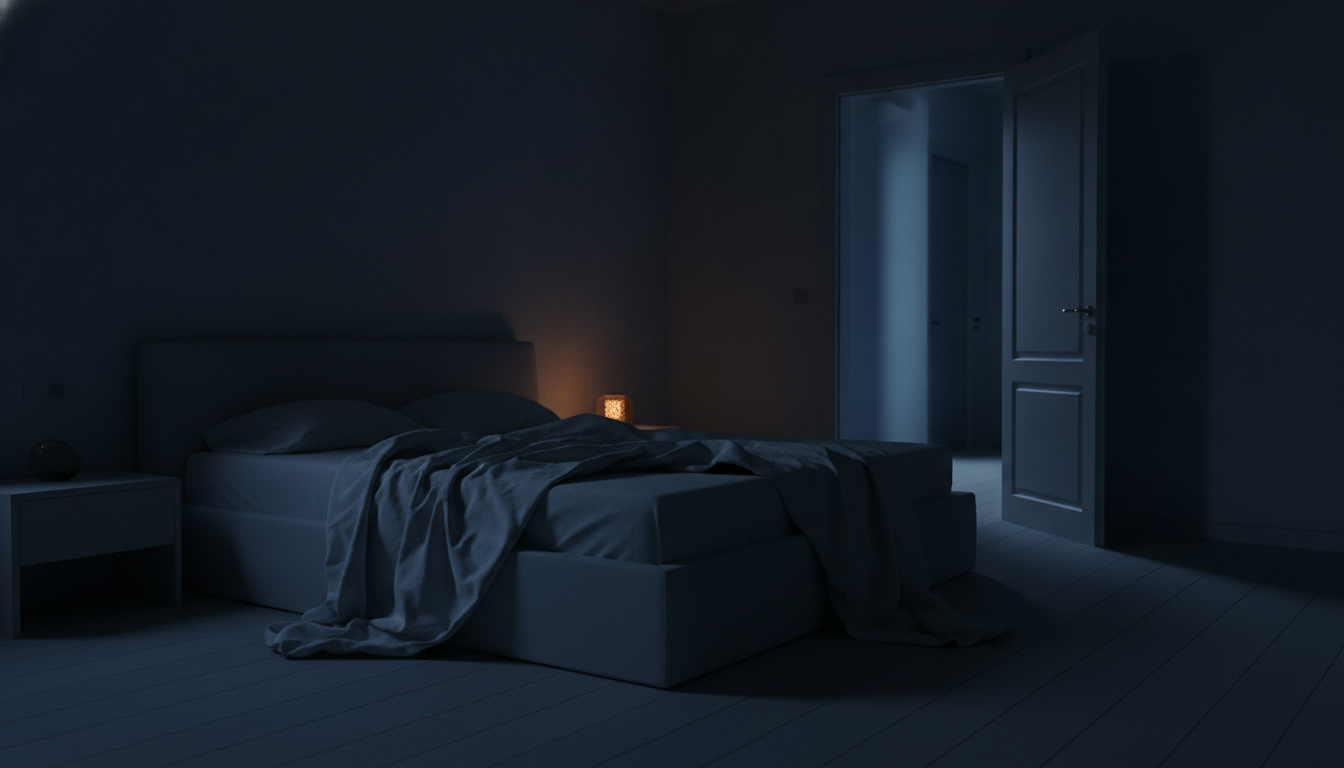
Sleepwalking is a disorder of arousal from deep non-REM sleep, in which the body acts while the brain is only partly awake. What the research shows about how common it is, why it comes from the first third of the night, the triggers that provoke it, and the safety-first approach to reducing episodes.
What sleepwalking actually is
Sleepwalking, or somnambulism, is a parasomnia in which a person performs complex behaviours, ranging from sitting up and fumbling with bedclothes to walking around the house or occasionally more elaborate actions, while they are not fully awake. The defining feature is that the brain is caught in a mixed state: parts of it are in deep sleep while others are active enough to drive movement, so the person can navigate and act but with clouded awareness, blank or glassy eyes, slow or nonsensical responses, and little or no memory of the event afterward. Roger Broughton set out the modern understanding in Science in 1968, arguing that sleepwalking and related events are disorders of arousal, incomplete awakenings out of deep sleep rather than acted-out dreams. That framework, carried into the American Academy of Sleep Medicine's classification, is why sleepwalking is grouped with confusional arousals and sleep terrors as an NREM disorder of arousal, and why it is fundamentally different from the dream-enactment that happens in REM sleep.
Why it comes from the first third of the night
Sleepwalking arises specifically out of slow-wave sleep, the deepest stage of non-REM sleep, during an incomplete arousal in which the body switches on before the brain has fully woken. Because slow-wave sleep is concentrated in the first third of the night, that is when sleepwalking almost always happens, typically in the first hour or two after falling asleep, not in the early-morning hours when REM sleep dominates. This timing is a useful diagnostic clue and it explains why anything that increases the amount or depth of slow-wave sleep, or that makes arousals out of it more likely, raises the chance of an episode. It also connects sleepwalking to the broader architecture of the night: the same deep-sleep-heavy early hours that make waking feel groggy are the window in which a partial arousal can tip into walking rather than a clean return to sleep.
How common it is, and the genetic link
Sleepwalking is common in children and less so, but far from rare, in adults. It peaks in childhood and most children grow out of it by adolescence. In adults, a large US population study by Ohayon and colleagues (Neurology, 2012) estimated that around 3.6 percent had walked in their sleep in the previous year, so it is a meaningful minority rather than a curiosity. There is a strong hereditary component: Hublin and colleagues, in a large Finnish twin study (Neurology, 1997), found that sleepwalking runs in families and is substantially heritable, with a much higher concordance in identical than fraternal twins. The practical implication is that if a parent sleepwalked, a child is more likely to, and that adult sleepwalkers often have a childhood history. Genetics sets the susceptibility; the triggers below determine whether that susceptibility turns into actual episodes.
The triggers that provoke episodes
In a genetically predisposed person, episodes are usually provoked by factors that either deepen slow-wave sleep or fragment it with arousals. Sleep deprivation is one of the best-demonstrated: Pilon, Montplaisir and Zadra showed in Neurology (2008) that recovering from sleep loss increases both the depth of slow-wave sleep and the number of arousals out of it, and that combining sleep deprivation with forced arousals reliably provoked sleepwalking in people prone to it. Alcohol and sedative-hypnotic medications are common triggers, as are fever and, in children, a full bladder. Crucially, anything that repeatedly fragments deep sleep from below can act as the arousal stimulus, so untreated obstructive sleep apnea and restless legs are recognized drivers of adult sleepwalking. Stress and an irregular schedule add to the load. The through-line is that a large slow-wave debt plus a source of arousal is the recipe, which is why the fixes target exactly those two things.
Safety first: how to respond and reduce episodes
The first priority is not stopping the walking but making it safe, because injury during an episode is the real risk. Secure the sleep environment: lock external doors and windows, block staircases with a gate, clear the floor of obstacles, and move sharp or dangerous objects and keys out of reach. During an episode, do not try to shake the person awake, since a forced awakening from deep sleep can trigger confusion, fear, or defensive aggression; instead, speak calmly and gently steer them back to bed. To reduce the frequency of episodes, attack the triggers: keep a regular schedule with enough sleep so you are not repeatedly repaying a large slow-wave debt, limit alcohol and review any sedative medications with a doctor, and get any suspected sleep apnea or restless legs assessed and treated, since removing that source of arousal often removes the episodes. Lowering stress and following steady sleep-hygiene habits supports all of this.
When to see a doctor
Occasional childhood sleepwalking in an otherwise well child, with a secured environment, usually needs no more than reassurance and safety measures, and typically fades with age. Medical evaluation is warranted when episodes are frequent, violent, or lead to injury or leaving the house; when sleepwalking begins for the first time in adulthood, since new adult-onset episodes are more likely to signal an underlying trigger such as sleep apnea, a medication effect, or another sleep disorder; or when episodes are accompanied by loud snoring and breathing pauses, unusual movements, or daytime sleepiness. A clinician can arrange a sleep study when needed, identify and treat the driver, and in select cases consider scheduled awakenings or medication. For most people, though, the combination of a safe environment and removing the triggers of sleep debt, alcohol, and untreated breathing problems does the heavy lifting. This article is educational and not medical advice.
Questions logged on this protocol
What causes sleepwalking?
Sleepwalking is a disorder of arousal out of deep slow-wave sleep: the body switches on and acts before the brain has fully woken, producing complex behaviour with clouded awareness and little memory of it. Susceptibility is strongly genetic and tends to run in families. Whether that susceptibility turns into actual episodes depends on triggers that deepen or fragment deep sleep, chiefly sleep deprivation, alcohol, sedative medications, fever, stress, and anything that repeatedly disturbs deep sleep such as untreated sleep apnea or restless legs.
Should you wake a sleepwalker?
No, not by force. Trying to shake a sleepwalker awake from deep sleep can leave them confused, frightened, or defensively aggressive, and it does not help. The safer approach is to stay calm, avoid startling them, speak quietly, and gently guide them back to bed. The more important protection is preparing the environment in advance, locking doors and windows, blocking stairs, and clearing hazards, so that an episode cannot turn into an injury.
Why does sleepwalking happen early in the night?
Because it arises out of slow-wave sleep, the deepest non-REM stage, which is concentrated in the first third of the night. Episodes therefore cluster in the first hour or two after falling asleep, when there is the most deep sleep to be partially aroused from, rather than in the early morning when REM sleep dominates. This timing is one of the clues that distinguishes sleepwalking from dream-enactment behaviours, which come out of REM sleep later in the night.
How do you stop sleepwalking?
You reduce episodes by removing the triggers rather than by any single cure. Get adequate, regular sleep so you are not repeatedly repaying a large deep-sleep debt, since recovery from sleep loss both deepens slow-wave sleep and increases arousals out of it. Limit alcohol, review sedative medications with a doctor, and get any sleep apnea or restless legs treated, because those fragment deep sleep and provoke episodes. Alongside this, secure the environment for safety. Most childhood sleepwalking resolves with age on its own.
Is sleepwalking a sign of a serious problem?
Usually not in children, where it is common and typically outgrown. It deserves medical attention when episodes are frequent, violent, or dangerous, when they lead to leaving the house, or when they begin for the first time in adulthood, since new adult-onset sleepwalking more often points to an underlying trigger such as obstructive sleep apnea, a medication effect, or another sleep disorder. Sleepwalking accompanied by loud snoring, breathing pauses, or daytime sleepiness should prompt evaluation for sleep apnea.
- [01]
- [02]
- [03]
- [04]
- [05]
Other stacks in this hub
How to Improve REM Sleep: What Actually Raises It and What Just Wrecks It
You cannot force REM sleep directly, but several everyday habits quietly suppress it, and removing them is how you get more. What the research says about when REM happens across the night, why alcohol and short sleep cut it most, and why the single biggest lever is simply giving yourself enough time asleep in the early morning hours.
Is 7 Hours of Sleep Enough? What the Evidence Actually Says
Seven hours is the number most sleep authorities put at the bottom of the healthy adult range, which makes it enough for many people and too little for some. What the large studies and the official recommendations say about the 7-hour mark, why sleep need varies between people, and the honest signs that tell you whether your own 7 hours is sufficient or short.
How Much Sleep Do Women Need? Separating the Evidence From the Myth
A popular claim says women need more sleep than men. The recommended ranges are actually the same for both, but there are real, evidence-based reasons a woman's sleep can differ across the menstrual cycle, pregnancy, and menopause. What the guidelines say, what the sex-difference research does and does not show, and how life stage changes the picture.