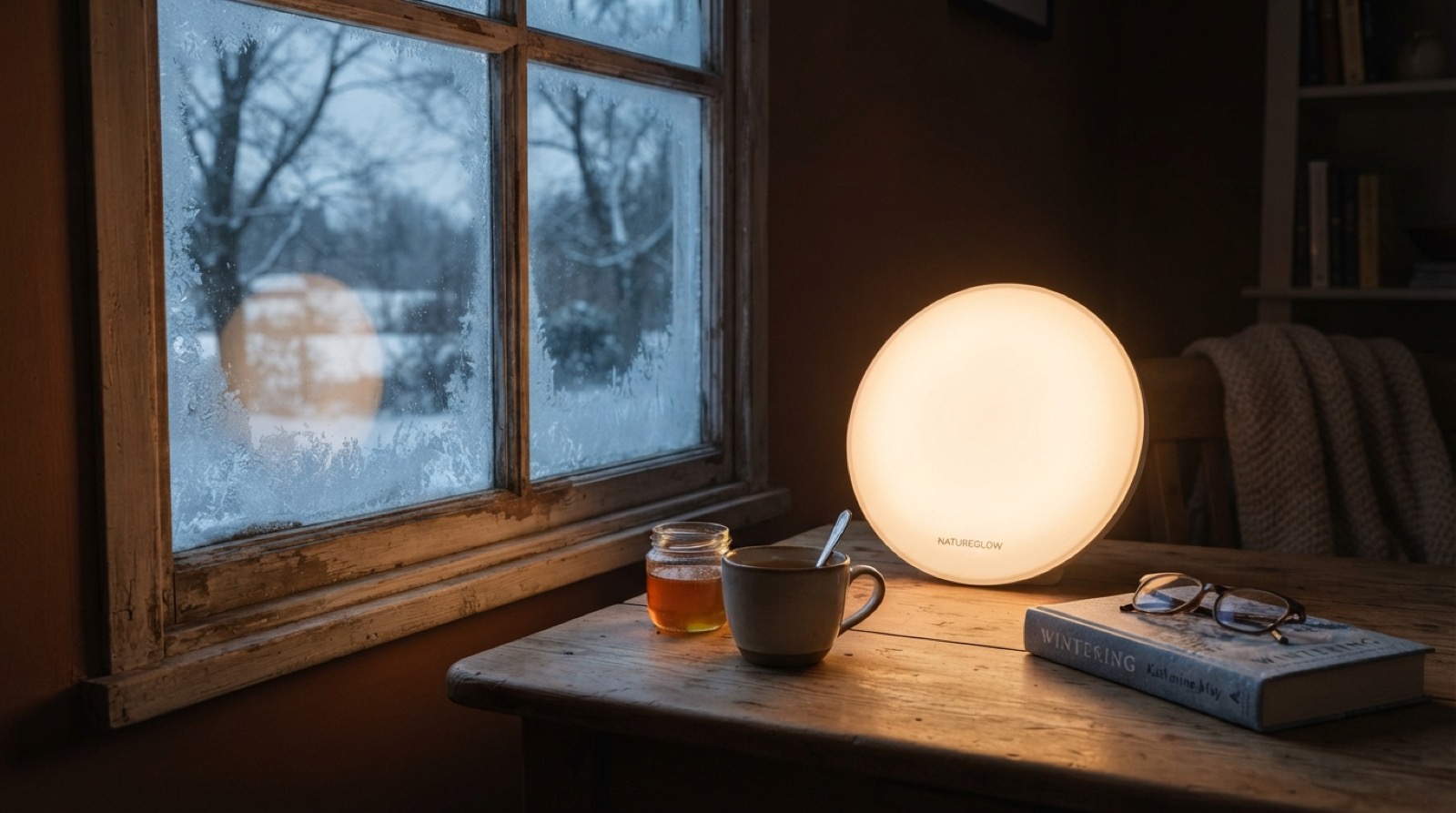
The SAD protocol is 10,000 lux for 30 minutes within an hour of waking. The Carex Day-Light Classic Plus is the lamp in our test set that actually holds ~10,000 lux at the distance you sit, the dose used in the original Terman SAD trials.
Check price · CarexSeasonal affective disorder responds to bright light at a defined dose: 10,000 lux for 30 minutes within an hour of waking. The mechanism, the trial evidence, the dose, and where light therapy ends and clinical care begins.
What SAD is, and why winter light loss drives it
Seasonal affective disorder (SAD) is a recurrent major depression with a seasonal pattern, most commonly a winter pattern, first described by Rosenthal et al. 1984 (Arch Gen Psychiatry) at the NIMH. The leading mechanistic account is that the seasonal collapse in morning daylight, shorter photoperiod and later, dimmer dawns, disrupts circadian entrainment and delays the internal clock relative to the sleep schedule. Lewy et al. 2006 (PNAS) framed this as the phase-shift hypothesis: many winter-SAD patients are phase-delayed, and correctly timed morning light realigns the clock. This is why a circadian site treats SAD as a light-timing problem, not only a mood problem.
The dose that the trials actually used
The clinical reference dose is 10,000 lux for 30 minutes within an hour of waking (Terman & Terman 2005, CNS Spectrums). Lux is illuminance at the eye, so distance is everything: a lamp rated '10,000 lux' usually hits that figure only at a specific close distance, and doubling the distance roughly quarters the lux. The dose is cumulative on the linear part of the curve, so a 2,500-5,000 lux source needs proportionally longer. For how this maps to real products and measured distances, see the best light therapy lamps guide and the explainer on lux vs lumens.
Why timing in the morning matters most
For the common winter (phase-delayed) pattern, morning light is the active ingredient because it phase-advances the clock, pulling the internal day earlier to meet the social day. Lewy et al. 2006 found that morning light produced better antidepressant responses than evening light, and that the degree of improvement tracked the size of the corrective phase shift. Evening bright light can push the clock the wrong way and worsen symptoms. The practical instruction is the same as the morning sunlight protocol: get the dose within an hour of habitual wake, not late in the day.
What the efficacy evidence shows
Bright-light therapy is among the best-supported non-pharmacological treatments for winter-pattern SAD. The American Psychiatric Association evidence review (Golden et al. 2005, Am J Psychiatry) found light therapy produced effect sizes comparable to antidepressant trials for seasonal depression, with clinically meaningful improvement typically within 1-2 weeks at 10,000 lux for 30 minutes each morning. The benefit depends on continued daily use through the dark season; it is a maintenance treatment for the months at risk, not a one-time fix.
Safety, contraindications, and who needs a clinician first
Reputable light-therapy lamps filter UV, and residual emission sits below workplace thresholds, so skin and eye risk is low for most people. But there are real cautions: bright light can precipitate hypomania or mania in people with bipolar disorder, so it should only be used under medical supervision there. People with retinal disease, a history of eye disorders, or who take photosensitizing medication (certain antibiotics, antipsychotics, St John's wort) should clear it with a clinician or ophthalmologist first. SAD itself is a clinical depression and warrants professional assessment, especially if symptoms are moderate to severe.
Light therapy vs dawn simulators, blue light, and medication
Several adjacent tools get confused with SAD light boxes. Dawn simulators (gradual light before waking) have some supporting evidence for winter symptoms but deliver a far smaller lux dose than a 10,000 lux box; they complement rather than replace it. Narrow-band blue or blue-enriched devices can be effective at lower intensity because melanopsin peaks near 480 nm, though the broad-spectrum 10,000 lux box has the largest evidence base. And light therapy is often used alongside, not instead of, psychotherapy or antidepressants. These are clinician-guided choices; this article is educational and not medical advice.
Questions logged on this protocol
Does light therapy actually work for seasonal depression?
For winter-pattern SAD, yes, it is one of the best-supported non-drug treatments. The American Psychiatric Association review (Golden et al. 2005) found effect sizes comparable to antidepressant trials, with meaningful improvement usually within 1-2 weeks at the standard dose of 10,000 lux for 30 minutes each morning. The benefit is maintained only with continued daily use through the dark season. SAD is a clinical depression, so light therapy should be part of a plan discussed with a clinician, not a self-diagnosis tool.
What lux and how long do I need for SAD?
The clinical reference dose is 10,000 lux for 30 minutes within an hour of waking (Terman & Terman 2005). Because lux is measured at the eye and falls off sharply with distance, a lamp must actually deliver that intensity at the distance you sit, often closer than the marketing implies. Lower-intensity sources need proportionally longer exposure. For which lamps hold the dose at a usable distance, see the best light therapy lamps guide.
When should I use my SAD lamp, morning or evening?
Morning, within about an hour of waking. The common winter pattern is a phase delay of the internal clock, and morning light phase-advances it back into alignment. Lewy et al. 2006 found morning light produced better antidepressant responses than evening light, with improvement tracking the corrective phase shift. Evening bright light can shift the clock the wrong way and worsen symptoms, so timing is not optional.
Is light therapy safe?
For most people, yes, when using a UV-filtered lamp at the recommended dose. But bright light can trigger hypomania or mania in people with bipolar disorder and must be used under medical supervision in that case. People with retinal or eye disease, or who take photosensitizing medications, should check with a clinician or ophthalmologist first. Mild side effects like headache or eye strain usually ease by adjusting distance or duration. This article is educational and not medical advice.
Can a regular bright lamp or sunrise alarm replace a SAD light box?
Not for the clinical dose. Ordinary room lighting is well under 1,000 lux at the eye, far below the 10,000 lux SAD protocol, and a sunrise alarm peaks at only a few hundred lux at pillow distance, which is a wake cue rather than a therapeutic dose. Dawn simulators have some evidence for winter symptoms but deliver much less light than a 10,000 lux box. To match the trial dose you need a dedicated light-therapy lamp that holds 10,000 lux at the distance you actually sit.
- [01]
- [02]
- [03]
- [04]
Other stacks in this hub
Cortisol and Sleep: The Morning Hormone That Times Your Wake
Cortisol is not only a stress hormone; it follows a strong daily rhythm that peaks in the early morning to drive waking and falls to its low at night to allow sleep. What the research says about the cortisol awakening response, how stress and disrupted sleep push the rhythm out of shape, and why fixing the rhythm matters more than chasing a single cortisol number.
Eating Before Bed and Sleep: What a Late Meal Does to Your Night
A late meal is not automatically bad for sleep, but eating large, heavy, or the wrong foods close to bedtime reliably disturbs it, and meal timing is also a signal to your body clock. What the research says about reflux, blood sugar, and circadian meal timing, and how to eat in the evening without wrecking your night.
What Happens When Your Circadian Rhythm Is Disrupted
Your body clock does far more than control sleep; it schedules hormones, metabolism, temperature, and alertness across the day. When behavior falls out of step with the clock, through shift work, jet lag, social jet lag, or erratic light, the misalignment shows up as poor sleep, daytime dysfunction, and, over the long run, metabolic and mood consequences. What the research says, and how the clock realigns.