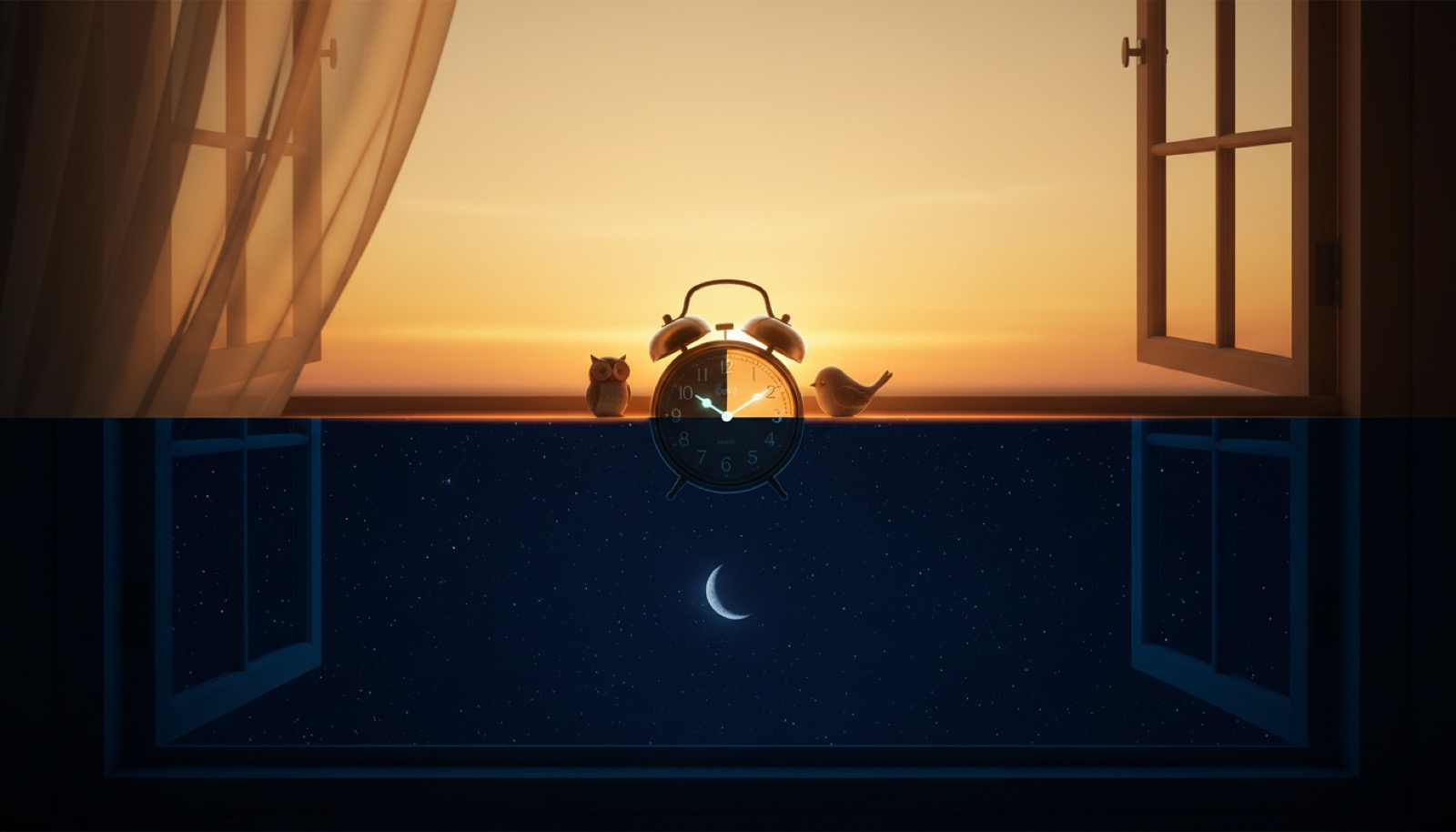
Owl and lark are the two ends of a continuous chronotype scale, not two fixed personality types. What sets which end you sit on, how the labels map onto the MEQ and MCTQ, whether you can move along the scale, and why the four-animal quizzes oversimplify it.
Owl and lark are the ends of a continuum, not two boxes
Night owl (evening type) and early bird (morning type) name the two ends of a single continuous trait, not two separate kinds of person. Chronotype is the timing your internal clock prefers relative to the solar day, and in any population it is distributed roughly normally: a few strong larks, a few strong owls, and most people in the middle. Roenneberg's large MCTQ datasets (Roenneberg et al. 2007, Curr Biol) show this bell-shaped spread rather than a clean split into two camps. So the honest answer to 'am I an owl or a lark' is usually 'somewhere on the scale, and probably nearer the middle than the label suggests.' The popular four-animal quizzes collapse this continuum into tidy categories, which reads well but misrepresents what the research measures. For the full picture of the trait see the chronotype field guide.
What decides which end you sit on
Where you land is substantially biological. Chronotype is heritable and tied to variants in core clock genes such as PER3 and CLOCK and to the intrinsic period of your circadian oscillator, which averages about 24.2 hours but varies between people (Czeisler et al. 1999, Science). A longer intrinsic period tends to push you toward the owl end, because a clock that runs slightly long drifts later each day and needs a stronger morning signal to stay entrained. On top of genetics, light exposure moves the expressed type: strong morning daylight with dark evenings pulls you earlier, while dim days and bright evenings push you later. So being an owl is not laziness or a bad habit; it is a clock set point that the environment can nudge but not erase.
How the labels map onto the MEQ and MCTQ
Researchers do not ask 'owl or lark' directly; they use two validated instruments. The Morningness-Eveningness Questionnaire (Horne & Ostberg 1976, Int J Chronobiol) scores your self-reported preference for when to be active and sorts you onto a morning-to-evening scale with five bands from definite morning type to definite evening type. The Munich ChronoType Questionnaire (Roenneberg et al. 2003, J Biol Rhythms) is more behavioral: it uses your actual sleep timing on work-free days, taking the midpoint of sleep on free days corrected for sleep debt (MSFsc) as an objective marker. An early MSFsc is lark territory, a late one is owl territory. The CircadianStack chronotype quiz is built on the MCTQ-short approach, which is why it returns a clock time rather than an animal.
Age moves you along the scale on a predictable arc
The owl-versus-lark question has a different answer at different ages, because chronotype follows a predictable developmental curve. Children are relatively early (larks). Chronotype delays through adolescence and reaches its latest point around age 20, which is the biological basis for the teenage tendency toward late nights and the argument for later school start times. From the early twenties it advances gradually earlier with age, which is why many older adults wake early even without trying. Roenneberg's MCTQ data mapped this arc across tens of thousands of people. The practical consequence is that the same person can be a genuine owl at 18 and a genuine lark at 60 without anything having gone wrong; the shift is normal development, not a discipline problem.
Can an owl become a lark?
Partly, within a modest window. The genetic component is fixed, so a strong owl will not become a natural lark, but the expressed timing is movable by roughly one to two hours with consistent light behavior. The advance toolkit is bright light within an hour of a fixed wake time, dim evenings, and optionally low-dose melatonin timed to the early evening rather than bedtime, since evening melatonin advances the clock along its phase response curve (Burgess et al. 2010, J Physiol). Consistency matters more than intensity: a fixed wake time seven days a week does more than an occasional heroic early morning. The realistic target is a moderate shift toward earlier, not a personality transplant. For the step-by-step method see how to reset your circadian rhythm.
The real cost is schedule mismatch, not the label
Being an owl is not unhealthy in itself; the problem is living against your clock. Roenneberg coined social jet lag for the gap between your sleep timing on work days and on free days, and population data link larger social jet lag to poorer health markers, higher BMI, and more smoking. Late types carry most of this burden because school and work are built around early schedules, so an owl forced onto a lark's timetable runs a chronic mismatch. The lever is alignment, not willpower: shift the clock earlier with light where you can, and where it cannot move far enough, adjust the schedule to fit the clock. The first useful step is knowing where you actually sit, so take the chronotype quiz to get your MCTQ-based result rather than guessing from an animal label.
Questions logged on this protocol
Is being a night owl or an early bird genetic?
Substantially, yes. Chronotype is heritable and tied to variants in clock genes such as PER3 and CLOCK and to the intrinsic period of your circadian clock, which averages about 24.2 hours but differs between people (Czeisler et al. 1999). A longer intrinsic period tends toward the owl end. Light exposure then nudges the expressed timing on top of that genetic set point, so strong morning light pulls you earlier and bright evenings push you later. Being an owl is a biological tendency, not a habit or a lack of discipline, though behavior can shift it by roughly one to two hours.
Can a night owl become an early bird?
Partly. The genetic component is fixed, so a true owl will not become a natural lark, but the expressed timing is movable by about one to two hours with consistent light behavior: bright light within an hour of a fixed wake time, dim evenings, and optionally low-dose melatonin timed to the early evening (Burgess et al. 2010). Consistency beats intensity; a fixed wake time seven days a week matters more than an occasional early start. The realistic goal is a moderate advance toward earlier, not a wholesale change of type. See how to reset your circadian rhythm for the method.
How do I know if I am an owl or a lark?
Researchers use two validated tools rather than a yes-or-no. The Morningness-Eveningness Questionnaire (Horne & Ostberg 1976) scores your preferred activity timing on a morning-to-evening scale, and the Munich ChronoType Questionnaire (Roenneberg et al. 2003) uses your actual sleep midpoint on free days, corrected for sleep debt, as an objective marker: early is lark, late is owl. Most people land in the middle rather than at either extreme. The CircadianStack chronotype quiz uses the MCTQ-short approach and returns a clock time rather than an animal category, which is more informative than the four-animal quizzes online.
Does chronotype change with age?
Yes, predictably. Children are relatively early, chronotype delays through the teens and is latest around age 20 (the basis for later school-start-time arguments), and then it advances gradually earlier through adulthood, which is why many older adults wake early. Roenneberg's large MCTQ datasets mapped this arc. So the same person can be a genuine owl at 18 and a genuine lark at 60, with the shift being normal development rather than a problem to fix.
Is it unhealthy to be a night owl?
Not inherently. The health signal in the data comes from social jet lag, the mismatch between your clock and your schedule, not from the chronotype itself. Roenneberg's population data link larger social jet lag to poorer health markers, higher BMI, and more smoking, and late types carry most of that burden because school and work run early. An owl living on a schedule that fits their clock does not show the same risk. The fix is alignment: shift the clock earlier with light where possible, and adjust the schedule where it cannot move enough.
- [01]
- [02]
- [03]
- [04]
- [05]
Other stacks in this hub
Chronotype Quiz: MCTQ
19-question MCTQ-short quiz scored client-side. Output: your chronotype + a personalized 7-day Protocol card PDF.
What a Late Chronotype Actually Is
Beyond 'night owl': the MCTQ definition, the genetics, and why a late chronotype is not laziness.
Chronotype: A Field Guide to Your Body Clock Type
Chronotype is your clock's preferred timing, measured by the MEQ and MCTQ, distributed on a continuum from early lark to late owl. What it is, what sets it, how it changes with age, and why it matters for sleep, mood, and performance.