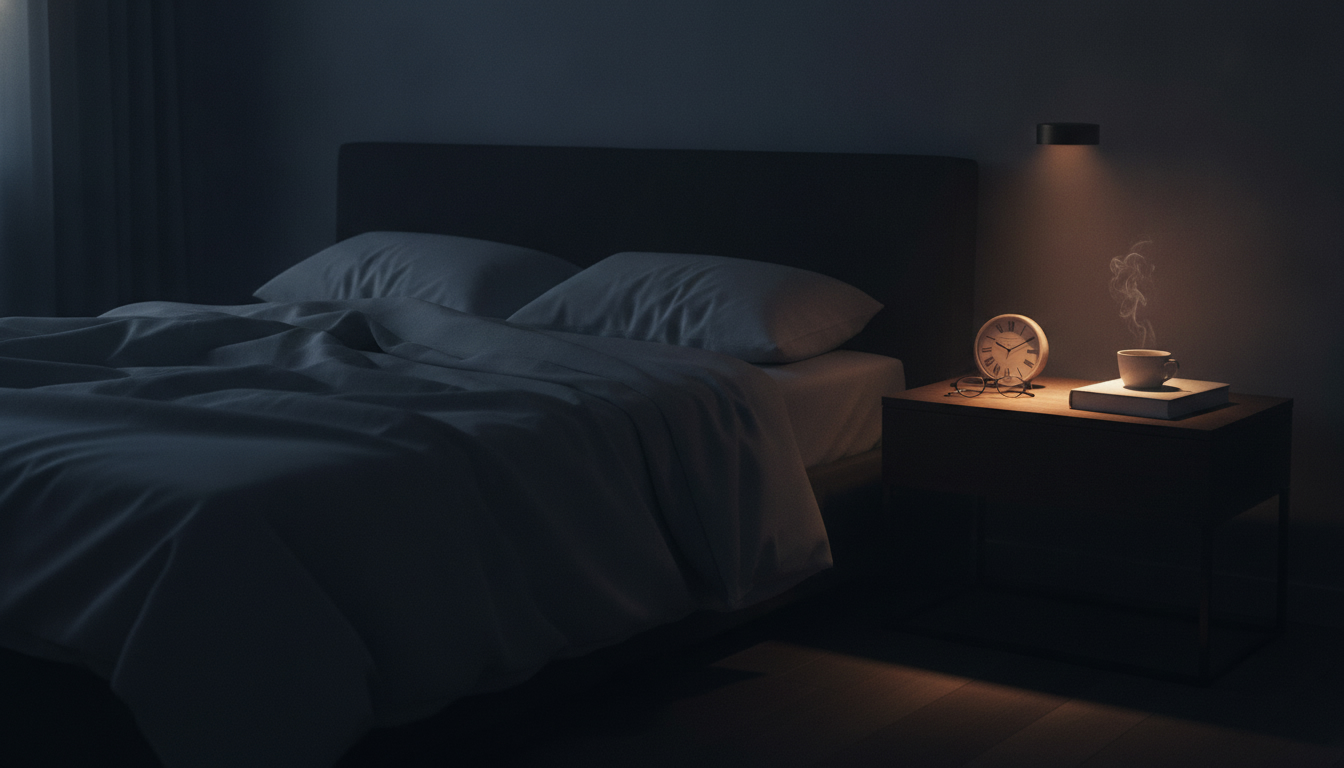
A bedtime routine is not a luxury; it is the set of behavioral and light cues that lower arousal and let the sleep system take over. Which parts of the wind-down actually shorten sleep-onset latency, in what order and at what time to do them, why a fixed wake time is the anchor the whole routine hangs on, and how to keep the routine alive after a bad night without turning it into a source of pressure.
What a bedtime routine actually does
A bedtime routine works through two mechanisms, and neither one is sedation. The first is conditioning: when the same sequence of cues reliably precedes sleep, those cues themselves start to lower arousal and signal that sleep is coming, the same associative logic behind the stimulus-control therapy Richard Bootzin introduced in 1972 and summarized with Michael Perlis in 2011. The second is obstacle removal: most adults do not fail to sleep because they lack a ritual, they fail because bright evening light, late caffeine, work stress, and an irregular schedule are actively opposing the sleep system. A good routine is the scaffold that strips those obstacles away in a fixed order so the homeostatic sleep pressure built up across the day, and the circadian signal for night, can do their job. The review of sleep hygiene components by Leah Irish and colleagues in 2015 in Sleep Medicine Reviews makes the useful point that the individual pieces vary in evidence: some are strongly supported, others are folk wisdom, and the routine works best when it is built around the supported levers rather than the decorative ones.
The anchor: a fixed wake time
The single most important part of a bedtime routine is not at bedtime at all; it is the wake time, held constant every day including weekends. The circadian system times when sleepiness arrives, and it entrains chiefly to the light you get after waking, so a wake time that drifts by two or three hours across the week keeps the clock unanchored and makes the arrival of sleepiness unpredictable. Analyses of sleep regularity, such as the work by Andrew Phillips and colleagues in 2017 in Scientific Reports, link irregular sleep and wake timing to a delayed circadian phase and worse outcomes, independent of how long people sleep. The practical rule is to pick a wake time you can hold seven days a week, get bright light soon after it, and set your target bedtime one full sleep window earlier (for most adults roughly seven and a half to eight and a half hours). Bedtime is then a consequence of the wake time and the sleep need, not an independent number to enforce, which is why chasing an early bedtime while sleeping in on weekends rarely works.
Dim and warm the light in the last hour
Light is the lever with the largest and fastest effect, and it is the one most routines ignore. Evening exposure to bright and blue-enriched light suppresses melatonin and pushes the clock later: Anne-Marie Chang and colleagues showed in 2015 in PNAS that reading on a light-emitting device before bed suppressed melatonin, delayed its onset, lengthened sleep onset, and left people sleepier the next morning compared with a printed book. The practical move is to treat the last 60 to 90 minutes as a light taper: switch off overhead and cool white lighting, drop to a single low, warm-toned lamp, and either put screens away or dim them to their lowest warm setting. The goal is not a specific gadget; it is a large drop in the intensity and blueness of light reaching your eyes, because it is the total light dose the circadian system reads. This is also why a dark bedroom matters as much as a dim wind-down: light leaking in overnight or on a middle-of-the-night trip to the bathroom can undo part of the taper.
The wind-down sequence: what belongs and what does not
Inside the dimmed last hour, the content of the routine should do one job: lower cognitive and physical arousal. What belongs is anything low-stakes and repeatable that pulls attention away from problem-solving: light reading, a warm shower, gentle stretching, a relaxation practice such as slow breathing or progressive muscle relaxation, laying out the next day so the planning mind can stand down. A warm bath or shower has a specific physiological rationale beyond feeling pleasant: the meta-analysis by Shahab Haghayegh and colleagues in 2019 in Sleep Medicine Reviews found that a warm bath or shower of about 40 to 42.5 degrees Celsius, taken 1 to 2 hours before bed, shortened sleep onset, because warming the skin promotes the heat loss that drops core body temperature into the range sleep prefers. What does not belong is work, stressful conversations, doomscrolling, news, and anything that raises heart rate or rumination. The specific rituals people cherish, tea, a journal, a scent, are fine and can strengthen the conditioning, but they are the trim, not the structure; if the light and timing are wrong, no amount of chamomile will rescue the night.
Timing the other levers: caffeine, alcohol, food, exercise
Several daytime inputs decide how well the evening routine can work, and their timing matters more than their presence. Caffeine is the clearest: Christopher Drake and colleagues showed in 2013 in the Journal of Clinical Sleep Medicine that 400 mg of caffeine taken even 6 hours before bed measurably reduced sleep, which is why the safe habit is to stop caffeine by early afternoon, roughly 8 hours before your target bedtime, adjusted for how sensitive you are. Alcohol is the great false friend: it speeds sleep onset but fragments the second half of the night and suppresses REM, so a nightcap trades falling asleep faster for worse, lighter sleep later. A large late meal can sit uncomfortably and, with alcohol, worsen reflux, so leave a couple of hours between the last big meal and bed. Vigorous exercise is good for sleep overall and only a problem in the last hour or two before bed for some people, because of the arousal and temperature bump; finishing exercise earlier in the evening is the simple fix. None of these is a ritual you add; they are constraints you set earlier in the day so the wind-down has a clear runway.
Building a routine that survives a bad night
The failure mode that turns a helpful routine into a harmful one is perfectionism. If the routine becomes a performance you have to execute flawlessly, or if you lie in bed grinding through the checklist and willing sleep to come, arousal goes up and the bed gets conditioned to wakefulness, the exact opposite of the goal. Two rules keep the routine healthy. First, protect the wake time above everything: even after a bad night, get up at the fixed time and get light, because sleeping in to recover is what unanchors the clock and seeds the next bad night. Second, follow the stimulus-control rule: the bed is for sleep, so if you are not asleep in roughly 20 minutes, or you wake and cannot fall back, get up, keep the lights low, do something calm and boring, and return only when sleepy. A routine you can run at 70 percent on a hard week beats a rigid one you abandon the first time it slips. And if difficulty sleeping persists most nights for three months or more, that is chronic insomnia, where cognitive behavioral therapy for insomnia (CBT-I), not a better wind-down ritual, is the first-line, evidence-based treatment.
Questions logged on this protocol
How long before bed should a bedtime routine start?
For most adults, about 60 to 90 minutes. That window is enough to taper light, let a warm bath or shower do its temperature work (the meta-analysis by Haghayegh and colleagues in 2019 put the timing at 1 to 2 hours before bed), and let arousal from the day come down, without being so long that it becomes a burden. The exact length is less important than doing the same core sequence at roughly the same time, since the routine works partly by conditioning: consistent cues that reliably precede sleep start to trigger the wind-down on their own.
What is the single most important part of a bedtime routine?
A fixed wake time, held seven days a week. It sounds counterintuitive that the most important part of a bedtime routine happens in the morning, but the circadian clock, which times when sleepiness arrives, entrains mainly to light after waking. A wake time that drifts across the week keeps the clock unanchored and the arrival of sleepiness unpredictable, which is why work by Phillips and colleagues in 2017 links irregular sleep and wake timing to a later circadian phase. Bedtime should follow from a stable wake time and your sleep need, not the other way around.
Do screens really matter that much before bed?
Light matters, and screens are one source of it. Anne-Marie Chang and colleagues showed in 2015 in PNAS that light-emitting screen use before bed suppressed melatonin, delayed its onset, lengthened sleep onset, and increased next-morning sleepiness compared with a printed book. The circadian system responds to the total dose of light, its intensity and blueness, so the practical goal in the last hour is a large drop in bright and blue-enriched light: overhead lights off, a single low warm lamp, and screens either away or dimmed to their lowest warm setting. The stimulating content on the screen can also raise arousal, which is a separate reason to put it down.
Does a warm shower or bath before bed actually help you sleep?
Yes, and there is a clear physiological reason. The meta-analysis by Shahab Haghayegh and colleagues in 2019 in Sleep Medicine Reviews found that a warm bath or shower, around 40 to 42.5 degrees Celsius taken 1 to 2 hours before bed, shortened the time to fall asleep. The mechanism is temperature: warming the skin drives blood flow to the surface and promotes heat loss, which drops core body temperature into the lower range that sleep onset prefers. The timing is the trick, an hour or two beforehand so the cool-down lands as you get into bed, not a hot shower immediately before lying down.
What if a bedtime routine still does not help me sleep?
First check that the routine is built on the levers that matter, a fixed wake time, a real light taper, and correctly timed caffeine, alcohol, food, and exercise, rather than on rituals alone. If the fundamentals are in place and you still cannot fall or stay asleep most nights for three months or more, that meets the definition of chronic insomnia, and the first-line treatment is cognitive behavioral therapy for insomnia (CBT-I), not a better wind-down. Persisting in a rigid routine while lying awake can actually make things worse by conditioning the bed to wakefulness, which is why the stimulus-control rule, leaving the bed when you cannot sleep, is part of the evidence-based approach.
- [01]
- [02]
- [03]
- [04]
- [05]
- [06]
Other stacks in this hub
How to Improve REM Sleep: What Actually Raises It and What Just Wrecks It
You cannot force REM sleep directly, but several everyday habits quietly suppress it, and removing them is how you get more. What the research says about when REM happens across the night, why alcohol and short sleep cut it most, and why the single biggest lever is simply giving yourself enough time asleep in the early morning hours.
Is 7 Hours of Sleep Enough? What the Evidence Actually Says
Seven hours is the number most sleep authorities put at the bottom of the healthy adult range, which makes it enough for many people and too little for some. What the large studies and the official recommendations say about the 7-hour mark, why sleep need varies between people, and the honest signs that tell you whether your own 7 hours is sufficient or short.
How Much Sleep Do Women Need? Separating the Evidence From the Myth
A popular claim says women need more sleep than men. The recommended ranges are actually the same for both, but there are real, evidence-based reasons a woman's sleep can differ across the menstrual cycle, pregnancy, and menopause. What the guidelines say, what the sex-difference research does and does not show, and how life stage changes the picture.