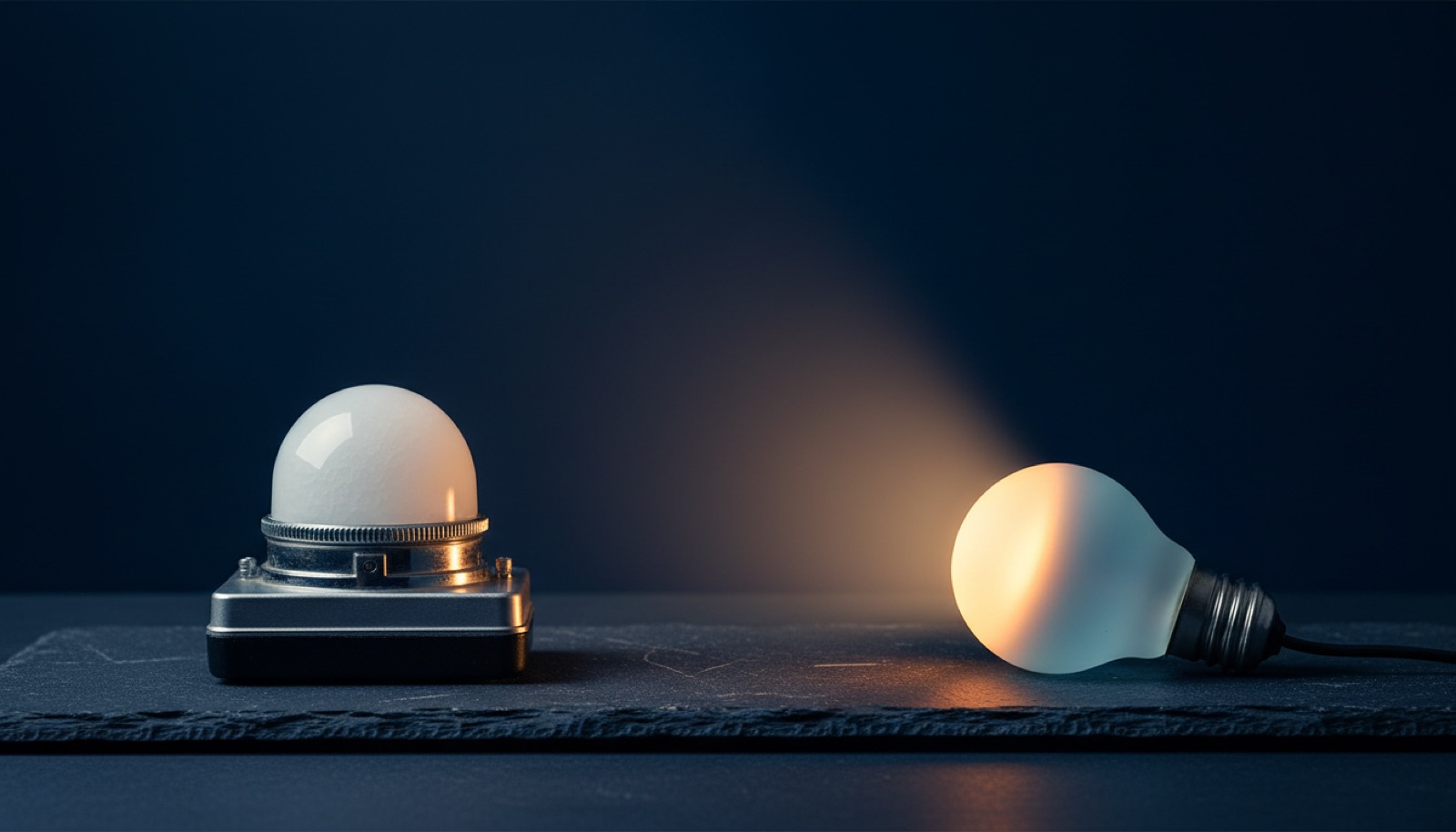
Lumens measure light leaving a source; lux measures light landing on your retina. Only lux maps to a circadian dose, which is why a lamp rated 10,000 lux at 6 inches delivers ~1,100 lux at the distance you actually sit.
Questions logged on this protocol
What is the difference between lux and lumens?
Lumens (lm) measure total visible light output leaving a source, weighted to human photopic sensitivity. Lux (lx) measure illuminance: lumens landing per square meter of surface, so 1 lux equals 1 lumen per square meter. Lumens describe the bulb; lux describe what arrives at a point in space, such as your cornea. The same 1,000-lumen lamp produces high lux on a small nearby surface and low lux spread across a large distant wall. For circadian purposes, lux at the eye is the only one of the two that maps to a dose (Zeitzer et al. 2000, J Physiol).
Why does my 10,000 lux lamp not feel that bright at my desk?
Because that 10,000 lux figure is almost always measured at an unstated close distance, often 6 to 8 inches. Illuminance falls off roughly with the inverse square of distance, so doubling the distance drops lux to about a quarter. A lamp rated 10,000 lux at 6 inches delivers roughly 2,500 lux at 12 inches and about 1,100 lux at 18 inches, the distance many people actually sit. The lumens leaving the lamp never changed; the lux at your eye collapsed with distance. This is why CircadianStack ranks lamps by measured lux at 12, 18, and 24 inches in the best-light-therapy-lamps-2026 guide, not by the headline number.
How do I convert lumens to lux?
Lux equals lumens divided by the illuminated area in square meters: lux = lm / m2. To go the other way, multiply lux by area. The catch is that the area depends on distance and beam angle, so there is no single conversion factor without knowing how the light spreads. For a roughly uniform source at distance d (meters) with output in candela (cd, lumens per steradian), illuminance is approximately lux = cd / d^2 on a surface facing the source. The practical takeaway: you cannot convert a lumen rating to a circadian lux dose without the distance, which is exactly the number manufacturers tend to omit.
Which unit matters for circadian rhythm and sleep?
Lux at the cornea, in the right wavelength band. Melanopsin, the photopigment in intrinsically photosensitive retinal ganglion cells that drives the circadian signal, peaks near 480 nm (Brainard et al. 2001, J Neurosci). Zeitzer et al. 2000 mapped the dose-response curve for melatonin suppression against illuminance at the eye: roughly half-maximal suppression near 100 lux and saturation by a few hundred to ~1,000 lux of typical white light. Lumens leaving a fixture are irrelevant to that curve until you know how many of them land on the retina, which is what lux measures.
Is more lumens always brighter for me?
Not at your eye. A 1,600-lumen bulb on a high ceiling can deliver fewer lux at your desk than a 450-lumen task lamp 18 inches away, because the task lamp concentrates its output on a small nearby area. Total lumens set the ceiling on how much light is available; geometry (distance, beam angle, reflector design) decides how much of it reaches you. For a morning light dose, a moderate-lumen lamp placed close and angled into the lower visual field beats a high-lumen ceiling fixture across the room.
How many lux is a sunny day vs an indoor room?
Direct outdoor sun delivers roughly 10,000 to 100,000 lux at ground level; overcast daylight 1,000 to 10,000 lux; a sunlit window indoors about 1,000 to 5,000 lux at arm's length. A typical lit living room runs 50 to 300 lux, and a dim bedroom under 50 lux. This is why indoor light rarely phase-shifts on its own and why morning outdoor exposure is the default recommendation: even a bright office at ~500 lux sits an order of magnitude below the outdoor dose your circadian system evolved to read.
Can I trust a phone lux meter app?
Only roughly. Smartphone ambient-light sensors are uncalibrated for absolute photometry and vary by device, angle, and firmware; independent comparisons commonly find errors of 30 to 50% or more against a calibrated lux meter. Typical smartphone lux-app error magnitude varies widely by device and study. They are useful for relative readings (is this spot brighter than that one, is the room above or below ~10 lux at night) but not for verifying a manufacturer's 10,000 lux claim. For that you need a calibrated illuminance meter held at your actual working distance.
- [01]
- [02]
- [03]
- [04]
- [05]
Other stacks in this hub
Cortisol and Sleep: The Morning Hormone That Times Your Wake
Cortisol is not only a stress hormone; it follows a strong daily rhythm that peaks in the early morning to drive waking and falls to its low at night to allow sleep. What the research says about the cortisol awakening response, how stress and disrupted sleep push the rhythm out of shape, and why fixing the rhythm matters more than chasing a single cortisol number.
Eating Before Bed and Sleep: What a Late Meal Does to Your Night
A late meal is not automatically bad for sleep, but eating large, heavy, or the wrong foods close to bedtime reliably disturbs it, and meal timing is also a signal to your body clock. What the research says about reflux, blood sugar, and circadian meal timing, and how to eat in the evening without wrecking your night.
What Happens When Your Circadian Rhythm Is Disrupted
Your body clock does far more than control sleep; it schedules hormones, metabolism, temperature, and alertness across the day. When behavior falls out of step with the clock, through shift work, jet lag, social jet lag, or erratic light, the misalignment shows up as poor sleep, daytime dysfunction, and, over the long run, metabolic and mood consequences. What the research says, and how the clock realigns.