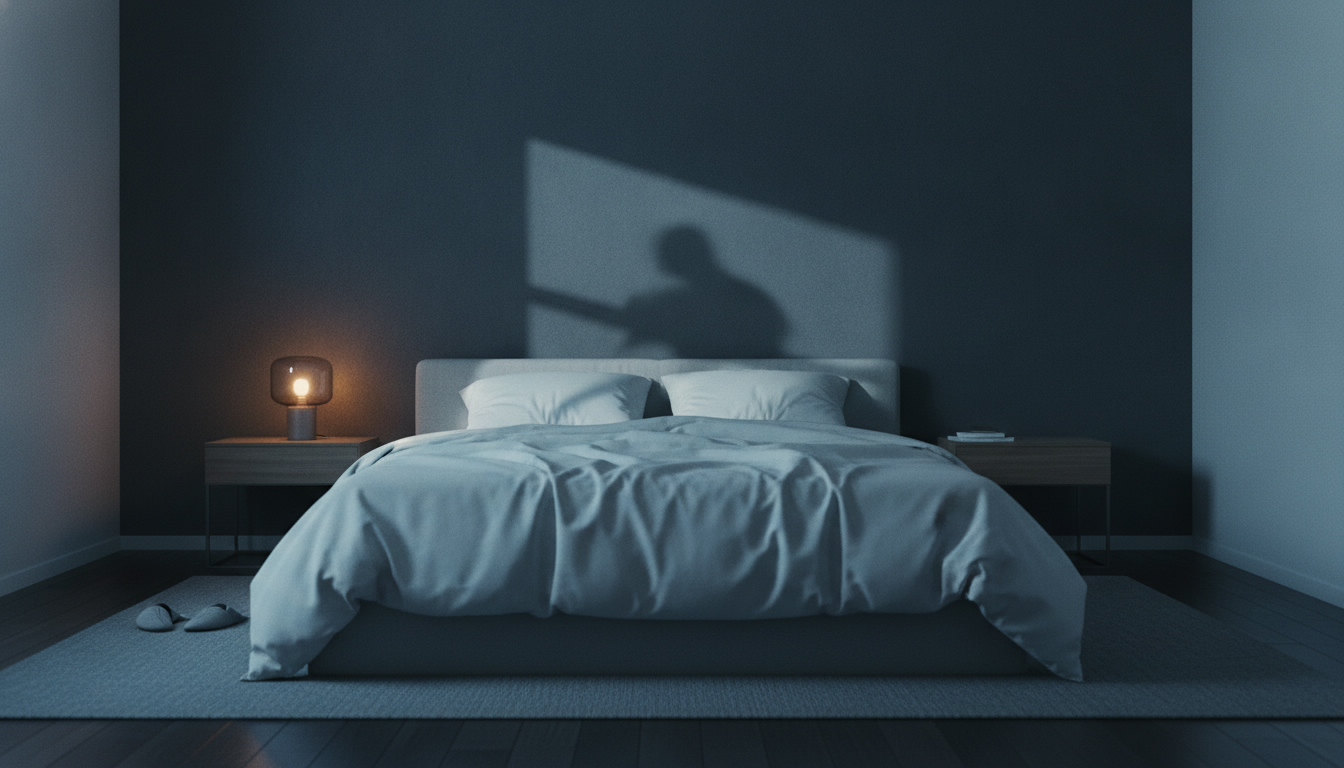
A hypnic jerk is the sudden involuntary muscle twitch that jolts you awake just as you drift off, often with a falling sensation or a flash of light. What the research says about how common they are, why they happen at the sleep-onset transition, which triggers make them worse, and when a twitch is worth a doctor's attention.
What a hypnic jerk actually is
A hypnic jerk, also called a sleep start or hypnagogic jerk, is a sudden, brief, involuntary muscle contraction that happens as you are falling asleep, in the drowsy transition between wakefulness and sleep. It can be a single whole-body jolt or a twitch of an arm or leg, and it often arrives with a subjective sensation: a feeling of falling, tripping, or missing a step, a flash of light, or a loud snapping sound inside the head. The physician and sleep researcher Ian Oswald described the phenomenon in detail in Brain in 1959, characterizing these sudden bodily jerks at sleep onset and the sensory experiences that accompany them. The key point is that a hypnic jerk is a wake-to-sleep transition event, tied to the moment the brain hands over from the waking state to sleep, which is why it happens right as you drift off and not in the middle of established sleep.
How common they are, and why they are benign
Hypnic jerks are one of the most common experiences in all of sleep, not a rare symptom. Sleep medicine references describe them as near-universal, with most people experiencing them at some point and a large share experiencing them regularly. The American Academy of Sleep Medicine, in the International Classification of Sleep Disorders (ICSD-3, 2014), lists sleep starts as an isolated symptom and normal variant rather than a disease, meaning they are a benign feature of healthy sleep in the overwhelming majority of cases. They occur across all ages and are not, on their own, a sign that anything is wrong with your brain or your sleep. This matters because the twitch can feel dramatic, and the reassurance that it is normal is itself part of managing it, since anxiety about the jerk tends to make the sleep-onset transition more fraught.
Why they happen at the sleep-onset transition
The exact mechanism is not settled, but the leading explanation ties hypnic jerks to the brain's shift out of the waking motor state. As you fall asleep, the wake-promoting systems that keep muscles toned begin to shut down and the body starts to relax toward sleep paralysis. One influential idea is that the jerk is a byproduct of that handover, an unstable moment where descending inhibition of the muscles and the last flickers of waking motor activity overlap, producing a sudden discharge. The accompanying falling sensation is often explained as the brain's attempt to make sense of the sudden loss of muscle tone and body position as sleep takes over, sometimes framed in evolutionary terms as a startle reflex left over from arboreal ancestors, though that story is speculative. What is reliable is the timing: the jerk is locked to the narrow window of the wake-sleep transition, which is why it shares the label hypnagogic with the dreamlike imagery that can appear in the same moments, and why it never happens once you are soundly asleep.
The triggers that make them worse
While hypnic jerks are usually spontaneous, several factors reliably increase their frequency and intensity, and they are all modifiable. Stimulants are the clearest: caffeine and nicotine raise arousal and are commonly linked to more frequent sleep starts, which is why an afternoon or evening coffee is a prime suspect. Vigorous exercise late in the evening leaves the nervous system aroused at bedtime and is another common amplifier, so the same wind-down logic that protects sleep onset applies here. Sleep deprivation is a major driver: when you are heavily sleep-deprived and crash into sleep faster and harder than usual, the transition is more abrupt and jerks become more likely, so paying down sleep debt reduces them. Emotional stress and anxiety, which keep pre-sleep arousal high, round out the list. The practical read is that a body wired on caffeine, stress, or exhaustion makes a rougher wake-to-sleep transition, and smoothing that transition smooths the jerks.
How to reduce them
Because ordinary hypnic jerks are benign, the goal is not to eliminate them but to reduce the triggers that make them frequent or violent enough to disturb sleep. The highest-yield move is cutting caffeine in the afternoon and evening, since caffeine has a long half-life and can raise arousal well into the night, the same reason it delays sleep onset generally. Keep vigorous exercise out of the last two to three hours before bed. Prioritize adequate sleep so you are not repeatedly crashing into sleep from a large sleep debt, which makes the transition abrupt. And lower pre-sleep arousal with a consistent wind-down: dim light, a buffer away from screens and stressful input, and a relaxation technique such as slow breathing or progressive muscle relaxation if your mind and body run hot at lights-out. None of these is a cure, because the jerk is a normal transition event, but together they make the wake-to-sleep handover calmer and the jerks less noticeable.
When a twitch is worth a doctor's attention
Ordinary hypnic jerks happen only at sleep onset, are occasional to frequent but not relentless, and are not accompanied by other neurological symptoms. A few patterns fall outside that description and are worth raising with a clinician. Jerks that are severe, repetitive, and build up in runs at sleep onset, sometimes preventing sleep entirely, can be propriospinal myoclonus at the wake-sleep transition, a distinct movement disorder described by the Bologna sleep group (Montagna, Vetrugno and colleagues) that is often mistaken for exaggerated sleep starts. Muscle jerks that occur during the day, on waking, or throughout established sleep rather than only at sleep onset, or that come with loss of awareness, tongue-biting, or confusion, need evaluation to rule out myoclonic seizures. Twitching combined with an irresistible urge to move the legs and relief on movement points instead toward restless legs and periodic limb movements. If the twitching is disabling your sleep, is not confined to the moment of falling asleep, or comes with any of these features, it is worth a medical assessment. This article is educational and not medical advice.
Questions logged on this protocol
What causes hypnic jerks?
A hypnic jerk is a sudden involuntary muscle contraction at the transition from wakefulness to sleep. The leading explanation is that it is a byproduct of the brain handing over from the waking motor state to sleep, an unstable moment where the shutdown of muscle tone and the last of waking motor activity overlap and produce a sudden discharge. The falling sensation that often comes with it is thought to be the brain interpreting the abrupt loss of muscle tone. They are made more frequent by caffeine, nicotine, late vigorous exercise, sleep deprivation, and stress, all of which raise arousal or make the sleep-onset transition more abrupt.
Are hypnic jerks dangerous?
No. Ordinary hypnic jerks are benign. The American Academy of Sleep Medicine classifies sleep starts as a normal variant and isolated symptom, not a disease, and they are near-universal across healthy people of all ages. They can feel dramatic, especially with a falling sensation or a flash of light, but on their own they are not a sign of a neurological problem. They are only worth medical attention when they fall outside the normal pattern, for example if they are severe and relentless, happen during the day or throughout sleep rather than only at sleep onset, or come with confusion or loss of awareness.
How do I stop hypnic jerks?
You cannot fully stop them because they are a normal feature of falling asleep, but you can reduce how often and how hard they hit by removing the triggers. Cut caffeine and nicotine in the afternoon and evening, keep vigorous exercise out of the last two to three hours before bed, pay down sleep debt so you are not crashing into sleep exhausted, and lower pre-sleep arousal with a consistent wind-down such as dim light and slow breathing. Because anxiety about the jerks can make them worse, the reassurance that they are harmless is itself part of the fix.
Why do I feel like I'm falling when I fall asleep?
That falling sensation is the classic subjective experience that accompanies a hypnic jerk. As you drift off, muscle tone drops and the body relaxes toward sleep; the leading explanation is that the brain interprets that sudden loss of tone and body position as falling, and often triggers the protective jerk at the same moment. It happens specifically in the drowsy wake-to-sleep window, which is why it comes with the same dreamlike hypnagogic imagery some people notice at sleep onset, and why it never happens once you are soundly asleep.
Are hypnic jerks a sign of sleep deprivation?
They can be made worse by it. When you are heavily sleep-deprived, you fall asleep faster and more abruptly, and that steeper transition makes hypnic jerks more likely and more intense. So a sudden increase in jerks during a stretch of short nights is a reasonable signal that you are carrying a large sleep debt. Sleep deprivation is not the only cause, though, since caffeine, late exercise, and stress also drive them, and many well-rested people get them too.
- [01]
- [02]
- [03]
Other stacks in this hub
How to Improve REM Sleep: What Actually Raises It and What Just Wrecks It
You cannot force REM sleep directly, but several everyday habits quietly suppress it, and removing them is how you get more. What the research says about when REM happens across the night, why alcohol and short sleep cut it most, and why the single biggest lever is simply giving yourself enough time asleep in the early morning hours.
Is 7 Hours of Sleep Enough? What the Evidence Actually Says
Seven hours is the number most sleep authorities put at the bottom of the healthy adult range, which makes it enough for many people and too little for some. What the large studies and the official recommendations say about the 7-hour mark, why sleep need varies between people, and the honest signs that tell you whether your own 7 hours is sufficient or short.
How Much Sleep Do Women Need? Separating the Evidence From the Myth
A popular claim says women need more sleep than men. The recommended ranges are actually the same for both, but there are real, evidence-based reasons a woman's sleep can differ across the menstrual cycle, pregnancy, and menopause. What the guidelines say, what the sex-difference research does and does not show, and how life stage changes the picture.